Facts
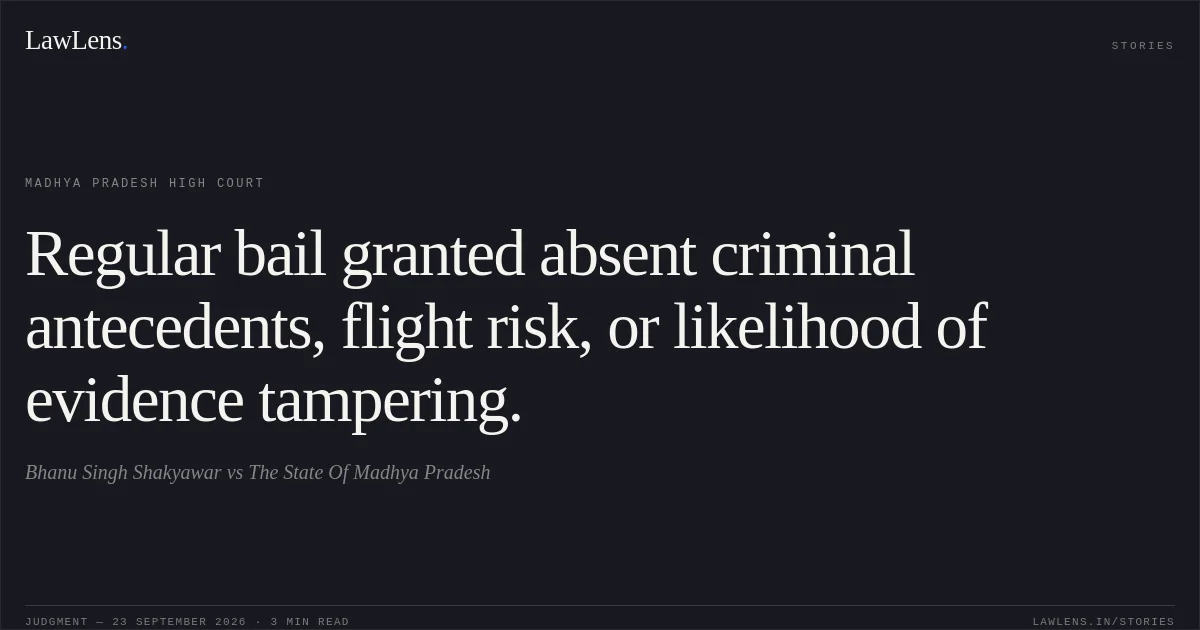
The applicant, Bhanu Singh Shakyawar, was arrested on 18 August 2026 in Crime No. 535/2026 registered at Police Station Garha, Jabalpur, for alleged offences under Sections 316, 318(4) and 61(2) of the Bharatiya Nyaya Sanhita, 2023, and Section 13(2) of the Prevention of Corruption Act, 1988.
Source reference: para. 1He had worked in the Accounts (Cash) Section of Netaji Subhash Chandra Bose Government Medical College, Jabalpur.
Source reference: p. 2; para. 6An internal enquiry allegedly found a cash shortage of Rs. 5,45,568 attributable to the period of his posting, while the total suspected defalcation was stated to exceed Rs. 1 crore.
Source reference: p. 2; para. 6The applicant contended that he had deposited the amounts received by him into the Medical College’s bank accounts, had himself disclosed alleged misappropriation by other accountants, and had supplied receipts and relevant details to the investigating agency.
Source reference: p. 1; para. 4The State opposed bail on the basis of the gravity of the allegations and the continuing verification of cash receipts and account statements, but acknowledged that the applicant had no criminal antecedents.
Source reference: p. 2; para. 5Issues
1. Whether the applicant was entitled to regular bail under Section 483 of the Bharatiya Nagarik Suraksha Sanhita, 2023, corresponding to Section 439 of the Code of Criminal Procedure, in view of the allegations of criminal misappropriation and corruption.
Source reference: para. 12. Whether continued custodial detention was necessary when the relevant seizure had been made, the applicant had allegedly cooperated with the investigation, and the trial was likely to take time.
Source reference: paras. 4–83. Whether the applicant’s release on bail would create a substantial risk of absconding, tampering with evidence, influencing witnesses, or repeating a similar offence.
Source reference: para. 7Law Applied
The Court applied Section 483 of the Bharatiya Nagarik Suraksha Sanhita, 2023, corresponding to Section 439 of the Code of Criminal Procedure, governing the High Court’s power to grant regular bail.
Source reference: para. 1The alleged offences were under Sections 316, 318(4) and 61(2) of the Bharatiya Nyaya Sanhita, 2023, and Section 13(2) of the Prevention of Corruption Act, 1988.
Source reference: para. 1The Court applied established bail principles requiring consideration of the prima facie case, the seriousness of the allegations, the possibility of absconding, the likelihood of tampering with evidence or influencing witnesses, the accused’s criminal antecedents, the need for further custodial interrogation, and the probable duration of the trial.
Source reference: paras. 6–8Bail was granted subject to conditions requiring attendance, non-involvement in similar offences, non-interference with witnesses or evidence, and compliance with the applicable provisions concerning examination of witnesses.
Source reference: para. 9Reasoning
The Court found that the applicant’s submissions—that he had deposited the amounts received by him, disclosed alleged defalcation by other officials, supplied supporting documents, and cooperated with the investigation—possessed prima facie merit and could not be rejected as manifestly baseless.
Source reference: para. 6Although the internal enquiry indicated a shortage of Rs. 5,45,568 during the applicant’s tenure and suggested that the total defalcation exceeded Rs. 1 crore, the Court held that the applicant’s actual complicity and the prosecution’s allegations would be determined at trial.
Source reference: para. 6The relevant seizure had been completed, no criminal antecedents were reported, and the applicant was approximately 42 years old with dependent family members.
Source reference: p. 2; para. 7These circumstances reduced the perceived risks of absconding, recidivism, tampering with documentary evidence, or influencing witnesses.
Source reference: para. 7Since the investigation was continuing and the trial was likely to take considerable time, the Court found no compelling reason for further incarceration, while expressly refraining from making any final observation on the merits.
Source reference: paras. 6–8Holding
The High Court allowed the applicant’s first bail application and directed his release in connection with Crime No. 535/2026 upon furnishing a personal bond of Rs. 1,00,000 with one surety of the same amount to the satisfaction of the trial Court.
Bail was made subject to conditions that the applicant appear on every directed hearing date, refrain from similar offences, avoid inducing, threatening or influencing persons acquainted with the facts, refrain from tampering with evidence or witnesses, and comply with the applicable statutory provisions concerning examination of witnesses.
Source reference: para. 9The order was to remain effective until conclusion of the trial, subject to cancellation of bail by the trial Court in the event of breach of the conditions.
Source reference: p. 4; para. 9Acts & Sections Cited
8 provisions across 4 statutes referred to in this judgment. Each provision opens on LawLens.
Bharatiya Nagarik Suraksha Sanhita, 20232
Bharatiya Nyaya Sanhita, 20233
Code of Criminal Procedure, 19732
Prevention of Corruption Act, 19881
Original Court PDF
Bhanu Singh ShakyawarvsThe State Of Madhya Pradesh
Click to open original judgment
Original judgment, available to read, download and summarize on LawLens.in