Facts
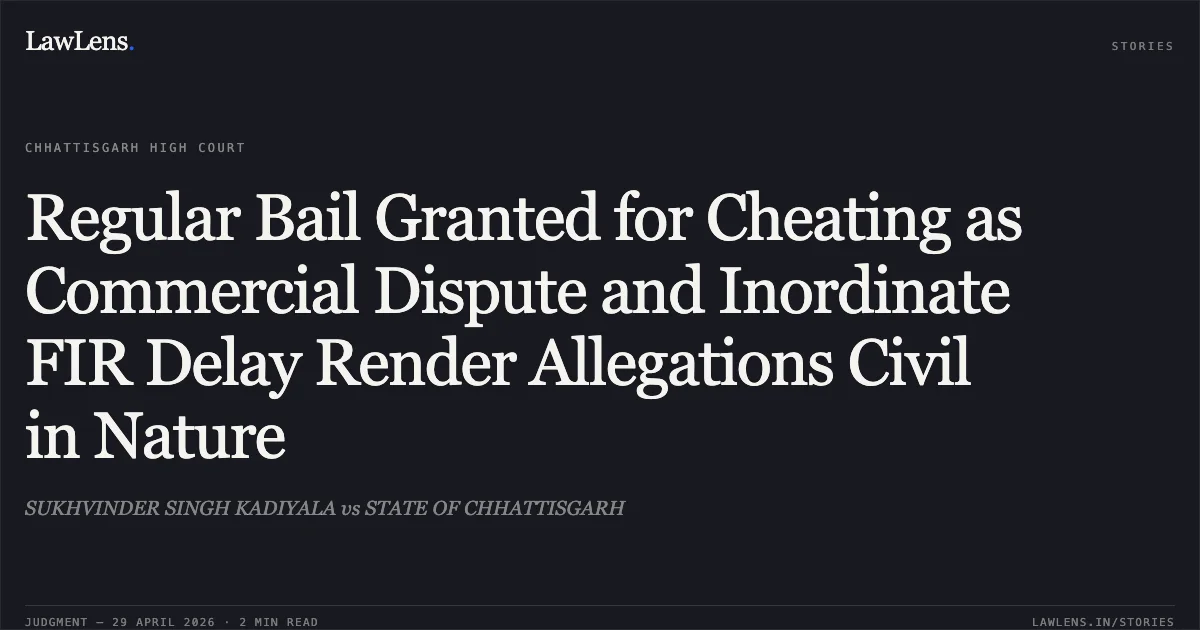
The applicant, owner of Dapcure Pharmaceutical Company, sought regular bail for offences under Section 420 read with Section 34 of the IPC.
Source reference: para 1The complainant, Rekhchand Janghel, alleged that the applicant and a co-accused, Hulas Kumar Sahu, induced him to invest ₹12,50,000/- with a promise to double the amount within a year.
Source reference: para 2The complainant transferred ₹5,00,000/- via digital mode to the co-accused's account and paid ₹7,50,000/- in cash.
Source reference: para 2When the complainant demanded the return of funds, the applicant allegedly executed an agreement and issued a cheque for the full amount, which was subsequently dishonoured.
Source reference: para 2The applicant was arrested on February 5, 2026, and contended that the dispute was civil in nature and that the FIR, lodged on February 3, 2025—nearly three years after the transactions—was an afterthought.
Source reference: para 3Issues
1. Whether the applicant is entitled to regular bail under Section 483 of the Bharatiya Nagarik Suraksha Sanhita (BNSS), 2023, considering the nature of the allegations and the period of incarceration.
Source reference: para 1, 6Law Applied
Section 483 of the Bharatiya Nagarik Suraksha Sanhita (BNSS), 2023, regarding the power of the High Court to grant bail.
Source reference: para 1Section 420 (Cheating) of the Indian Penal Code, 1860.
Source reference: para 1Guidelines established in Arnesh Kumar v. State of Bihar concerning the necessity of arrest and detention in offences punishable with less than seven years.
Source reference: para 3Distinction between criminal cheating and civil disputes arising from business transactions and dishonoured cheques under the Negotiable Instruments Act.
Source reference: para 3, 6Reasoning
The Court observed that while the allegations involved a substantial sum of ₹12,50,000/-, the digital evidence indicated that the funds were transferred to the co-accused rather than the applicant, and there was no direct material evidence for the cash payment.
Source reference: para 6The Court highlighted that the FIR was lodged after an inordinate and unexplained delay of approximately three years from the initial transactions, casting doubt on the prosecution's narrative.
Source reference: para 6The Court noted that the dispute possessed significant elements of a civil nature, as it stemmed from a failed business investment and a dishonoured cheque.
Source reference: para 6The Court took into account that the applicant had no criminal antecedents, had been in jail since early February 2026, and the trial was expected to be protracted as the charge sheet had not yet been filed.
Source reference: para 3, 6Holding
The High Court allowed the bail application, holding that the applicant was entitled to be released on regular bail.
The applicant was ordered to be released upon furnishing a personal bond with two sureties, subject to conditions including: (i) not seeking adjournments during evidence; (ii) mandatory presence during trial dates; and (iii) compliance with Section 269 and 209 of the Bharatiya Nyaya Sanhita (BNS) in case of absence or misuse of liberty.
Source reference: para 7Acts & Sections Cited
7 provisions across 3 statutes referred to in this judgment. Each provision opens on LawLens.
Bharatiya Nagarik Suraksha Sanhita, 20233
Indian Penal Code, 18602
Bharatiya Nyaya Sanhita, 20232
Original Court PDF
SUKHVINDER SINGH KADIYALAvsSTATE OF CHHATTISGARH
Click to open original judgment
Original judgment, available to read, download and summarize on LawLens.in