Facts
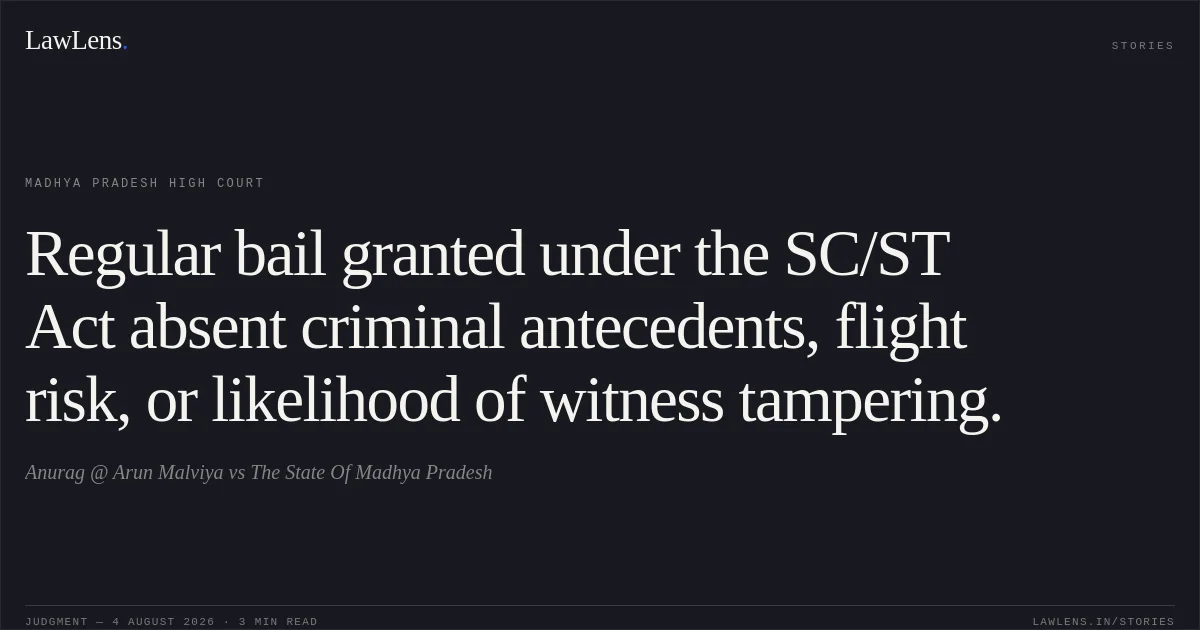
The appellant challenged the order dated 27 July 2026 by which the Special Judge, SC/ST (Prevention of Atrocities) Act, Betul, rejected his bail application.
Source reference: para. 1The prosecution alleged that on 19 July 2026, the appellant abused and slapped Rajesh Sheshkar at a petrol pump, allegedly referring to his caste.
Source reference: para. 7Later that night, 8–9 persons allegedly came to the petrol pump, and the appellant indicated Rajesh to them, after which they assaulted him with wooden sticks and pipes, damaged the office, and threatened him.
Source reference: para. 7Rajesh suffered injuries to his head and hands; however, the X-ray showed no bony injury to his hands.
Source reference: para. 7Crime No. 601 of 2026 was registered at Police Station Kotwali, Betul, under Sections 296(b), 115(2), 351(2), 191(2), 331(6), and 324(2) of the Bharatiya Nyaya Sanhita, 2023, and Sections 3(1)(da), 3(1)(dha), and 3(2)(va) of the SC/ST (Prevention of Atrocities) Act, 1989.
Source reference: para. 7The appellant was arrested on 20 July 2026, remained in custody thereafter, and a mobile phone was recovered at his instance.
Source reference: para. 7The complainant expressed no objection to the grant of bail, while the State opposed bail on the basis that the call-detail records indicated that the appellant had contacted other assailants.
Source reference: paras. 4–5Issues
1. Whether the appellant was entitled to regular bail despite the allegations under the BNS, 2023 and the SC/ST (Prevention of Atrocities) Act, 1989, and the State’s contention regarding his connection with the other assailants.
Source reference: paras. 5, 7–92. Whether the appellant’s custody, lack of criminal antecedents, family circumstances, the stage of investigation, and the likely delay in conclusion of trial justified setting aside the rejection of bail.
Source reference: para. 8Law Applied
The Court applied the statutory bail jurisdiction in the context of the offences registered under Sections 296(b), 115(2), 351(2), 191(2), 331(6), and 324(2) of the BNS, 2023, and Sections 3(1)(da), 3(1)(dha), and 3(2)(va) of the SC/ST (Prevention of Atrocities) Act, 1989.
Source reference: paras. 7, 10The governing principle was that bail may be granted after assessing the prima facie case, the nature and gravity of the accusation, the accused’s criminal antecedents, likelihood of absconding, possibility of tampering with evidence or influencing witnesses, period of custody, and the probable duration of trial.
Source reference: paras. 7–9The Court also recognised the requirement of informing the victim/complainant under Section 15-A of the 1989 Act.
Source reference: para. 2Bail was made subject to the appellant’s compliance with the conditions requiring attendance, non-involvement in similar offences, non-inducement or intimidation of persons acquainted with the facts, non-tampering with evidence, and compliance with Section 309 of the CrPC/Section 346 of the BNSS, 2023 concerning examination of witnesses in attendance.
Source reference: para. 10Reasoning
The Court found that the appellant’s contentions had prima facie substance and were not manifestly baseless.
Source reference: para. 7Although the prosecution relied on the call-detail records to suggest the appellant’s complicity, the Court noted that the investigation was still ongoing, the applicant had no reported criminal antecedents, and the medical evidence disclosed no bony injury to the complainant’s hands.
Source reference: paras. 5, 7The appellant had been in custody since 20 July 2026, had family responsibilities and roots in society, and there was no substantial criminal past or previous conviction indicating a likelihood of recidivism.
Source reference: para. 8The Court further found no compelling reason to continue incarceration, and considered that there was no apparent likelihood of the appellant fleeing from justice, tampering with evidence, or influencing witnesses.
Source reference: para. 8Given the pendency of criminal matters and the absence of a reasonable likelihood of an early conclusion of the appeal/trial, the rejection of bail by the trial court was held to be erroneous.
Source reference: para. 8Holding
The appeal was allowed and the order dated 27 July 2026 rejecting bail was set aside.
The appellant, Anurag @ Arun Malviya, was directed to be released on bail in Crime No. 601 of 2026 upon furnishing a personal bond of ₹50,000 with one solvent surety of the same amount to the satisfaction of the trial court.
Source reference: para. 10Bail was made effective until the conclusion of trial, subject to the prescribed conditions, with liberty to the trial court to consider cancellation of bail on merits in the event of breach of any condition.
Source reference: para. 11The trial court was directed to reproduce the bail conditions on the personal and surety bonds and ensure that they were explained where necessary.
Source reference: para. 12Acts & Sections Cited
9 provisions across 4 statutes referred to in this judgment. Each provision opens on LawLens.
Scheduled Castes and the Scheduled Tribes (Prevention of Atrocities) Act, 19891
Bharatiya Nyaya Sanhita, 20236
Code of Criminal Procedure, 19731
Bharatiya Nagarik Suraksha Sanhita, 20231
Original Court PDF
Anurag @ Arun MalviyavsThe State Of Madhya Pradesh
Click to open original judgment
Original judgment, available to read, download and summarize on LawLens.in