Facts
The applicant sought regular bail for offences registered under Sections 69, 64(1), 64(2)(m), and 351(3) of the Bharatiya Nyaya Sanhita (BNS), 2023
Source reference: para. 1The complainant, a 30-year-old woman, alleged that she became acquainted with the applicant in 2020, who introduced himself as "Sonu" from the Hindu community
Source reference: para. 7She claimed she left her husband in September 2023 to live with the applicant upon his promise of marriage, later discovering his actual religious identity
Source reference: para. 7After her divorce in November 2024, the applicant allegedly refused to marry her and threatened her
Source reference: para. 7The applicant contended that it was a consensual long-term relationship and that the complainant was aware of his identity
Source reference: para. 4The applicant has been in judicial custody since March 26, 2026, and the investigation is complete with the final report filed
Source reference: para. 1, 7Issues
1. Whether the applicant is entitled to regular bail under Section 483 of the Bharatiya Nagarik Suraksha Sanhita (BNSS), 2023, given the nature of the consensual relationship and the completion of the investigation
Source reference: para. 1, 72. Whether the applicant's criminal antecedents serve as a bar to granting bail in the present circumstances
Source reference: para. 5, 9Law Applied
The Court considered Section 483 of the BNSS, 2023 regarding the grant of regular bail
Source reference: para. 1It assessed the penal provisions of the BNS, 2023, specifically Section 64 (punishment for rape) and Section 69 (sexual intercourse by deceitful means/promise to marry)
Source reference: para. 1The Court relied on Supreme Court precedents Amol Bhagwan Nehul v. State of Maharashtra (2025 INSC 782) and Ayub Khan v. State of Rajasthan (2024 INSC 994) to evaluate bail eligibility in cases of long-term adult relationships
Source reference: para. 6the principle that while criminal antecedents require stringent conditions, they do not automatically mandate continued incarceration if the risk of fleeing or tampering is low
Source reference: para. 8, 9Reasoning
The Court observed that the case prima facie involved a long-term relationship between two consenting adults
Source reference: para. 7It noted the applicant’s argument that the complainant lived with him even before her legal divorce, suggesting awareness of his status
Source reference: para. 4, 7Since the investigation concluded and the final report was filed, the Court found no compelling reason for continued incarceration, as the trial would take time to conclude
Source reference: para. 7Addressing the State’s objection regarding the applicant's three criminal antecedents (including a POCSO conviction currently under appeal and an NDPS case), the Court determined that these could be mitigated by imposing "stringent conditions" rather than denying bail entirely
Source reference: para. 5, 6, 9The Court concluded that there was no significant likelihood of the applicant fleeing justice or tampering with evidence
Source reference: para. 8Holding
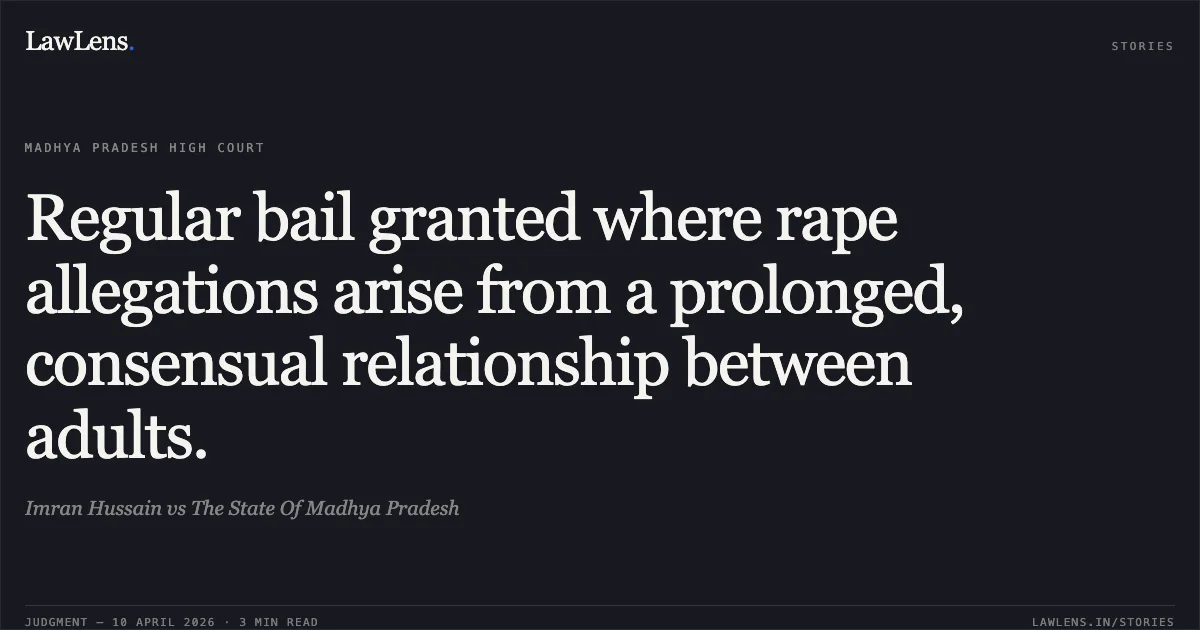
The High Court allowed the application and granted regular bail to the applicant
The Court held that the substance of the relationship and the completion of the investigation justified release despite the applicant’s history
Source reference: para. 7, 9The applicant was ordered to be released on a personal bond of Rs. 75,000/- with a solvent surety of the same amount
Source reference: para. 10Specific conditions were imposed, including: (i) regular appearance before the trial court; (ii) abstaining from similar offences; (iii) no tampering with evidence or threatening witnesses; and (iv) marking presence at the Industrial Area Police Station, Ratlam, on the first Saturday of every month until the conclusion of the trial
Source reference: para. 10Acts & Sections Cited
16 provisions across 6 statutes referred to in this judgment. Each provision opens on LawLens.
Bharatiya Nagarik Suraksha Sanhita, 20232
Bharatiya Nyaya Sanhita, 20233
Indian Penal Code, 18606
Narcotic Drugs and Psychotropic Substances Act, 19852
Code of Criminal Procedure, 19731
Original Court PDF
Imran HussainvsThe State Of Madhya Pradesh
Click to open original judgment
Original judgment, available to read, download and summarize on LawLens.in