Facts
The petitioner was appointed as a temporary Computer Operator on 14 February 2014 and sought a direction to the Government to sanction a regular post of Computer Operator, approve service rules for the post, and regularise her services from the date of appointment with all consequential benefits.
Source reference: p.1The respondents included the Government of Tamil Nadu, the Registrar General of the High Court, the Principal District Judge, Tiruppur, and the Sessions Judge, Magalir Neethimandram, Tiruppur.
Source reference: p.1The Court noted that an earlier decision in W.P. No. 4109 of 2025 had considered a similar claim concerning temporary Computer Operators and had directed consideration by the competent appointing authority under the applicable adhoc rules.
Source reference: p.2The present petition was therefore considered on the same lines.
Source reference: p.3Issues
Whether the High Court, in exercise of its power of judicial review under Article 226, could directly direct regularisation of the petitioner’s services as a Computer Operator when she had been appointed temporarily and no service rules were in force on the date of appointment.
Source reference: p.2Whether the petitioner’s claim for regularisation and consequential benefits was required to be considered by the competent appointing authority in accordance with the applicable adhoc rules and eligibility criteria.
Source reference: p.2Law Applied
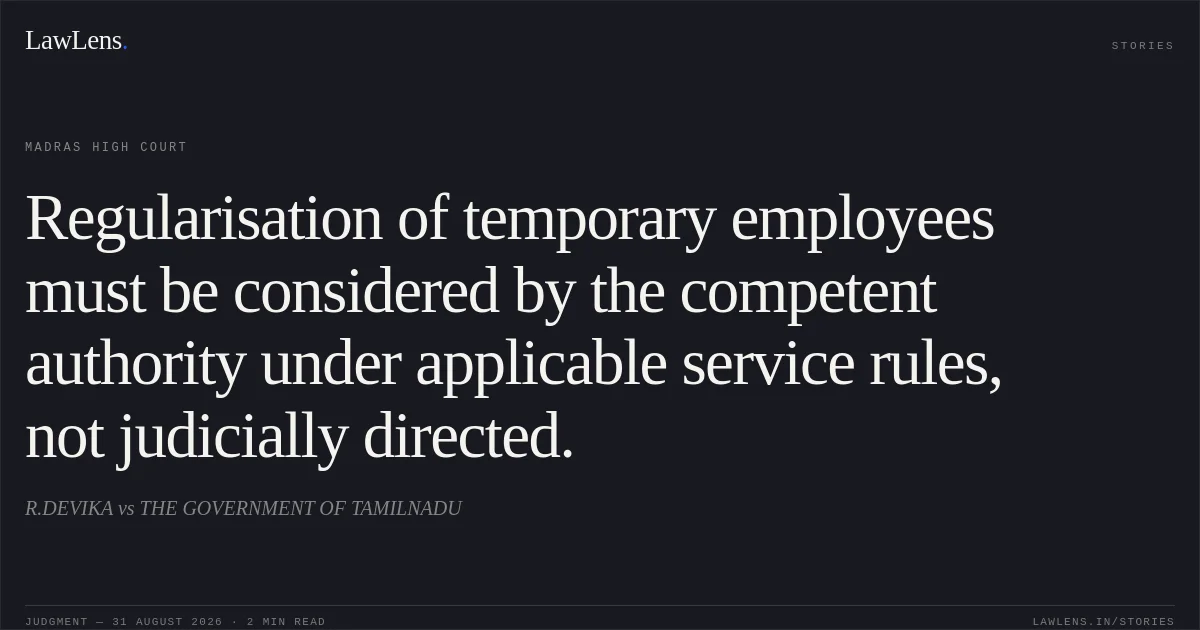
The Court applied the principle that regularisation of temporary or adhoc employees cannot ordinarily be ordered directly by the High Court in judicial review, particularly where appointment has not been made against a sanctioned post and in accordance with the applicable service rules.
Source reference: p.2It relied on the Constitution Bench decision in State of Karnataka v. Uma Devi, which holds that regularisation must be governed by the relevant statutory or service rules and cannot be claimed as an automatic consequence of long temporary service.
Source reference: p.2The adhoc rules referred to in G.O.Ms. No. 67 dated 10 February 2026 were to govern the consideration of the claims of temporary Computer Operators.
Source reference: p.2Reasoning
The petitioner’s appointment was temporary, and no service rule governing the post was in force when she was appointed in 2014.
Source reference: p.2Applying Uma Devi, the Court held that it could not itself direct regularisation merely on the basis of the petitioner’s continued service.
Source reference: p.2The question of regularisation was required to be examined by the competent appointing authority—namely, the concerned Principal District Judge—after applying the adhoc rules and verifying the petitioner’s qualifications and eligibility for the post.
Source reference: p.2Since the present case involved the same legal issue as W.P. No. 4109 of 2025, the Court adopted the reasoning and disposition in that case.
Source reference: pp.2–3Holding
The Court declined to directly order sanction of the post or regularisation of the petitioner from 14 February 2014.
Instead, it disposed of the writ petition on the same terms as W.P. No. 4109 of 2025, requiring the competent appointing authority to consider the petitioner’s case strictly in accordance with the applicable adhoc rules and eligibility requirements.
Source reference: pp.2–3The writ petition was disposed of without costs, and the connected miscellaneous petition was closed.
Source reference: p.3Original Court PDF
R.DEVIKAvsTHE GOVERNMENT OF TAMILNADU
Click to open original judgment
Original judgment, available to read, download and summarize on LawLens.in
![Disciplinary proceedings must be stayed and a bias objection against the Inquiry Officer decided first.. Mahesh Kumar vs Delhi Jal Board, Govt. Of Nctd. CAT - ['Delhi']. LawLens](/stories/thumbnails/disciplinary-proceedings-must-be-stayed-and-a-bias-objection-against-the-inquiry-officer-d-dc61ff989b874f3bbeb00a6e2a7f219e.webp)
![Authorities must treat the service claim as a representation and decide it by a reasoned order after hearing.. muzamil rashid hajam vs PUBLIC WORK DEPARTMENT R AND B. CAT - ['Srinagar']. LawLens](/stories/thumbnails/authorities-must-treat-the-service-claim-as-a-representation-and-decide-it-by-a-reasoned-o-d231134b67ee4c118f575dc7bfca83a4.webp)