Facts
The State of Tamil Nadu filed intra-court appeals against a common writ order dated September 22, 2017, which had presumably directed the regularization of the respondents' services.
Source reference: p. 2The respondents were engaged as Sweepers on a daily wage basis.
Source reference: p. 2The State contended that the respondents had not completed 10 years of service as of January 1, 2006, and therefore did not meet the criteria for regularization under G.O.Ms.No.22.
Source reference: para. 28The matter was brought before a Division Bench of the Madras High Court to determine the legality of regularizing such "back-door" appointments.
Source reference: p. 2-3Issues
1. Whether daily wage employees who entered service without following due process are entitled to regularization and permanent absorption.
Source reference: para. 262. Whether the respondents’ service could be regularized given they had not completed 10 years of service as of the cutoff date.
Source reference: para. 28Law Applied
The Court applied the constitutional mandate of equal opportunity in public employment under Articles 14 and 16 of the Constitution of India.
Source reference: para. 27It relied heavily on the Constitution Bench decision in State of Karnataka v. Umadevi (3), which held that appointments made in violation of statutory rules are a nullity and cannot be regularized.
Source reference: para. 13The Court further cited Renu v. District and Sessions Judge, Tis Hazari Courts, establishing that any appointment without proper advertisement and open competition is illegal.
Source reference: para. 7-11M.P. State Coop. Bank Ltd. v. Nanuram Yadav, which asserted that "regularisation cannot be a mode of appointment" and those who enter through the "back door" must leave the same way.
Source reference: para. 12Reasoning
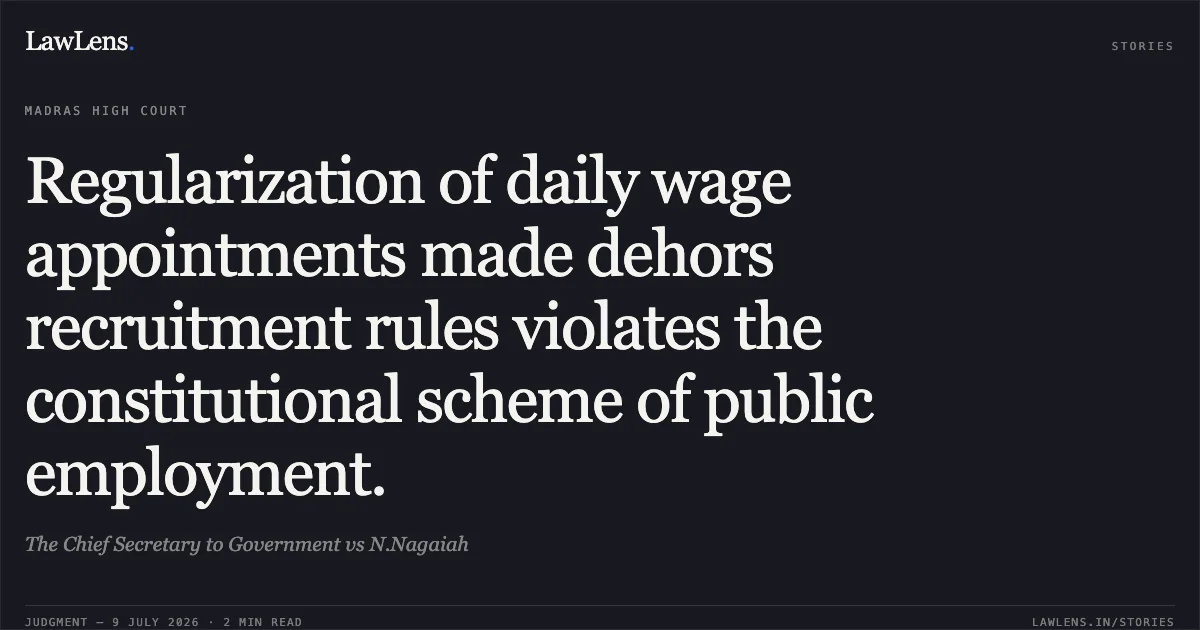
The Court reasoned that all public appointments must follow the constitutional scheme of open competitive selection to protect the fundamental rights of aspiring candidates.
Source reference: para. 26It observed that the respondents were engaged as casual laborers without following recruitment rules or due process.
Source reference: para. 26, 28Applying the Umadevi principle, the Court found that allowing regularization for such temporary/contractual staff would "dishonor the constitutional scheme".
Source reference: para. 26Furthermore, even under the government’s own (now withdrawn) G.O.Ms.No.22, the respondents failed to meet the 10-year service requirement as of January 1, 2006.
Source reference: para. 28The Court specifically noted that a previous contrary Division Bench order (W.A. 606/2019) did not constitute a binding precedent because it failed to discuss the legal principles settled by the Supreme Court in Umadevi.
Source reference: para. 29Holding
The Court answered that daily wage appointees lack a legal right to regularization if their entry was dehors the rules.
The Division Bench set aside the Writ Court’s common order dated September 22, 2017, and allowed the State’s appeals.
Source reference: para. 30, p. 11The holding affirms that fundamental rights under Article 16 are infringed by regularizing illegal appointments and that the judiciary should not exercise jurisdiction based on "misplaced sympathy".
Source reference: para. 12, 28Acts & Sections Cited
1 provisions across 1 statute referred to in this judgment. Linked provisions open on LawLens.
Letters Patent1
Original Court PDF
The Chief Secretary to GovernmentvsN.Nagaiah
Click to open original judgment
Original judgment, available to read, download and summarize on LawLens.in