Facts
The petitioners, serving as an Assistant Sub-Inspector and Constable in the Madhya Pradesh Police, were posted at Mauganj.
Source reference: p. 1During night patrolling on 1 November 2022, they received information about an injured person at a bus stand, shifted him to hospital, and recorded the incident in the Rojnamcha as an accident.
Source reference: p. 1A subsequent social-media video allegedly indicated that the police had been informed of a life-threatening assault.
Source reference: p. 1Following a preliminary enquiry, the petitioners were found negligent, and respondent No. 5 imposed the minor penalty of “Censure” by order dated 31 March 2023.
Source reference: p. 1Respondent No. 4, exercising suo motu revisional powers under Regulation 270 of the Police Regulations, set aside the penalty by order dated 4 July 2023 and directed initiation of fresh departmental proceedings.
Source reference: p. 1Consequently, a charge-sheet dated 25 September 2023 was issued against the petitioners and the Station House Officer, and a joint departmental enquiry was commenced.
Source reference: pp. 1–2The petitioners challenged the revisional order and consequential charge-sheet, principally on the ground that no notice or opportunity of hearing had been provided before the penalty was annulled.
Source reference: pp. 2–3Issues
Whether the revisional authority could exercise suo motu powers under Regulation 270 of the Police Regulations to set aside the penalty and direct fresh departmental proceedings without issuing notice to, and affording an opportunity of hearing to, the petitioners.
Source reference: pp. 3–4Whether the consequential charge-sheet and departmental enquiry founded upon the impugned revisional order were legally sustainable.
Source reference: pp. 3–4Law Applied
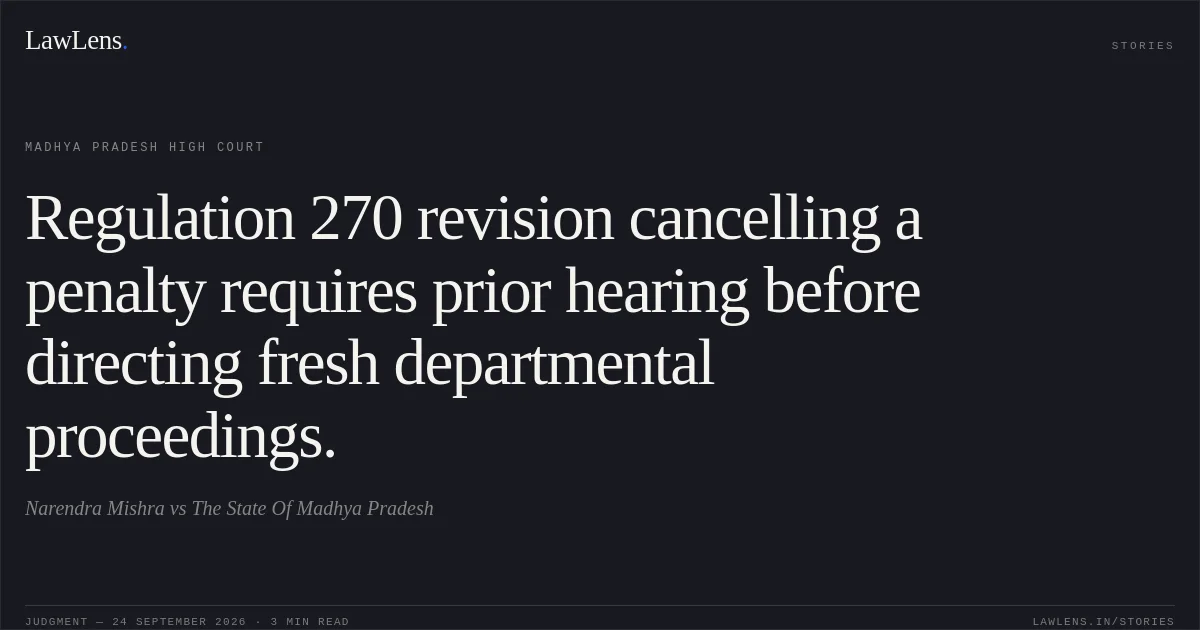
Regulation 270 of the Madhya Pradesh Police Regulations, including its proviso, requires that an affected employee be given notice and an opportunity of hearing before an order imposing penalty is set aside in suo motu revision and fresh departmental proceedings are directed.
Source reference: p. 4The Court relied upon Rajendra Kumar Chaturvedi v. State of M.P. and Others, 2010 (1) MPLJ 417, which held that failure to provide such hearing violates both the proviso to Regulation 270 and the principles of natural justice.
Source reference: p. 3The Court also referred to Basanti Gaur v. State of M.P. and Others, 2009 (4) MPLJ 635, and Angad Singh Rathore v. State of M.P. and Others, 2010 (1) MPLJ 171, as relied upon by the petitioners.
Source reference: p. 3Reasoning
The Court found that respondent No. 4 had exercised revisional jurisdiction under Regulation 270, annulled the earlier penalty of “Censure,” and directed a fresh departmental enquiry without first issuing notice or affording the petitioners an opportunity of hearing.
Source reference: p. 4Applying the rule stated in Rajendra Kumar Chaturvedi, the Court held that such prior hearing was mandatory because the revisional order adversely affected the petitioners by reopening the disciplinary matter and exposing them to fresh proceedings.
Source reference: p. 4The absence of the required opportunity rendered the revisional order contrary to Regulation 270 and violative of natural justice.
Source reference: p. 4Since the charge-sheet was consequential to the invalid revisional order, it too could not survive.
Source reference: p. 4Holding
The Court allowed the writ petition and quashed the revisional order dated 4 July 2023 and the consequential charge-sheet dated 25 September 2023.
The matter was remitted to respondent No. 4 for fresh consideration and an appropriate order in accordance with law, after granting the petitioners a full opportunity of hearing.
Source reference: p. 4The exercise was directed to be completed preferably within three months from receipt of a certified copy of the order, with the decision to be communicated to the petitioners forthwith.
Source reference: p. 4Original Court PDF
Narendra MishravsThe State Of Madhya Pradesh
Click to open original judgment
Original judgment, available to read, download and summarize on LawLens.in