Facts
The petitioners’ lands were acquired for construction of the 2 × 500 MW Atal Bihari Vajpayee Thermal Power Plant.
Source reference: paras. 2, 4(III), 6After compensation was assessed and paid, the petitioners were treated as Project Affected Persons/land oustees under the Chhattisgarh Model Rehabilitation Policy, 2007.
Source reference: paras. 2, 4(III), 6They were initially appointed as Line Attendants on contract and, by order dated 19 May 2026, were appointed as Junior Attendants on a contractual basis for three years, renewable annually on the basis of performance until superannuation.
Source reference: paras. 2, 4(III), 6The petitioners sought regular appointment, contending that similarly situated land oustees affected by the same project had been granted regular posts.
Source reference: para. 3The respondents contended that all sanctioned posts earmarked for regular employment of project-affected persons had already been filled, but that the petitioners had been accommodated through contractual appointments in accordance with the applicable rehabilitation policies.
Source reference: paras. 4(I)–(II)The petitions were heard and decided together on account of common facts and issues.
Source reference: para. 1Issues
1. Whether the Model Rehabilitation Policy, 2007 confers an enforceable right upon project-affected persons to regular or permanent appointment against a sanctioned post?
Source reference: paras. 3(b), 6–82. Whether the contractual appointments offered to the petitioners were contrary to Clauses 7.1, 11.2.2 and 11.2.3 of the Model Rehabilitation Policy, 2007?
Source reference: paras. 3(b), 6–8, 123. Whether the petitioners were entitled to regular appointment merely because some other land oustees affected by the same project had earlier received regular appointments?
Source reference: paras. 3(a), 10–11Law Applied
The Court applied Clauses 7.1, 11.2.2 and 11.2.3 of the Chhattisgarh Model Rehabilitation Policy, 2007.
Source reference: paras. 7–8Clause 7.1 provides for arranging employment for one eligible member of each displaced family, subject to qualification and suitability, but does not expressly require regular or permanent appointment.
Source reference: paras. 7–8Clauses 11.2.2 and 11.2.3 prescribe eligibility and priority for employment or alternative monetary benefits for project-affected persons; they do not create an absolute right to appointment against a regular post.
Source reference: paras. 7–8, 14The Court also relied on the ordinary meaning of “employment,” which does not inherently signify permanent employment.
Source reference: para. 9Further, following State of Haryana v. Naresh Kumar Bali , (1994) 4 SCC 448, the Court held that no mandamus can issue compelling the State or its instrumentalities to create posts or provide employment contrary to the governing statutory or policy framework.
Source reference: para. 15Reasoning
The Court read Clauses 11.2.2 and 11.2.3 together with Clause 7.1 and held that the Policy required provision of employment to eligible project-affected persons, not necessarily appointment to a regular or permanent post.
Source reference: paras. 6–8Since the petitioners had admittedly been granted contractual employment as land oustees, initially for three years and renewable annually until superannuation subject to performance, the policy requirement had been substantially fulfilled.
Source reference: para. 10The Court declined to treat the expression “employment” in Clause 7.1 as meaning only regular employment, particularly because the Policy did not use expressions such as “regular employment,” “permanent employment,” or “appointment against a regular sanctioned post”.
Source reference: paras. 8, 12The fact that other land oustees had earlier received regular appointments did not establish an indefeasible right to identical treatment.
Source reference: para. 11Those appointments had to be assessed in light of the administrative circumstances and availability of sanctioned posts at the relevant time.
Source reference: para. 11The respondents had specifically stated that the posts earmarked for regular employment had already been exhausted.
Source reference: para. 11The Court therefore found no arbitrariness or discrimination in offering the petitioners contractual appointments instead of creating or providing additional regular posts.
Source reference: paras. 10–15Holding
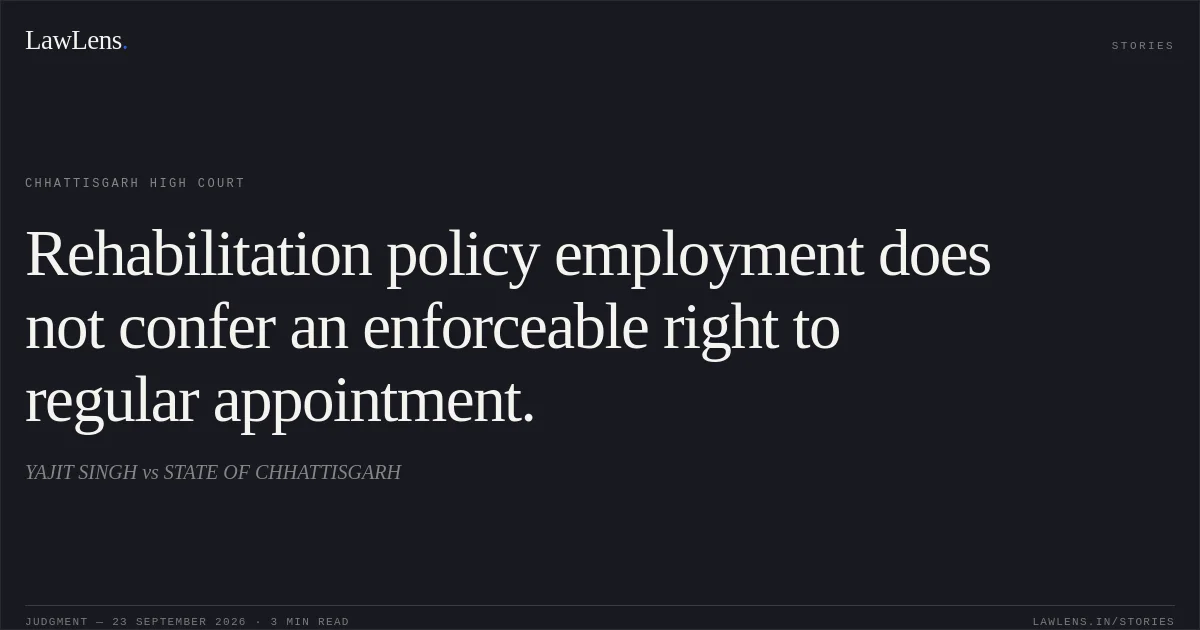
The Court held that the petitioners had received employment in accordance with the Model Rehabilitation Policy, 2007 and that the Policy did not confer an absolute or enforceable right to regular or permanent appointment.
The contractual nature of their appointments was not inconsistent with the Policy, and parity with earlier regular appointees could not be claimed as a perpetual right.
Source reference: para. 11All four writ petitions were accordingly dismissed as devoid of merit, with no order as to costs.
Source reference: para. 16Original Court PDF
YAJIT SINGHvsSTATE OF CHHATTISGARH
Click to open original judgment
Original judgment, available to read, download and summarize on LawLens.in