Facts
The applicant, Pradeep Kumar, was provisionally selected as a Postal Assistant following the 2013-14 Direct Recruitment Examination
Source reference: p. 17On 23.12.2015, the respondents terminated his services after canceling the entire examination for five circles due to alleged malpractices
Source reference: p. 18Following the Supreme Court’s judgment in Monu Tomar v. Union of India, which held that the entire exam was not vitiated and directed the reinstatement of "non-tainted" candidates, the applicant underwent a second round of scrutiny
Source reference: p. 6, 19Despite an adverse CFSL report regarding signature mismatches, the applicant successfully challenged his subsequent removal before the CAT and High Court
Source reference: p. 22Consequently, the respondents issued a reinstatement order dated 20.01.2025 but invoked the principle of "No Work No Pay," denying the applicant seniority, back wages, and increments from the date of his original appointment
Source reference: p. 2, 23Issues
1. Whether the principle of "No Work No Pay" is legally applicable to a government servant whose termination was set aside by a court of law on grounds of non-compliance with the requirements of Article 311 of the Constitution
Source reference: p. 10 / para. 6.52. Whether the applicant is entitled to continuity of service, seniority, and back wages from the date of initial appointment upon reinstatement
Source reference: p. 16 / para. 7.1Law Applied
The court primarily applied Fundamental Rule (FR) 54-A, which mandates the regularization of the period of absence from duty when a dismissal is set aside by a Court of Law
Source reference: p. 10Under FR 54-A(3), if a removal is set aside on merits, the intervening period must be treated as "duty for all purposes" with full pay
Source reference: p. 11The court also relied on the principle established in M. Gopala Krishna Naidu v. State of Madhya Pradesh, emphasizing that the regularization of service is an objective function requiring the application of mind by the competent authority
Source reference: p. 12Furthermore, it followed the precedent in Monu Tomar v. Union of India, which granted 50% back wages to non-suspected candidates, and Pinkesh v. Union of India, where the Tribunal quashed similar "No Work No Pay" clauses in identical postal recruitment cases
Source reference: p. 13, 24Reasoning
The Tribunal reasoned that FR 54-A constitutes a statutory right to protection for the employee, and the respondents failed to exercise their duty under this rule to issue a specific order regularizing the absence
Source reference: p. 10The court observed that "No Work No Pay" is not an absolute rule under FR 54-A; rather, the rule requires the competent authority to determine the quantum of pay after considering the facts
Source reference: p. 13Since the applicant's termination was historically linked to a wider cancellation found to be arbitrary by higher courts, and because the applicant was ultimately found not to be "tainted" by malpractice, the denial of all service benefits was deemed inequitable
Source reference: p. 13, 22The Tribunal noted that the respondents' stance was counterproductive "consider jurisprudence," as seen in Mahendra Prasad Agarwal v. Arvind Kumar Singh, and held that since the termination was illegal, the applicant could not be penalized for an enforced absence
Source reference: p. 14Holding
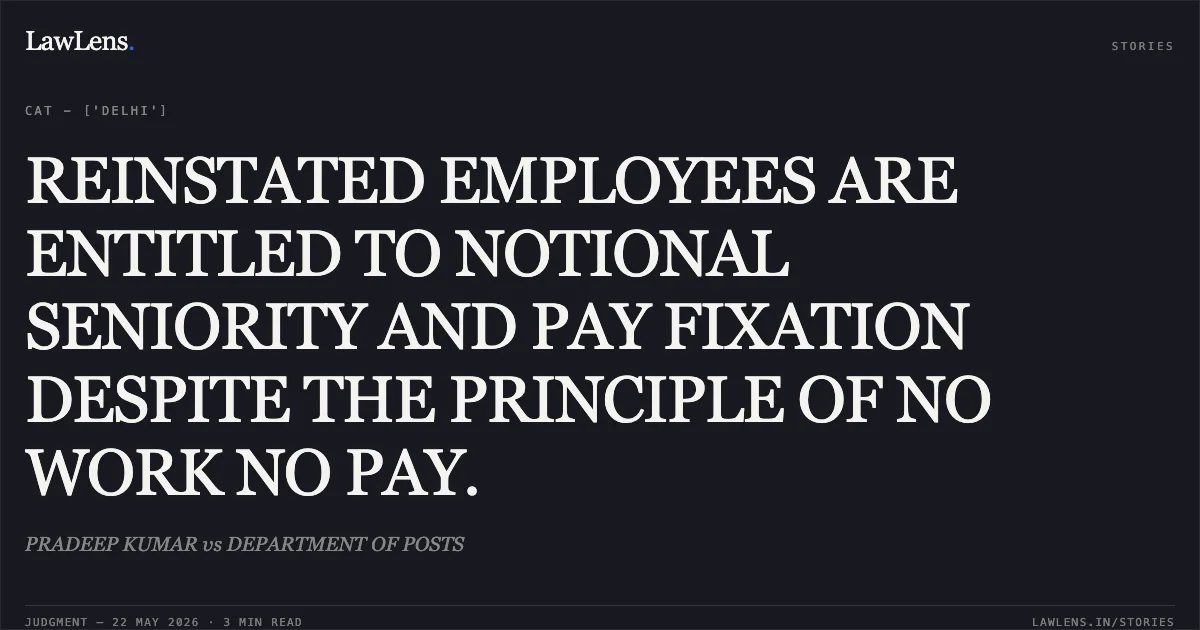
The Tribunal allowed the O.A., quashing Clause 3 of the order dated 20.01.2025 to the extent it denied consequential benefits.
It held that the applicant is entitled to continuity of service for all intents and purposes from the initial appointment date, including seniority and notional pay fixation.
Source reference: p. 16 / para. 7.1(i)The respondents were directed to carry out pay re-fixation, although actual arrears of pay and allowances were restricted to a period of three years preceding the filing of the O.A. Compliance was ordered within three months, failing which the applicant would be entitled to GPF-rate interest.
Source reference: p. 16 / para. 7.1(iii)Acts & Sections Cited
1 provisions across 1 statute referred to in this judgment. Each provision opens on LawLens.
Administrative Tribunals Act, 19851
Original Court PDF
PRADEEP KUMARvsDEPARTMENT OF POSTS
Click to open original judgment
Original judgment, available to read, download and summarize on LawLens.in