01Facts
Anil Kumar claimed that he was directly engaged by State Bank of Patiala as a daily-wage Peon at its Meerut City Branch from 16 April 1990 to 21 December 1992, and that his services were terminated without notice or retrenchment compensation despite his having completed more than 240 days of continuous service.
pp. 2–3, paras 1–2He relied on an identity card, character and experience certificates, curfew pass, and payment vouchers issued or allegedly issued by the Bank.
pp. 2–4, paras 2, 5The Bank denied any employer–employee relationship and contended that Kumar had worked as a security guard through an independent service provider—identified before the Labour Court as M/s Secure Well Services and before the High Court as M/s Industrial Services Agency.
pp. 2–3, paras 3, 10–12The Central Government Industrial Tribunal-cum-Labour Court held that Kumar was directly engaged by the Bank, had completed more than 240 days of service, and had been terminated in violation of Section 25F of the Industrial Disputes Act. It directed reinstatement with effect from 22 December 1992 and payment of 10% back wages.
pp. 3–5, paras 5–8The Bank challenged the Award under Articles 226 and 227 of the Constitution.
p. 5, para 9During the pendency of the writ petition, Kumar was granted relief under Section 17B of the Industrial Disputes Act, and the Bank stated that approximately ₹11 lakh had been paid under that order up to 2022.
pp. 9–10, para 23 · p. 25, para 4502Issues
i.Whether the Respondent was an employee of the Bank, or had merely been deputed by an independent contractor/service provider?
pp. 10–14, paras 26–32ii.Whether the Respondent had completed 240 days of continuous service and whether termination without notice or retrenchment compensation violated Section 25F of the Industrial Disputes Act, 1947?
pp. 16–17, paras 36–38iii.Whether the earlier civil suit and proceedings under Section 33C(2) of the Industrial Disputes Act barred the industrial adjudication on principles of res judicata?
pp. 14–16, paras 33–35iv.Whether reinstatement with back wages was the appropriate relief, or whether monetary compensation should be awarded instead?
pp. 17–25, paras 39–4503Law Applied
In exercising jurisdiction under Articles 226 and 227, the High Court does not sit as an appellate court over findings of an Industrial Tribunal and ordinarily will not interfere with findings of fact based on relevant evidence unless they are perverse, based on no evidence, or such that no reasonable adjudicator could have reached them, as stated in International Airport Authority of India v. International Air Cargo Workers Union, (2009) 13 SCC 374.
pp. 10–11, para 26Although the initial burden of proving employment and 240 days of service rests on the workman, the degree of proof varies with the circumstances, and the employer must produce the best evidence in its possession once a prima facie case is shown: Bank of Baroda v. Ghemarbhai Harjibhai Rabari, (2005) 10 SCC 792.
pp. 12–13, para 30Termination in violation of Section 25F does not automatically entitle a daily-wage worker to reinstatement and back wages; compensation may be appropriate depending on the duration and nature of employment, the passage of time, and other circumstances: Jagbir Singh v. Haryana State Agriculture Marketing Board, (2009) 15 SCC 327; Haryana Tourism Corporation Ltd. v. Fakir Chand, (2003) 8 SCC 248; and BSNL v. Bhurumal, (2014) 7 SCC 177.
pp. 18–24, paras 39–42Proceedings under Section 33C(2) are generally confined to computation of an existing right and cannot finally determine the existence of an employer–employee relationship; moreover, a civil court’s finding in proceedings dismissed for want of jurisdiction cannot operate as a final industrial adjudication.
pp. 14–16, paras 33–35Provisions in the judgment · 4
Industrial Disputes Act, 1947 Section 25FSection 33CSection 33Section 17B
04Reasoning
The High Court found that the Tribunal’s conclusion was supported by cumulative evidence, including the identity card describing Kumar as a Peon, certificates issued on the Bank’s letterhead, the curfew pass, payment vouchers, and the Bank’s admission that Kumar had worked at the Bank from approximately 1990 to 1992.
pp. 10–13, paras 27–30Once the Bank admitted that Kumar had worked at its premises and asserted that he had been deployed through an agency, the evidentiary burden shifted to the Bank to produce the alleged service agreement, invoices, payment records, deployment documents, or evidence from the contractor. The Bank produced none of these materials and gave inconsistent accounts regarding the identity of the contractor.
pp. 13–14, para 31The Tribunal’s finding of direct employment was therefore a plausible view based on evidence and did not warrant interference under Articles 226 or 227.
p. 14, para 32The Court further held that the earlier civil proceedings and Section 33C(2) proceedings did not bar the industrial reference. The Section 33C(2) proceedings could not determine the foundational employer–employee relationship, while the civil suit had been dismissed on the ground that the dispute lay within the jurisdiction of the industrial forum.
pp. 14–16, paras 33–35In light of the Bank’s admission regarding the period of work and its failure to produce contrary attendance or payment records, the finding that Kumar had completed the requisite period of service and that termination violated Section 25F was not perverse.
pp. 16–17, paras 36–38However, the Court distinguished the finding of illegal termination from the question of remedy. Kumar’s engagement had lasted less than three years, the termination had occurred in 1992, more than thirty-three years had elapsed, and he was near the applicable age of superannuation.
pp. 17–25, paras 39–45Applying the principle that reinstatement and back wages are not automatic for a daily-wage worker terminated in breach of Section 25F, the Court held that lump-sum compensation would better serve the ends of justice, particularly since substantial sums had already been paid under Section 17B.
pp. 17–25, paras 39–4505Holding
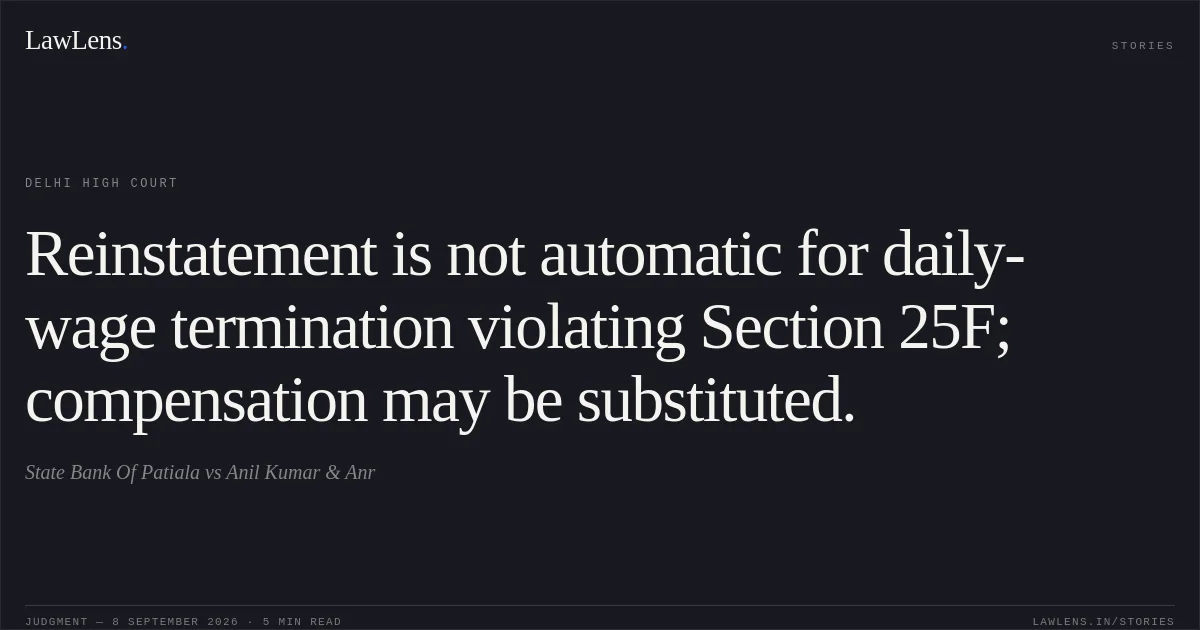
The High Court upheld the Tribunal’s finding that Kumar was directly engaged by the Bank and that his termination violated Section 25F of the Industrial Disputes Act.
pp. 14–17, paras 32–38It declined to interfere with the finding of illegal termination and rejected the Bank’s res judicata objection.
pp. 14–17, paras 32–38However, it modified the relief of reinstatement with 10% back wages and awarded lump-sum compensation of ₹3,00,000 instead.
p. 25, para 45The compensation was directed to be paid within eight weeks, over and above amounts validly paid under Section 17B; the Bank remained liable for any unpaid Section 17B amount up to the date of judgment.
pp. 26, paras 45–47The writ petition and pending applications were disposed of accordingly.
p. 26, para 47Original Court PDF
State Bank Of PatialavsAnil Kumar & Anr
Click to open original judgment
Original judgment, available to read, download and summarize on LawLens.in