Facts
The petitioner’s late husband was appointed as a Khalasi in the work-charged establishment on 16 February 1974. His services were terminated with effect from 30 June 1975.
Source reference: pp. 2–3The Labour Court, Bhubaneswar, in I.D. Case No. 82 of 1992, held the termination illegal and directed reinstatement with 60% back wages and consequential service benefits; the award was affirmed by the High Court and the Supreme Court.
Source reference: pp. 2–3, 9He was reinstated on 7 December 2007 and paid the awarded back wages.
Source reference: p. 3He subsequently claimed regularisation on the ground that similarly situated work-charged employees had been regularised. During the pendency of his proceedings, he retired on 31 March 2012.
Source reference: p. 4Pursuant to an earlier direction of the High Court, his claim was reconsidered but rejected by order dated 28 August 2023 on the grounds that he had retired from a non-pensionable work-charged establishment and was receiving EPF pension.
Source reference: pp. 4–5, 10–11After his death on 31 January 2024, his wife challenged the rejection order and sought treatment of her husband as a regular employee covered by the Odisha Civil Services (Pension) Rules, 1992, together with retiral and family-pension benefits.
Source reference: pp. 5, 11–12The State argued that the period between termination and reinstatement constituted a break in service, distinguishing the precedents relied upon by the petitioner.
Source reference: pp. 7–9Issues
1. Whether, in view of the Labour Court’s award of reinstatement, back wages and consequential service benefits, the deceased employee should be treated as having continued in service without interruption from 16 February 1974 until 31 March 2012.
Source reference: pp. 9–122. Whether the deceased employee was entitled to be treated as a regular employee covered by the OCS (Pension) Rules, 1992, notwithstanding his service in the work-charged establishment.
Source reference: pp. 10–123. Whether the petitioner was entitled to retiral benefits payable to the deceased employee and family pension after his death.
Source reference: pp. 12–13Law Applied
The High Court exercised jurisdiction under Articles 226 and 227 of the Constitution to review the rejection of the pension claim.
Source reference: p. 2It applied the legal effect of the Labour Court’s final award, affirmed by the High Court and Supreme Court, which directed reinstatement with back wages and “all consequential service benefits”; reinstatement pursuant to such an award restores continuity of service unless expressly excluded.
Source reference: pp. 2–3, 9–12The Court further relied on the principle applied in Narusu Pradhan v. State of Odisha & Ors. and Sambhu Debnath v. State of Odisha & Ors., as well as the related decision in State of Odisha & Ors. v. G. Balakrishna, that similarly situated work-charged employees who had rendered continuous service could be treated as regular employees and extended pensionary benefits.
Source reference: pp. 6–7, 12Upon such treatment as a regular employee, the deceased became covered by the OCS (Pension) Rules, 1992, subject to adjustment or recovery of EPF pension and other overlapping benefits.
Source reference: p. 13Reasoning
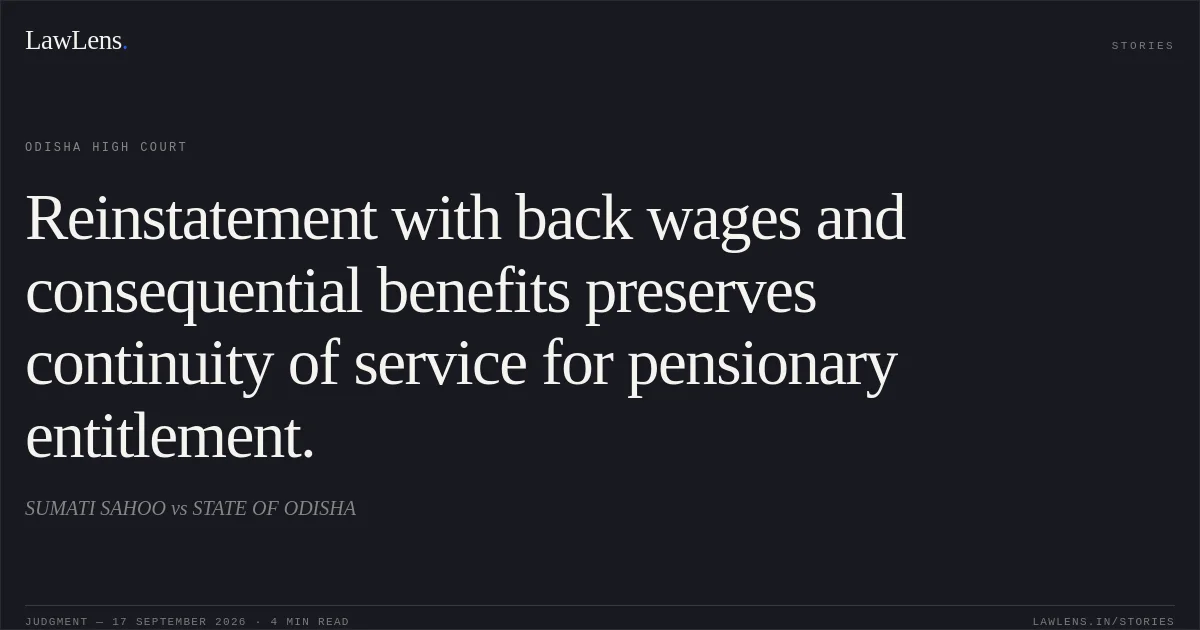
The Court held that the termination could not be treated as creating a service break because it had been declared illegal and the employee had been ordered to be reinstated with back wages and all consequential service benefits.
Source reference: pp. 9–12The reinstatement order issued after dismissal of the State’s challenge implemented that award; therefore, the employee was deemed to have continued in the work-charged establishment from 16 February 1974 until retirement on 31 March 2012.
Source reference: pp. 9–12The State’s distinction based on the physical period between termination and reinstatement was consequently rejected.
Source reference: pp. 9–12Applying the principles in Narusu Pradhan and Sambhu Debnath, the Court found the deceased employee similarly situated and held that his status could not be denied merely because he had retired while formally remaining in the work-charged establishment.
Source reference: p. 12The rejection order was therefore inconsistent with the binding effect of the Labour Court’s award and the applicable pensionary principles.
Source reference: pp. 10–12Holding
The writ petition was allowed.
The order dated 28 August 2023 was quashed.
Source reference: p. 12The deceased employee was directed to be treated as having retired as a regular employee on 31 March 2012 and as covered by the OCS (Pension) Rules, 1992.
Source reference: p. 12The authorities were directed to release the retiral benefits due to him from 31 March 2012 until his death on 31 January 2024, and to pay the petitioner family pension with effect from 1 February 2024.
Source reference: pp. 12–13The entire exercise was to be completed within four months of receipt of the judgment.
Source reference: no citationEPF pension, gratuity, and EPF family pension already received were directed to be adjusted or recovered from the amounts payable.
Source reference: p. 13Original Court PDF
SUMATI SAHOOvsSTATE OF ODISHA
Click to open original judgment
Original judgment, available to read, download and summarize on LawLens.in