Facts
The complainant alleged that Amit Kumar Rai represented himself as unmarried and a Bihar Police Sub-Inspector, married her on 22 June 2022, and obtained money and gifts from her family.
Source reference: p. 2–4, 7–10She later learned that he was already married and had two children, and alleged that his parents and first wife had concealed this fact and facilitated the marriage.
Source reference: p. 2–4, 7–10The Magistrate took cognizance of offences under Sections 323, 420, 495 and 496 IPC against the petitioners—Amit Kumar Rai’s father, mother and first wife.
Source reference: p. 2–4, 7–10The petitioners challenged the cognizance order and, after their application under Section 245 CrPC was rejected, also challenged the discharge order.
Source reference: p. 2–4, 7–10Issues
Whether the complaint and accompanying material disclosed a prima facie case under Sections 323, 420, 495 or 496 IPC against the petitioners, who were relatives of the person alleged to have contracted the subsequent marriage.
Source reference: p. 11–17Whether the cognizance order and the subsequent rejection of discharge should be quashed as an abuse of the process of court.
Source reference: p. 17–18Law Applied
The Court applied Sections 494–496 IPC: Section 495 concerns the offence defined in Section 494, aggravated by concealment of the prior marriage, while Section 496 concerns a person who fraudulently or dishonestly goes through a marriage ceremony knowing that no lawful marriage results.
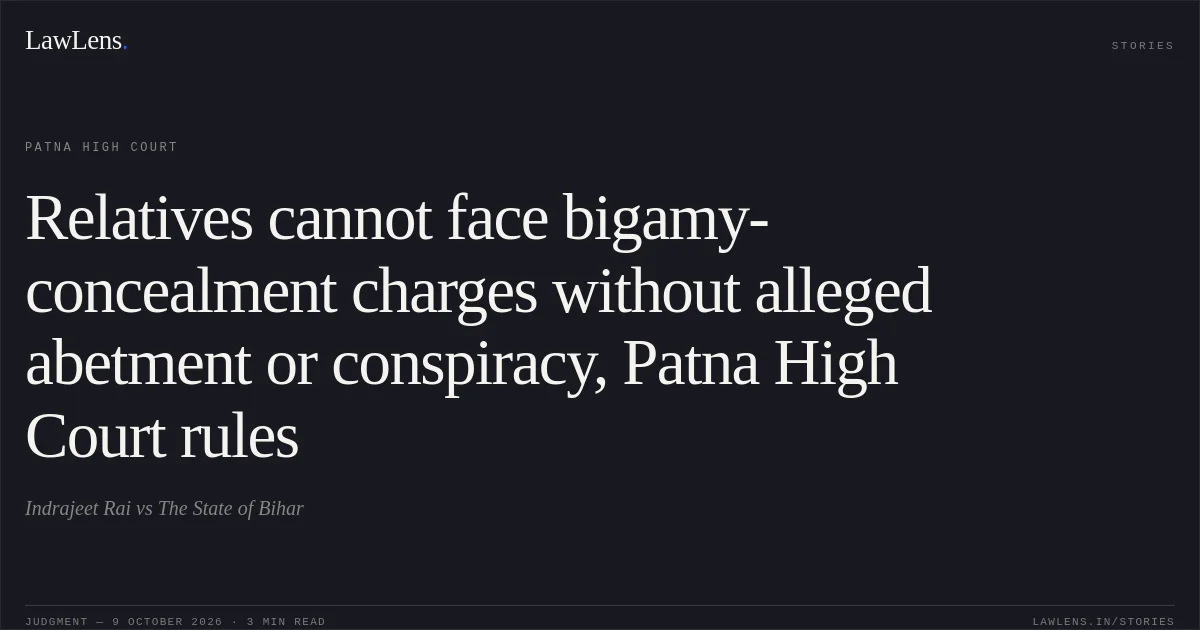
Source reference: p. 11–15It held that these offences are directed at the spouse who contracts the subsequent marriage, and that relatives’ liability would require a basis such as common intention, abetment or conspiracy; none was alleged or cognizance taken under Sections 34, 109 or 120B IPC in this case.
Source reference: p. 11–15The Court relied on S. Nitheen v. State of Kerala, (2024) 8 SCC 706, concerning the quashing of Section 494 read with Section 34 charges against relatives.
Source reference: p. 13It also applied the abuse-of-process principles in State of Haryana v. Ch. Bhajan Lal, 1992 Supp (1) SCC 335, and relied on State of Orissa v. Mamta Mohanty, (2011) 3 SCC 436, and Anand Kumar Mohatta v. State (NCT of Delhi), (2019) 11 SCC 706, regarding consequential proceedings founded on an unsustainable initial order.
Source reference: p. 16–18Reasoning
The Court found that the principal allegations of misrepresentation, receipt of money and physical scuffle were directed at Amit Kumar Rai; the alleged transactions were principally in his account, and the complainant attributed no specific act of cheating or assault to the petitioners.
Source reference: p. 7–10, 15–16It also noted that the petitioners allegedly informed the complainant of Amit Kumar Rai’s existing marriage, and that the later assurance to return money did not itself establish their prior knowledge or participation in the alleged fraud.
Source reference: p. 7–10, 15–16The Court held that the allegations did not show that the petitioners themselves contracted the subsequent marriage or fraudulently went through its ceremony, and that no basis for their liability through common intention, abetment or conspiracy had been pleaded or invoked.
Source reference: p. 12–16It further found that the ingredients of Sections 323 and 420 IPC were not made out against them.
Source reference: p. 16Holding
The High Court held that the prosecution against the petitioners was unsustainable and that continuing it would amount to abuse of the process of court.
It quashed the 1 May 2023 cognizance order insofar as it concerned the petitioners and set aside the 10 September 2026 order rejecting their discharge application.
Source reference: p. 17–18The application was allowed.
Source reference: p. 17–18Acts & Sections Cited
18 provisions across 3 statutes referred to in this judgment. Each provision opens on LawLens.
Indian Penal Code, 1860
Code of Criminal Procedure, 19733
Original Court PDF
Indrajeet RaivsThe State of Bihar
Click to open original judgment
Original judgment, available to read, download and summarize on LawLens.in