Facts
The petitioner filed an FIR on 28.07.2010 (Sasaram PS Case No. 647 of 2010) alleging offences under Sections 147, 148, 341, 323, 329, and 504 of the IPC
Source reference: para 2On 15.09.2016, the learned CJM, Sasaram, dropped the proceedings on the ground of limitation, noting that the maximum punishment for the alleged offences was three years and the period for taking cognizance had elapsed
Source reference: para 2This order was subsequently upheld by the Revisional Court (Additional Sessions Judge XIX, Rohtas) on 21.02.2023
Source reference: para 2, 6The petitioner challenged these orders before the High Court, asserting that the limitation period should be computed from the date of filing the FIR, not the date of cognizance.
Source reference: no citationIssues
1. Whether the period of limitation for a criminal trial under the Code of Criminal Procedure (CrPC) commences on the date of filing the complaint/initiating prosecution or on the date the Magistrate takes cognizance
Source reference: para 2, 42. Whether the informant can be penalized for delays caused by the investigating agency or the Court in taking cognizance
Source reference: para 4, 5Law Applied
Section 469 of the CrPC, which defines the commencement of the period of limitation as the date of the offence or the date knowledge of the offence/offender is acquired
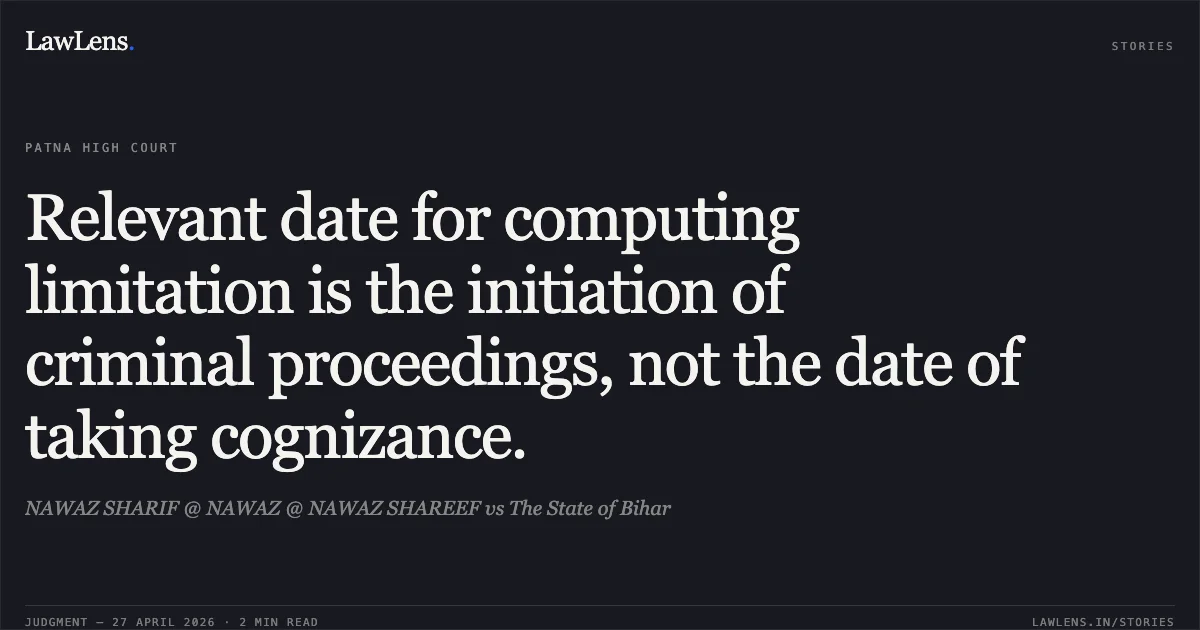
Source reference: para 3Supreme Court precedent Japani Sahoo v. Chandra Sekhar Mohanty (2007) 7 SCC 394, which established that for computing limitation, the relevant date is the date of filing the complaint or initiating criminal proceedings, not the date of taking cognizance
Source reference: para 4Reasoning
The Court observed that both lower courts fundamentally misapplied the law laid down in Japani Sahoo
Source reference: para 2It reasoned that since the FIR was lodged on 28.07.2010—the same day the offence occurred—the prosecution was initiated within the limitation period
Source reference: para 5The Court emphasized that an informant has no control over the police's submission of a charge sheet or the Magistrate's speed in taking cognizance; therefore, the informant cannot be penalized for judicial or administrative delays
Source reference: para 4It further noted that any contrary interpretation would allow accused persons to evade justice by manipulating the police to delay investigations
Source reference: para 5Holding
The High Court held that the limitation period stops upon the initiation of prosecution (filing of FIR/complaint)
It allowed the application and quashed the orders dated 15.09.2016 and 21.02.2023
Source reference: para 6The Court directed the CJM, Rohtas, to pass orders on the materials collected during the investigation within one month of receiving the judgment copy
Source reference: para 7Acts & Sections Cited
6 provisions across 1 statute referred to in this judgment. Each provision opens on LawLens.
Indian Penal Code, 18606
Original Court PDF
NAWAZ SHARIF @ NAWAZ @ NAWAZ SHAREEFvsThe State of Bihar
Click to open original judgment
Original judgment, available to read, download and summarize on LawLens.in