01Facts
On 7 September 2015 at approximately 8:00 a.m., Sabu Nanaiah was allegedly shot dead while returning from his coffee estate.
¶ 3The prosecution alleged that the respondent, who had a property-related dispute with the deceased concerning mutation of revenue records, concealed himself near a silver oak tree and fired at the deceased with an SBBL gun.
¶ 3The deceased’s wife, PW4, stated that she heard three gunshots, reached the spot within a few minutes, saw the respondent approaching with the gun, and heard him say that he had “taught a lesson” to her husband.
¶ 19–23The respondent subsequently surrendered at the police station with the gun, and cartridges were recovered pursuant to his statement.
¶ 49–54Medical and ballistic evidence connected the injuries and recovered cartridges with the seized gun.
¶ 44–46, 77The Sessions Court accepted that the death was homicidal but acquitted the respondent for offences under Section 302 IPC and the Arms Act, granting him the benefit of doubt.
¶ 6–7The State appealed against the acquittal under Section 378 Cr.P.C.
¶ 102Issues
i.Whether the Trial Court erred in acquitting the respondent for the offences under Section 302 IPC and Sections 3 read with 25 of the Arms Act, and whether the High Court could reverse the acquittal and convict him on the evidence on record.
¶ 15ii.Whether the prosecution established a complete and reliable chain of circumstances connecting the respondent with the murder, including motive, the statement made to PW4, recovery of the firearm and cartridges, and the medical and ballistic evidence.
¶ 17, 26, 44, 49iii.What sentence and consequential directions were required upon reversal of the acquittal.
¶ 78–8103Law Applied
The Court applied Section 302 IPC to the offence of murder and the Arms Act provisions concerning the use of a firearm; in the final order, the respondent was convicted under Section 27 of the Arms Act.
¶ 82Under Section 378 Cr.P.C., an appellate court may examine a State appeal against acquittal, while Section 386(a) Cr.P.C. empowers it to reverse an acquittal, find the accused guilty and pass sentence according to law.
¶ 80Section 6 of the Evidence Act makes statements forming part of the same transaction admissible under the doctrine of res gestae, provided they are spontaneous and sufficiently proximate to the occurrence.
¶ 30–34Section 27 permits proof of that portion of an accused’s information which distinctly relates to a discovery; Sections 134 and 165 recognise that evidence is assessed by quality rather than quantity and that the court may actively elicit relevant facts.
¶ 35–43, 72–75The Court also relied on Section 313 Cr.P.C. principles that, once incriminating circumstances are established, the accused’s failure to provide a plausible explanation may constitute an additional link in a circumstantial chain.
¶ 66–70The Court relied, inter alia, on Mousam Singha Roy v. State of W.B. for the rule that suspicion cannot replace proof, Gentela Vijayavardhan Rao v. State of A.P. and Sukhar v. State of U.P. on res gestae, State, Govt. of NCT of Delhi v. Sunil on recovery evidence, and Mallappa v. State of Karnataka on appellate reversal of acquittal.
¶ 13, 30–34, 55–59, 77Provisions in the judgment · 13 · Linked ones open on LawLens
Code of Criminal Procedure, 1973 Section 378Section 313Section 172Section 235Section 360Section 386Section 377
Indian Penal Code, 1860 Section 302Section 392
Arms Act, 1959 Section 3Section 25Section 27
Bharatiya Nagarik Suraksha Sanhita, 2023 Section 427
04Reasoning
The Court affirmed that the death was homicidal, relying on the post-mortem evidence showing fatal gunshot injuries causing shock and haemorrhage.
¶ 16It treated PW4’s evidence as reliable notwithstanding that she had not witnessed the actual firing: her immediate arrival after hearing three shots, her observation of the respondent carrying the gun, and his contemporaneous statement were held admissible as part of the same transaction under Section 6 of the Evidence Act.
¶ 23, 30–34, 76The alleged property and mutation dispute supplied a motive, supported by revenue records and the testimony of the Taluk office official.
¶ 26–29, 77The seizure of the respondent’s SBBL gun and the recovery of two empty cartridges pursuant to his information were supported by PW21 and the Investigating Officer and were not discredited in cross-examination.
¶ 49–59The ballistic expert’s evidence established that the injuries, wads and cartridges could have been fired from the seized gun, corroborating the medical evidence.
¶ 44–46, 77The respondent’s failure to explain how his gun came to be used in the offence, coupled with his complete denial under Section 313 Cr.P.C., was treated as an additional incriminating circumstance.
¶ 66–70, 77The High Court concluded that the Trial Court had failed to consider material medical and ballistic evidence and had therefore adopted a perverse appreciation of the evidence warranting appellate interference.
¶ 46, 72, 7705Holding
The appeal was allowed and the acquittal dated 30 November 2018 was set aside.
¶ 82(i)–(ii)The respondent was convicted under Section 302 IPC and Section 27 of the Arms Act.
¶ 82(iii)He was sentenced to life imprisonment and a fine of ₹1,00,000 under Section 302 IPC, with ₹90,000 directed to be paid to PW4 upon identification; default would entail six months’ further imprisonment.
¶ 82(iv)For the Arms Act offence, he was sentenced to three years’ imprisonment and a fine of ₹10,000, with two months’ imprisonment in default.
¶ 82(v)Both sentences were directed to run concurrently, and the respondent was ordered to surrender before the Trial Court within one week, failing which he was to be secured and committed to prison.
¶ 82(vi)–(vii)Original Court PDF
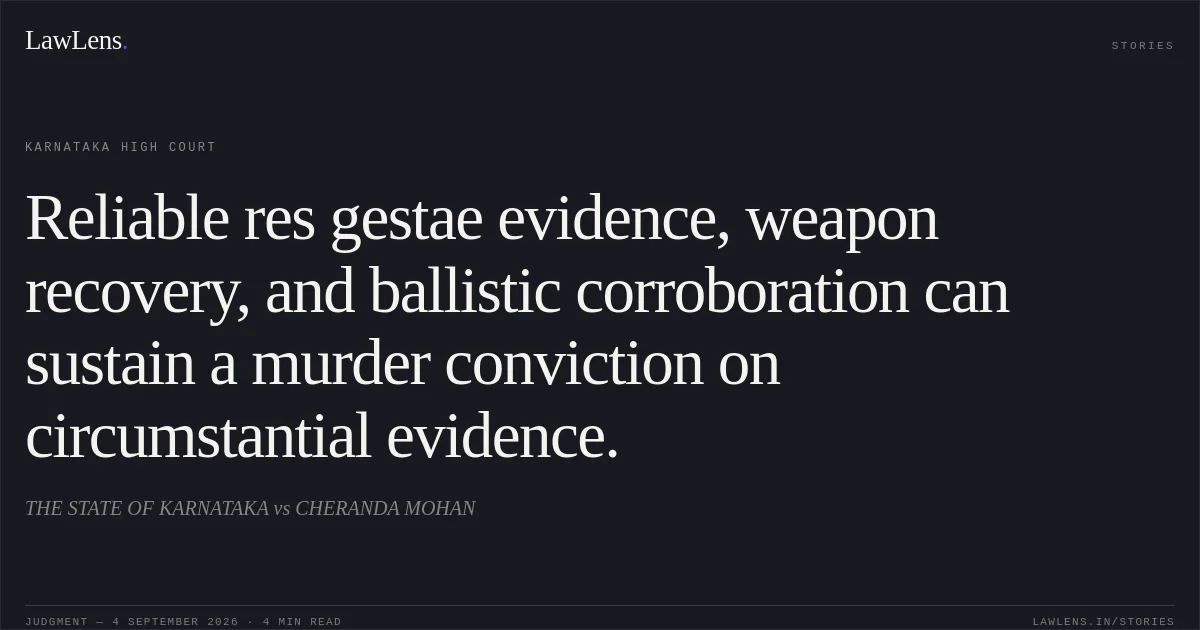
THE STATE OF KARNATAKAvsCHERANDA MOHAN
Click to open original judgment
Original judgment, available to read, download and summarize on LawLens.in