Facts
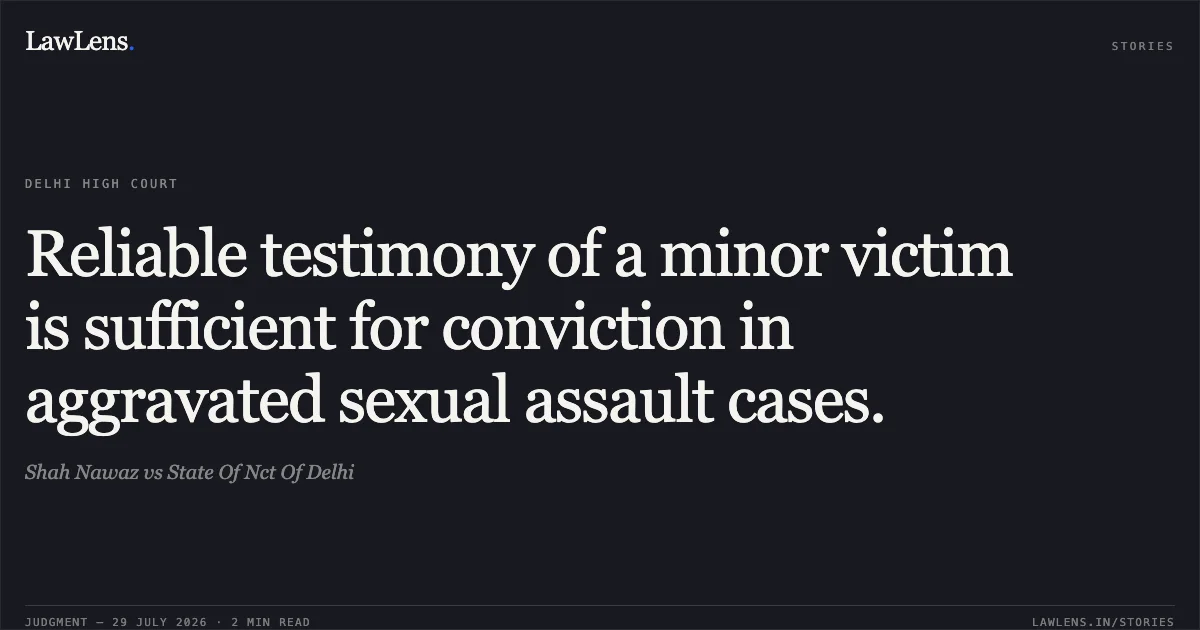
The Appellant, Shah Nawaz, was convicted by the Special POCSO Court for offences under Section 10 of the POCSO Act and Section 354B IPC.
Source reference: no citationThe case arose from an incident approximately 4–5 days prior to April 30, 2021, where the Appellant (the biological father) was found naked lying on top of his 10-year-old daughter (PW3) after removing her clothes.
Source reference: p. 8PW2 (the mother) intervened and rescued the child.
Source reference: no citationThe FIR was registered on April 30, 2021, following a delay attributed to a COVID-19 lockdown.
Source reference: p. 11The Appellant contended that the case was falsely fabricated due to a property dispute and challenged the lack of medical corroboration and non-examination of other siblings who were present.
Source reference: p. 6Issues
1. Whether the delay in lodging the FIR and the absence of physical injuries/medical corroboration vitiate the prosecution’s case
Source reference: p. 11-122. Whether the sole testimony of a minor victim is sufficient for conviction under the POCSO Act in the absence of corroboration from other witnesses or forensic evidence
Source reference: p. 143. Whether the acts committed by the Appellant squarely fall within the definition of "Aggravated Sexual Assault" under Sections 9 and 10 of the POCSO Act
Source reference: p. 18-19Law Applied
The Court relied on Section 7 of the POCSO Act, which defines sexual assault as acts with sexual intent involving physical contact without penetration.
Source reference: p. 18Sections 9(m) and 9(n) which characterize assault as "aggravated" if the victim is under 12 or if the accused is a relative/parent.
Source reference: p. 19The Court applied the principles from Ganesan v. State, establishing that the sole testimony of a victim, if reliable, is sufficient for conviction.
Source reference: p. 14State of Punjab v. Gurmit Singh to emphasize that a victim of sexual assault is not an accomplice and her testimony should not be viewed with suspicion.
Source reference: p. 16The rule that the burden of proving a specific defense (e.g., property dispute) lies on the accused via "preponderance of probabilities" per Harbhajan Singh v. State of Punjab.
Source reference: p. 15-16Reasoning
The Court found the testimony of the minor victim (PW3) to be clear, cogent, and natural, noting that minor discrepancies in the date of the incident were expected due to the passage of time.
Source reference: p. 9-10The Court held that the delay in filing the FIR was reasonably explained by the night-time occurrence and the prevailing lockdown.
Source reference: p. 11-12Regarding the lack of medical evidence, the Court noted that since the charge was attempted assault and involved "contact without penetration," the absence of bruises or internal injuries was irrelevant.
Source reference: p. 12The Court dismissed the Appellant’s defense of a "property dispute" as a mere suggestion lacks documentary proof.
Source reference: p. 15The court reasoned that in the absence of evidence of tutoring, it is highly improbable for a child to falsely implicate her own father in such a grave offense.
Source reference: p. 16Holding
The High Court affirmed the trial court's judgment, holding that the Appellant’s act of undressing and lying naked over his daughter constituted aggravated sexual assault under Section 9 read with Section 10 of the POCSO Act and Section 354B IPC.
The appeal was dismissed, and the sentence of 7 years of rigorous imprisonment and a fine of ₹25,000 was upheld.
Source reference: p. 19-20Acts & Sections Cited
12 provisions across 4 statutes referred to in this judgment. Each provision opens on LawLens.
Code of Criminal Procedure, 19734
Bharatiya Nagarik Suraksha Sanhita, 20231
Protection of Children from Sexual Offences Act, 20125
Indian Penal Code, 18602
Original Court PDF
Shah NawazvsState Of Nct Of Delhi
Click to open original judgment
Original judgment, available to read, download and summarize on LawLens.in