Facts
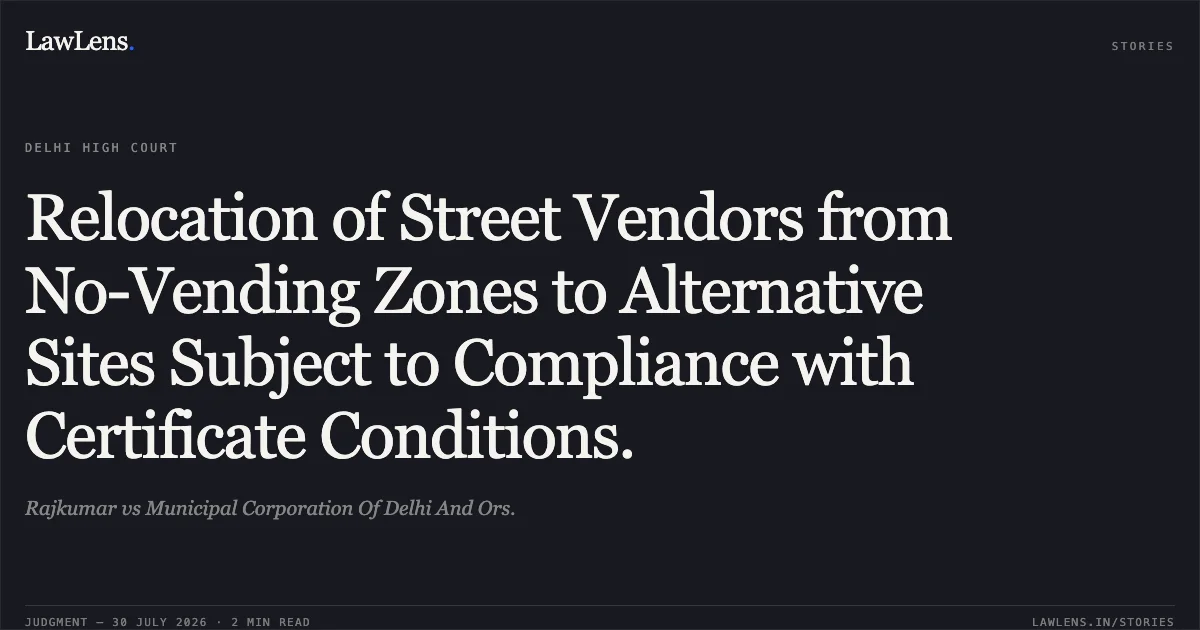
The Petitioner, a street vendor holding a provisional Certificate of Vending (CoV) for "Food/Snack with gas cylinder/fire," sought protection to vend at 10 G, Jawahar Nagar, Kamla Nagar, Delhi.
Source reference: p. 1-2The Petitioner alleged harassment and lack of action on his representation dated July 16, 2026.
Source reference: p. 1-2The Respondent (MCD) contended that the Kamla Nagar area is a designated "No-Vending Zone" and cited a previous court order in Jawahar Nagar Block Welfare Association v. UT of Delhi (CONT.CAS(C) 1426/2022) directing the removal of unauthorized squatters from that specific stretch.
Source reference: p. 2-3Issues
1. Whether a street vendor holding a valid CoV can be permitted to vend in a designated "No-Squatting" or "No-Vending" zone.
Source reference: p. 3, para. 62. Whether the court can direct the relocation of a vendor and modify the conditions of a CoV to balance livelihood rights with public order.
Source reference: p. 5, para. 8Law Applied
Street Vendors (Protection of Livelihood and Regulation of Street Vending) Act, 2014, specifically Section 21 regarding the formulation of a vending plan by the Town Vending Committee (TVC).
Source reference: p. 6, para. 9Delhi Street Vendors (Protection of Livelihood and Regulation of Street Vending) Scheme, 2019.
Source reference: p. 4, Condition 16The primary legal principle maintained is that while street vendors have rights, they cannot operate in "No-Squatting/No-Vending Zones" and must strictly adhere to the hygiene and safety conditions specified in their CoVs.
Source reference: p. 3, para. 6Reasoning
The Court noted that while the Petitioner holds a CoV, the current location (Kamla Nagar) is a restricted zone where squatting is prohibited by prior judicial orders.
Source reference: p. 3The Court reasonied that the Petitioner’s right to vend must be balanced against pedestrian and vehicular movement and public health.
Source reference: p. 3-4To resolve the conflict, the Court adopted a relocation approach similar to Anil Kumar v. MCD (W.P.(C) 7593/2026), directing the MCD to provide an alternative space.
Source reference: p. 5The Court analyzed the safety requirements of using gas cylinders in public spaces, stipulating size restrictions (small/medium) to minimize encroachment.
Source reference: p. 5Finally, it weighed the Petitioner's request to be a "stationary vendor" against the CoV’s condition No. 11 (which restricts mobile vendors to 30 minutes), ultimately exempting him from that specific time restriction provided he remains within a designated space and does not obstruct pedestrians.
Source reference: p. 5Holding
The Court disposed of the petition by directing that the Petitioner be relocated to an alternative space identified by the Assistant Commissioner, MCD, within ten days.
The Petitioner is permitted to operate as a stationary vendor (exempt from Condition No. 11 of the CoV) provided he: (i) uses only small/medium gas cylinders; (ii) does not encroach on pedestrian areas; (iii) maintains hygiene; (iv) does not create third-party interests or sub-let the vend; and (v) erects no permanent structures. These directions remain subject to the final vending plan to be formulated by the TVC-II under Section 21 of the Act.
Source reference: p. 5-6, para. 9Original Court PDF
RajkumarvsMunicipal Corporation Of Delhi And Ors.
Click to open original judgment
Original judgment, available to read, download and summarize on LawLens.in