Facts
The applicant sought quashing under Section 528 of the Bharatiya Nagarik Suraksha Sanhita, 2023 (“BNSS”) of FIR Crime No. 444/2024 registered at Police Station Adhartal, Jabalpur, for offences under Sections 363, 366, 376(3), 376(2)(n) of the IPC and Sections 3/4(2), 5(L), 5(J)(ii) and 6 of the POCSO Act, along with the consequential proceedings in Special Case No. 26/2025 pending before the Special Judge (POCSO), Jabalpur.
Source reference: para. 1The prosecution alleged that the prosecutrix had been kidnapped and subjected to repeated sexual assault. After investigation, a charge-sheet was filed and the trial commenced.
Source reference: para. 2During the trial, the prosecutrix stated that she had voluntarily married the applicant, did not wish to prosecute him, and supported the compromise; the Trial Court rejected the compromise application on the ground that the alleged offences were non-compoundable.
Source reference: para. 2The applicant asserted that the parties had married on 22 January 2024, lived together as husband and wife, and had a child who subsequently died.
Source reference: para. 3The prosecutrix also filed an independent application before the High Court under Section 359(6) of the BNSS, affirming that the compromise was voluntary and that she had no grievance against the applicant.
Source reference: paras. 3, 5Although school records indicated that she was below eighteen years of age, she stated before the Trial Court that she was nineteen and had voluntarily accompanied and married the applicant.
Source reference: para. 9Issues
Whether the High Court could exercise its inherent jurisdiction under Section 528 of the BNSS to quash the FIR, charge-sheet and pending POCSO proceedings on the basis of the prosecutrix’s voluntary compromise and unwillingness to prosecute?
Source reference: paras. 1, 6–10Whether the alleged gravity and non-compoundable nature of the offences under the IPC and POCSO Act precluded quashing where the prosecutrix had resiled from the prosecution case and the likelihood of conviction was extremely remote?
Source reference: paras. 4, 7–11Law Applied
The Court applied Section 528 of the BNSS, which preserves the High Court’s inherent power to make orders necessary to give effect to an order under the BNSS, prevent abuse of the process of any court, or secure the ends of justice.
Source reference: paras. 1, 10It relied on Gian Singh v. State of Punjab, (2012) 10 SCC 303, for the principle that, although serious offences having an overriding societal impact ordinarily should not be quashed merely because the parties have compromised, the High Court may exercise its inherent jurisdiction in exceptional cases where continuation of the prosecution would amount to abuse of process or where quashing is necessary to secure the ends of justice.
Source reference: para. 7The Court also considered the statutory scheme governing the alleged offences under Sections 363, 366, 376(3) and 376(2)(n) of the IPC and Sections 3/4(2), 5(L), 5(J)(ii) and 6 of the POCSO Act, recognising that POCSO offences ordinarily cannot be defeated by consent or compromise alone.
Source reference: paras. 4, 10Reasoning
The Court acknowledged that the alleged rape and POCSO offences were grave, non-compoundable and ordinarily not amenable to quashing on the basis of compromise.
Source reference: paras. 4, 7, 10However, it treated the case as exceptional because the prosecutrix had entered the witness box and categorically testified that she had voluntarily accompanied the applicant, married him, lived with him as his wife, and did not want criminal action against him.
Source reference: paras. 8–9Her independent application before the High Court further confirmed that the compromise was voluntary, that she continued to reside with the applicant, and that she had no grievance against him.
Source reference: para. 5Although the school records suggested that she was a minor, the Court noted her assertion that she was nineteen and placed particular reliance on the collapse of the prosecution case following her testimony.
Source reference: para. 9On that basis, the Court concluded that the likelihood of conviction was extremely remote and that continuation of the proceedings would serve no realistic prosecutorial purpose and would instead disrupt the parties’ settled matrimonial life.
Source reference: paras. 10–11Holding
The High Court answered the issues in favour of the applicant and exercised its inherent jurisdiction under Section 528 of the BNSS.
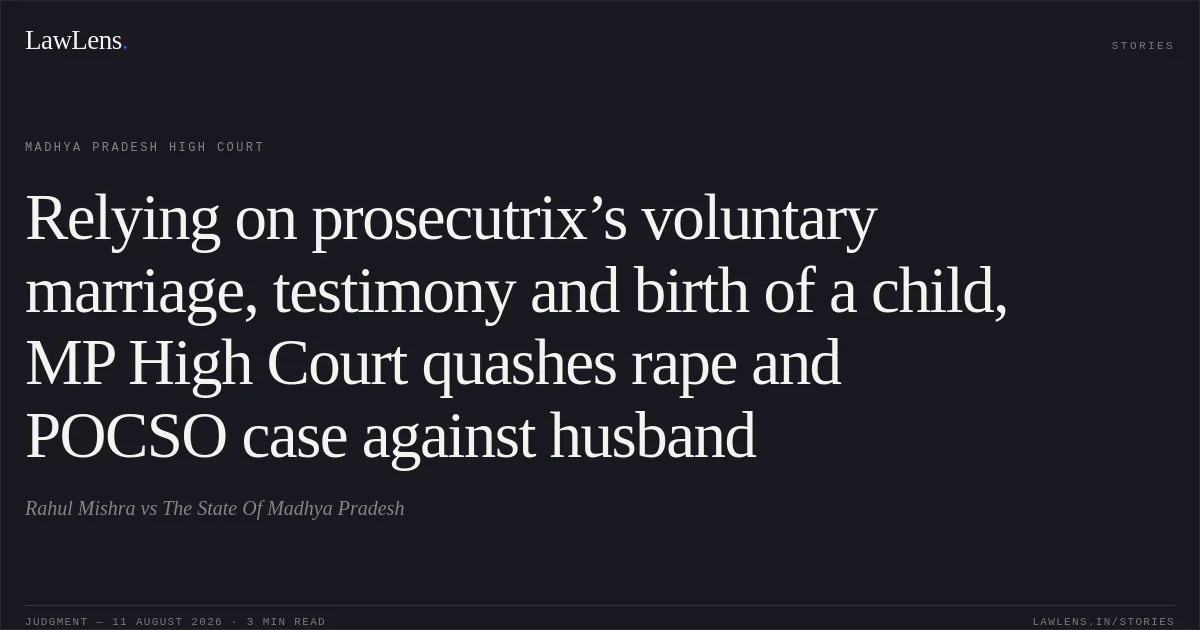
The petition was allowed, and FIR Crime No. 444/2024, the charge-sheet, Special Case No. 26/2025 pending before the Special Judge (POCSO), Jabalpur, and all consequential proceedings were quashed.
Source reference: para. 12Acts & Sections Cited
9 provisions across 3 statutes referred to in this judgment. Each provision opens on LawLens.
Bharatiya Nagarik Suraksha Sanhita, 20232
Indian Penal Code, 18603
Original Court PDF
Rahul MishravsThe State Of Madhya Pradesh
Click to open original judgment
Original judgment, available to read, download and summarize on LawLens.in