Facts
The petitioner was appointed as a General Duty Clerk by the respondent on 14 December 1965. After a charge-sheet dated 29 September 1994 and suspension on 5 January 1995, he was dismissed from service on 16 May 2002 pursuant to disciplinary proceedings.
Source reference: p.1The appropriate Government referred the dispute concerning the legality and justification of the dismissal to the Labour Court on 14 August 2003. The petitioner’s statement of claim sought recovery of certain amounts but did not expressly challenge his dismissal.
Source reference: pp.1–2Despite opportunities to file a rejoinder, he failed to do so and was absent on 28 July 2005, when the Labour Court framed and decided a preliminary issue regarding the maintainability of the claim.
Source reference: pp.2, 4–6By award dated 3 August 2005, the Labour Court held that the claim did not correspond to the terms of reference and rejected it. The petitioner’s recall application was dismissed on 23 September 2006.
Source reference: pp.2, 4–6His subsequent fresh statement of claim was rejected on 8 January 2008 on the ground that the earlier award had been published and had become enforceable, rendering the Labour Court functus officio under Section 17(2) of the Industrial Disputes Act, 1947.
Source reference: pp.2–3, 6The petitioner consequently invoked Articles 226 and 227 of the Constitution seeking remand for adjudication on merits.
Source reference: p.3Issues
1. Whether the Labour Court was justified in holding that the petitioner’s statement of claim was not maintainable because it did not specifically challenge the legality or justification of his dismissal, and whether the award dated 3 August 2005 warranted interference under Articles 226 and 227 of the Constitution.
Source reference: pp.4–62. Whether the Labour Court erred in dismissing the petitioner’s recall application dated 23 September 2006.
Source reference: p.63. Whether the Labour Court could entertain the petitioner’s fresh statement of claim after the earlier award had been published and had become enforceable, or whether it had become functus officio under Section 17(2) of the Industrial Disputes Act, 1947.
Source reference: pp.6–74. Whether the matter should be remanded for adjudication on the merits of the petitioner’s dismissal, particularly when the domestic enquiry allegedly raised issues of natural justice.
Source reference: pp.3–4, 7Law Applied
The Court applied the limited scope of judicial review under Articles 226 and 227, under which the High Court does not sit as an appellate court over Labour Court findings and interferes only in cases of perversity, patent illegality, absence of evidence, or jurisdictional error.
Source reference: p.4It applied the principle that adjudication before the Labour Court must proceed on the basis of the pleadings filed before it, and that a party’s failure to cure a pleading defect despite repeated opportunities cannot ordinarily justify supervisory interference.
Source reference: pp.4–6The Court also applied Section 17(2) of the Industrial Disputes Act, 1947, under which an award becomes enforceable after publication and expiry of the prescribed period, thereby rendering the Labour Court functus officio in respect of the concluded dispute.
Source reference: pp.6–7The Court considered the principle in Cooper Engineering Ltd. v. P.P. Mundhe concerning consideration of the validity of a domestic enquiry at the preliminary stage, but found no basis for remand in the circumstances of the case.
Source reference: p.3It further applied the principles of natural justice to hold that a disciplinary enquiry is fair where the delinquent employee is given adequate opportunities to participate, cross-examine witnesses, and lead evidence.
Source reference: p.7Reasoning
The High Court held that the petitioner’s claim before the Labour Court did not challenge his dismissal, despite the management’s specific objection and the Labour Court’s repeated opportunities to file a rejoinder or amend the pleadings.
Source reference: pp.4–6His explanation for non-appearance and his contention that the defect was curable did not establish denial of opportunity, particularly because he had failed to comply with the Labour Court’s directions and had remained absent when the preliminary issue was taken up.
Source reference: pp.5–6The recall application was correctly treated as an impermissible attempt to review the award, and the subsequent fresh claim was barred once the earlier award had been published and had become enforceable.
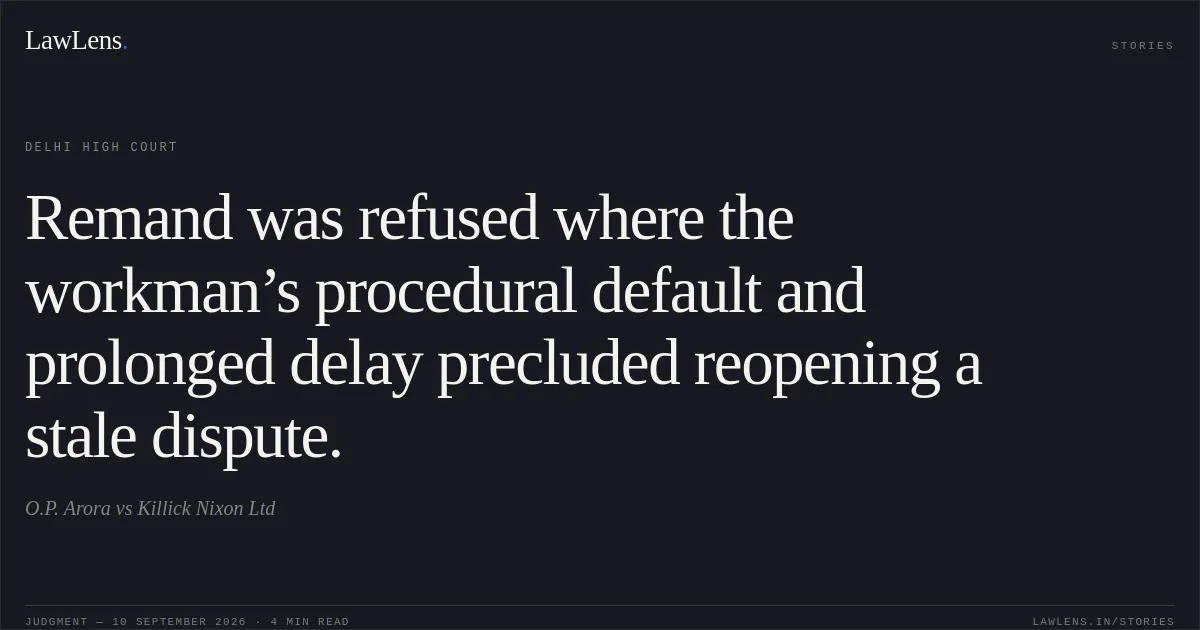
Source reference: pp.6–7Although the dismissal had not been adjudicated substantively, the Court declined remand because the dispute was more than two decades old and the relevant events dated back over three decades.
Source reference: p.7On examining the enquiry proceedings, the Court found that the petitioner had been repeatedly afforded opportunities to participate, cross-examine management witnesses, receive earlier records, and lead defence evidence; therefore, there was no violation of natural justice warranting a fresh adjudication.
Source reference: p.7Holding
The High Court answered the issues against the petitioner. It held that the Labour Court’s award dated 3 August 2005, order dated 23 September 2006, and order dated 8 January 2008 did not suffer from perversity, patent illegality, or jurisdictional error warranting interference under Articles 226 or 227.
The Court further held that the domestic enquiry was fair and consistent with natural justice, and that remand for adjudication on the merits of the dismissal was unwarranted due to the age of the dispute and the petitioner’s failure to diligently prosecute the Labour Court proceedings.
Source reference: p.7The writ petition was accordingly dismissed, and all pending applications, if any, were also disposed of.
Source reference: p.8Acts & Sections Cited
2 provisions across 1 statute referred to in this judgment. Linked provisions open on LawLens.
Industrial Disputes Act, 19472
Original Court PDF
O.P. AroravsKillick Nixon Ltd
Click to open original judgment
Original judgment, available to read, download and summarize on LawLens.in