Facts
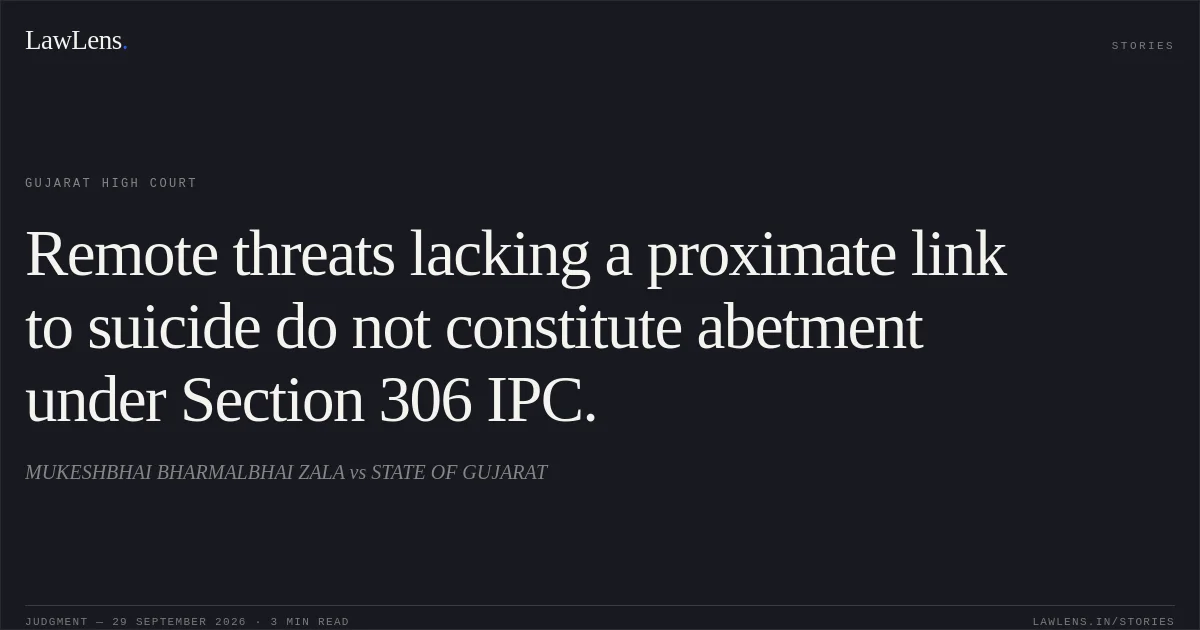
The applicant sought quashing under Section 482 of the Code of Criminal Procedure, 1973, of an FIR registered against him and others for offences under Sections 306, 506(2), 498 and 114 of the Indian Penal Code, 1860, and Sections 3(2)(5) and 3(2)(5)(a) of the Scheduled Castes and Scheduled Tribes (Prevention of Atrocities) Act, 1989.
Source reference: p. 1The FIR alleged that the deceased’s wife had left him to live with another accused, who allegedly resided at the applicant’s house; when the deceased went looking for her, the accused threatened him, after which he died by suicide.
Source reference: p. 2The applicant contended that he had merely provided shelter, that the alleged threat occurred seven to eight days before the suicide, and that the statutory ingredients of the offences were not made out against him.
Source reference: pp. 2–4The State and complainant opposed quashing, including on the ground that the trial had commenced and witnesses had been examined.
Source reference: pp. 4–5Issues
Whether the FIR and investigation materials disclosed a prima facie case against the applicant for abetment of suicide, criminal intimidation, the offence under Section 498 IPC, or the charged offences under the Atrocities Act.
Source reference: pp. 6–12Whether the High Court could exercise its inherent jurisdiction under Section 482 CrPC to quash the proceedings qua the applicant after the trial had commenced.
Source reference: pp. 4–5, 12Law Applied
Section 482 CrPC empowers the High Court to prevent abuse of process and secure the ends of justice.
Source reference: pp. 6–7, 12Under State of Haryana v. Bhajan Lal, AIR 1992 SC 604, quashing may be justified, among other circumstances, where allegations—even accepted at face value—do not constitute an offence, the uncontroverted allegations and evidence disclose no offence, or the allegations are inherently improbable.
Source reference: pp. 6–7, 12For Sections 306 and 107 IPC, the court relied on Abhinav Mohan Delkar v. State of Maharashtra, (2026) 6 SCC 233, for the principle that abetment requires a sufficiently proximate act and a conscious intention to drive the victim to suicide; harassment or the victim’s subjective perception alone is insufficient.
Source reference: pp. 7–9Criminal intimidation under Section 506 IPC requires a threat of specified injury accompanied by the requisite intention to cause alarm or compel or restrain conduct; Section 498 IPC concerns taking, enticing, concealing or detaining a married woman with the specified criminal intent.
Source reference: pp. 10–11The court also relied on Thesima Begam v. State of Tamil Nadu, (2020) 14 SCC 580, for the proposition that commencement of trial does not, by itself, bar exercise of Section 482 jurisdiction.
Source reference: p. 12Reasoning
The court found the allegations against the applicant vague and omnibus.
Source reference: pp. 8–9The alleged threat was said to have occurred approximately seven to eight days before the suicide, and the investigation materials disclosed no proximate act demonstrating that the suicide was the direct consequence of conduct by the applicant or that he intended to instigate it.
Source reference: pp. 8–9The record also did not establish the requisite intention to cause alarm for Section 506(2), or that the applicant enticed, took away, concealed or detained the deceased’s wife with the criminal intent required by Section 498 IPC.
Source reference: pp. 10–11Nor did the materials show that the applicant knew the deceased belonged to a Scheduled Caste or Scheduled Tribe; Section 114 IPC consequently had no independent application in the absence of an underlying offence.
Source reference: p. 12Applying Bhajan Lal, the court held that the case fell within categories (1), (3) and (5), and rejected the objection that the trial’s commencement precluded quashing.
Source reference: pp. 12–13Holding
The court held that the allegations and investigation materials did not disclose the charged offences against the applicant and that the case warranted intervention under Section 482 CrPC.
It allowed the application and quashed the FIR and all consequential proceedings qua the applicant only; its observations were confined to the applicant and were not to affect proceedings against the remaining accused.
Source reference: p. 13Acts & Sections Cited
7 provisions across 3 statutes referred to in this judgment. Each provision opens on LawLens.
Code of Criminal Procedure, 19731
Indian Penal Code, 18605
Scheduled Castes and the Scheduled Tribes (Prevention of Atrocities) Act, 19891
Original Court PDF
MUKESHBHAI BHARMALBHAI ZALAvsSTATE OF GUJARAT
Click to open original judgment
Original judgment, available to read, download and summarize on LawLens.in