Facts
The appellant, a government employee with more than 19 years of service, was transferred from Dehra, District Kangra, to Kaza, District Lahaul and Spiti, by order dated 30.08.2018.
Source reference: paras. 2–5He challenged the transfer before the judicial forums and did not join at Kaza.
Source reference: paras. 2–5After the Supreme Court directed him to join within ten days on 28.01.2019, he joined on 07.02.2019 but proceeded on leave the following day and remained absent until 20.03.2019.
Source reference: paras. 2–5A departmental inquiry under Rule 14 of the CCS (CCA) Rules, 1965, found the charge of failure to join duty at Kaza proved.
Source reference: paras. 2, 11The disciplinary authority imposed the penalty of removal from service on 01.11.2019, which was affirmed in appeal on 08.01.2020.
Source reference: paras. 2, 11The learned Single Judge upheld both orders in CWP No. 422 of 2020 on 14.06.2024.
Source reference: para. 1Issues
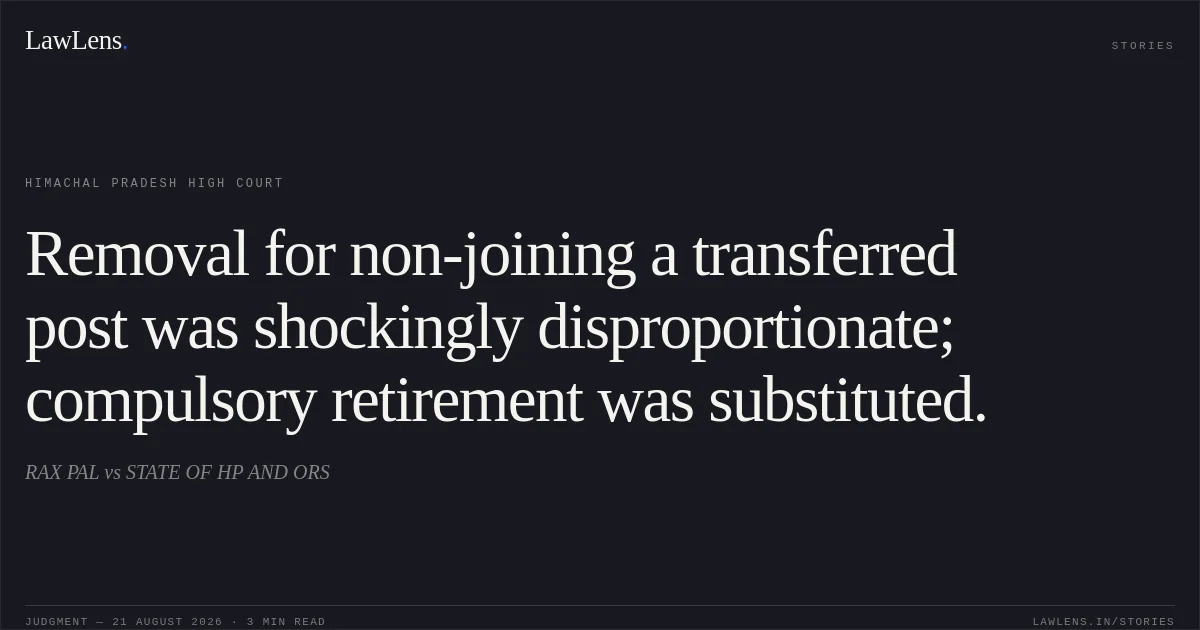
Whether the penalty of removal from service, imposed after more than 19 years of service for failure to join the transferred place of posting and subsequent absence, was shockingly disproportionate to the misconduct?
Source reference: para. 10Whether the removal penalty ought to be substituted with a lesser major penalty, particularly compulsory retirement, in the facts and circumstances of the case?
Source reference: paras. 22, 29Law Applied
The Court applied the disciplinary framework under Rules 11, 14 and 15 of the CCS (CCA) Rules, 1965, recognising that disobedience of a lawful transfer order and unauthorised absence may constitute misconduct.
Source reference: no citationHowever, judicial review of disciplinary punishment is limited and interference is justified where the penalty is irrational, unreasonable or shocks the conscience.
Source reference: paras. 18–20This proportionality principle was drawn from Ranjit Thakur v. Union of India, (1987) 4 SCC 611; Union of India v. G. Ganayutham, (1997) 7 SCC 463; Deputy Commissioner, Kendriya Vidyalaya Sangathan v. J. Hussain, (2013) 10 SCC 106; and Raghubir Singh v. Haryana Roadways, (2014) 10 SCC 301.
Source reference: paras. 18–20The Court also considered UT of Dadra & Nagar Haveli v. Gulabhia M. Lad, (2010) 5 SCC 775, under which proportionality depends upon the gravity of misconduct, past conduct, nature of duties and degree of discipline required.
Source reference: para. 21S.R. Tewari v. Union of India, (2013) 6 SCC 602, recognising that the circumstances compelling the employee’s conduct may be relevant to the quantum of punishment.
Source reference: para. 22Under Rule 11 of the CCS (CCA) Rules, several major penalties short of removal, including compulsory retirement, stoppage of increments and reduction in rank or pay, were available.
Source reference: para. 29Reasoning
The Court accepted that the appellant was required to obey the transfer order and that the departmental inquiry had validly found the charge proved.
Source reference: no citationNevertheless, it held that the disciplinary authority had allowed matters outside the framed charge—particularly the appellant’s earlier litigation concerning a 2017 transfer—to influence the quantum of punishment.
Source reference: para. 16The Court also found that the appellate authority had failed to properly consider the appellant’s 19 years of service, his family circumstances, including his wife’s employment, aged and ill family members, and his child’s serious illness, as well as the fact that he had pursued legal remedies rather than simply abandoning service.
Source reference: paras. 17, 29Although the conduct warranted disciplinary action, removal was considered excessively severe when compared with the nature of the misconduct and the range of lesser major penalties available under Rule 11.
Source reference: para. 29The Court therefore concluded that the punishment crossed the permissible threshold of proportionality and shocked the judicial conscience.
Source reference: no citationThe precedents concerning financial dishonesty and misconduct in a disciplined armed force were held inapplicable to the appellant’s case, which concerned non-joining after a disputed transfer.
Source reference: paras. 27–28Holding
The Letters Patent Appeal was allowed.
The orders of removal dated 01.11.2019, the appellate order dated 08.01.2020, and the learned Single Judge’s judgment dated 14.06.2024 were set aside.
Source reference: para. 30The penalty was modified from removal to compulsory retirement with effect from the date of removal, together with all consequential benefits.
Source reference: para. 30The respondents were directed to complete the necessary exercise within eight weeks.
Source reference: para. 30Original Court PDF
RAX PALvsSTATE OF HP AND ORS
Click to open original judgment
Original judgment, available to read, download and summarize on LawLens.in