Facts
The petitioner, appointed as a police constable in 1993, was charged with entering a TASMAC bar, demanding liquor without payment, assaulting cashier Poobalan after he refused, and taking ₹500 from his pocket.
Source reference: pp. 2–3Following a departmental inquiry, the Superintendent of Police removed the petitioner from service on 10 April 2013; his appeal and subsequent review were unsuccessful.
Source reference: pp. 2–3The petitioner challenged the order dated 9 February 2023, relying in part on a later letter from Poobalan and the parties’ reconciliation, and contending that removal was disproportionate.
Source reference: p. 3The State maintained that the charge was proved by eyewitness evidence and that the penalty was warranted.
Source reference: p. 4Issues
Whether the disciplinary finding that the petitioner committed the charged misconduct was liable to be set aside in judicial review.
Source reference: pp. 5, 9Whether removal from service was shockingly disproportionate to the proved misconduct.
Source reference: p. 10Law Applied
Under Article 226, judicial review of disciplinary proceedings concerns the legality and fairness of the decision-making process, not an appeal on the merits.
Source reference: pp. 6–9A court may interfere where the inquiry violates natural justice or prescribed rules, the finding is unsupported by evidence or perverse, or no reasonable person could have reached it; where some evidence supports the finding, the court ordinarily will not reappreciate it.
Source reference: pp. 6–9B.C. Chaturvedi v. Union of India, (1995) 6 SCC 749, further establishes that a court ordinarily cannot substitute its own penalty, but may intervene if the punishment shocks its conscience.
Source reference: pp. 6–9These principles were reiterated in Deputy General Manager (Appellate Authority) v. Ajai Kumar Srivastava, (2021) 2 SCC 612.
Source reference: pp. 6–9Reasoning
The disciplinary authority relied on the evidence of three witnesses, including Poobalan, whose account described the petitioner taking ₹500 from his pocket after demanding liquor and being refused.
Source reference: p. 9The Court found evidence supporting the disciplinary finding and identified no perversity or procedural basis for interference; Poobalan’s subsequent acceptance of an apology did not displace the departmental finding.
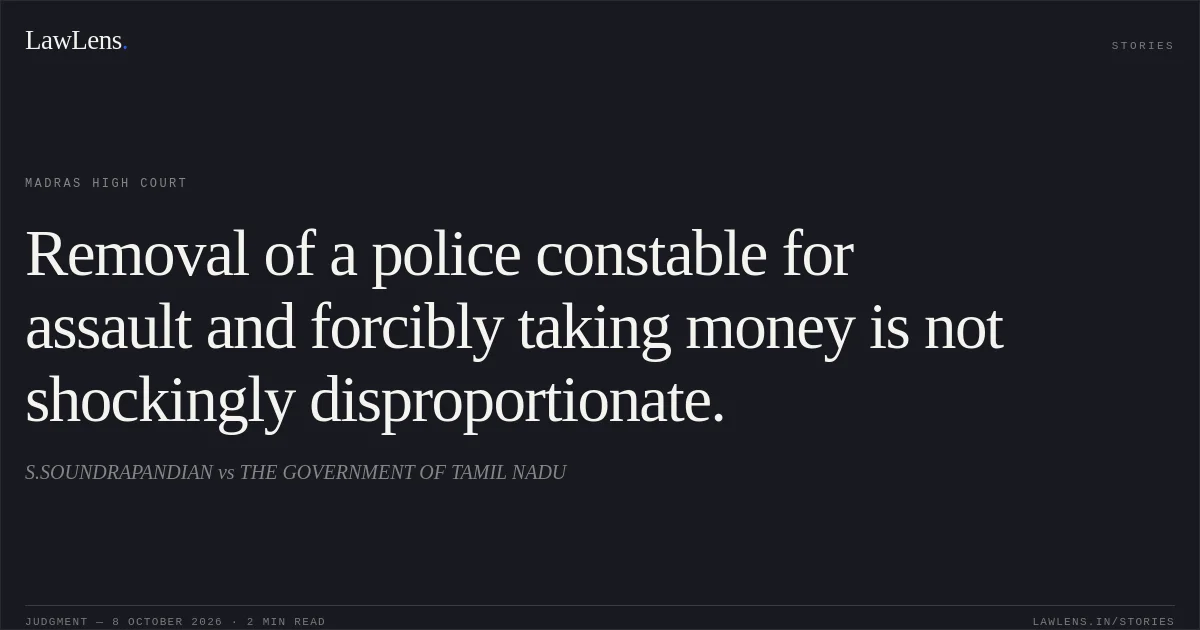
Source reference: pp. 5, 9Given the petitioner’s position as a police constable and the nature of the misconduct—assault and taking money—the Court held that removal was commensurate with the charge, rather than shockingly disproportionate.
Source reference: p. 10Holding
The Court answered both issues against the petitioner, finding no ground to disturb either the disciplinary finding or the punishment.
It dismissed the writ petition, made no order as to costs, and closed the connected miscellaneous petitions.
Source reference: p. 10Original Court PDF
S.SOUNDRAPANDIANvsTHE GOVERNMENT OF TAMIL NADU
Click to open original judgment
Original judgment, available to read, download and summarize on LawLens.in