Facts
The appellant instituted a declaratory suit claiming tenancy rights in respect of the suit premises.
Source reference: no citationThe respondent filed a counter-claim for eviction, asserting that the appellant was a lessee under the Transfer of Property Act, 1882 (“the 1882 Act”), and not a tenant protected by the West Bengal Premises Tenancy Act, 1997 (“the 1997 Act”), because the rent for the non-residential premises exceeded the statutory ceiling under Section 3(f)(ii) of the 1997 Act.
Source reference: para. 9The Trial Court dismissed the appellant’s declaratory suit and decreed the respondent’s counter-claim for eviction.
Source reference: paras. 4–5The appellant filed F.A.T. 228 of 2026 against dismissal of the declaratory suit and F.A.T. 229 of 2026 against the eviction decree.
Source reference: no citationIn the counter-claim, the appellant was described inconsistently as both a “lessee” and a “licensee”; the appellant contended that this contradiction invalidated the notice relied upon for eviction.
Source reference: paras. 10–13The documentary tenancy and supplementary agreements, however, repeatedly described the parties as landlord and tenant and the payment as rent.
Source reference: paras. 23–34Issues
Whether F.A.T. 228 of 2026 was maintainable before the High Court in view of its lack of pecuniary jurisdiction?
Source reference: paras. 1–3Whether the appellant was a licensee or a lessee under the 1882 Act, and whether the alleged inconsistency in the respondent’s pleadings affected the eviction proceedings?
Source reference: paras. 10–20Whether the notice issued by the respondent validly terminated the appellant’s occupation under Section 106 of the 1882 Act?
Source reference: paras. 16–20, 37–39Whether the eviction decree was sustainable when the rent exceeded the ceiling prescribed under Section 3(f)(ii) of the 1997 Act?
Source reference: paras. 23–39Law Applied
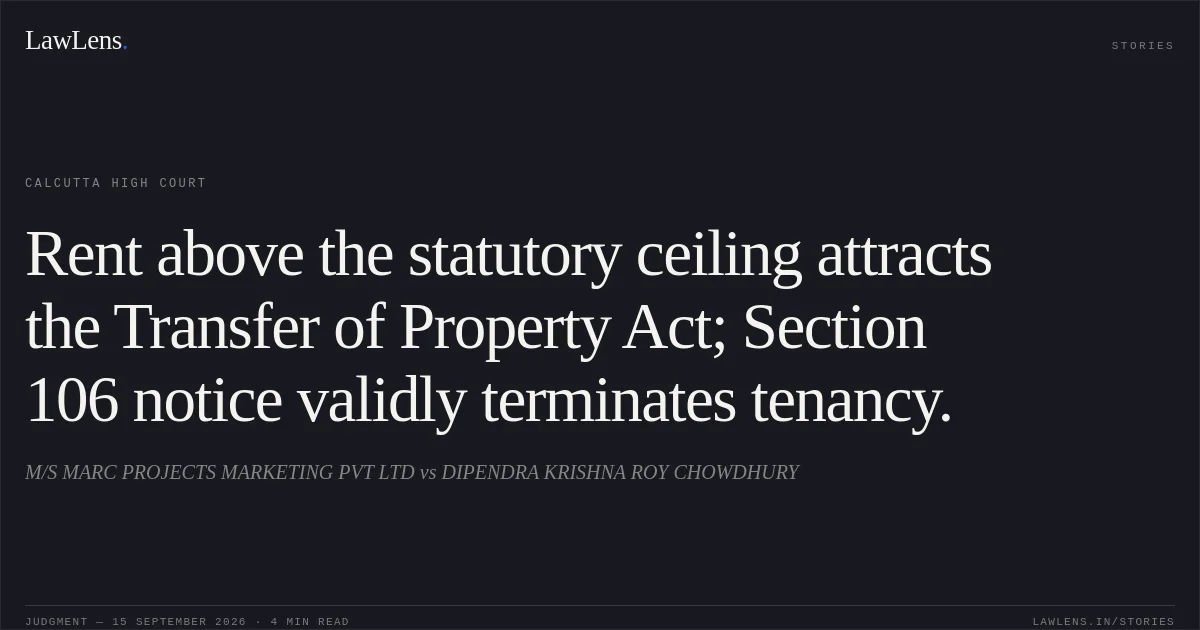
The Court applied Section 3(f)(ii) of the West Bengal Premises Tenancy Act, 1997, under which premises let for non-residential purposes beyond the prescribed rent ceiling fall outside the protection of that Act; the residuary law governing the relationship is therefore the Transfer of Property Act, 1882.
Source reference: para. 37Section 106 of the 1882 Act requires prior notice terminating a lease and providing the prescribed period for vacating; a notice giving fifteen days to vacate was held sufficient in the circumstances.
Source reference: paras. 19, 38–39The Court further applied the principle that eviction of a licensee does not require a notice under Section 106, since intimation by the licensor, including institution of a suit, is sufficient.
Source reference: paras. 16–18It relied on Calcutta Dock Labour Board v. EIC Holdings Limited , (2008) 4 CHN 308, for the proposition that an inadvertent defect in a notice is not fatal unless it goes to the root of the matter.
Source reference: para. 12The Court also applied the principles that contractual documents must be construed as a whole rather than by isolating a stray expression, and that a party may be estopped from advancing an inconsistent position after having taken a contrary stand before the Trial Court.
Source reference: paras. 29–31, 35Reasoning
The Court held that the result was the same whether the appellant was treated as a licensee or a lessee.
Source reference: no citationIf the appellant was a licensee, no notice under Section 106 was necessary, and institution of the eviction suit sufficiently communicated termination of the licence.
Source reference: paras. 16–18If the appellant was a lessee, the fifteen-day notice issued before institution of the suit substantially complied with Section 106.
Source reference: paras. 19, 38–39On the evidence, the parties’ original and supplementary agreements repeatedly referred to the appellant as a tenant, the respondent as landlord, and the payments as rent.
Source reference: paras. 23–34The reference to the premises as “license property” in one clause was merely a stray expression and could not override the documents read as a whole.
Source reference: paras. 23–34The inclusion of the appellant’s heirs, executors, administrators, legal representatives and assigns further indicated an intended heritable landlord–tenant relationship, inconsistent with a licence.
Source reference: paras. 24–27Since the rent exceeded the ceiling under Section 3(f)(ii) of the 1997 Act, the 1882 Act governed the relationship, and the termination notice was legally sufficient.
Source reference: paras. 37–39The Court also noted that the appellant had itself defended the case on the basis that it was a lessee, and could not adopt a contrary position on appeal.
Source reference: para. 35Holding
F.A.T. 228 of 2026 was dismissed as non-maintainable for lack of pecuniary jurisdiction, with liberty to the appellant to appeal before the concerned District Court against the decree dismissing its declaratory suit.
F.A.T. 229 of 2026 was dismissed on contest, and the eviction decree passed on the respondent’s counter-claim was affirmed.
Source reference: paras. 40–41The executing court was directed to proceed with the respondent’s execution case and dispose of it as expeditiously as possible.
Source reference: paras. 42–43There was no order as to costs, and CAN 1 of 2026 and CAN 2 of 2026 were disposed of consequentially.
Source reference: paras. 44–46Acts & Sections Cited
2 provisions across 2 statutes referred to in this judgment. Each provision opens on LawLens.
Transfer of Property Act, 18821
West Bengal Premises Tenancy Act, 19971
Original Court PDF
M/S MARC PROJECTS MARKETING PVT LTDvsDIPENDRA KRISHNA ROY CHOWDHURY
Click to open original judgment
Original judgment, available to read, download and summarize on LawLens.in