Facts
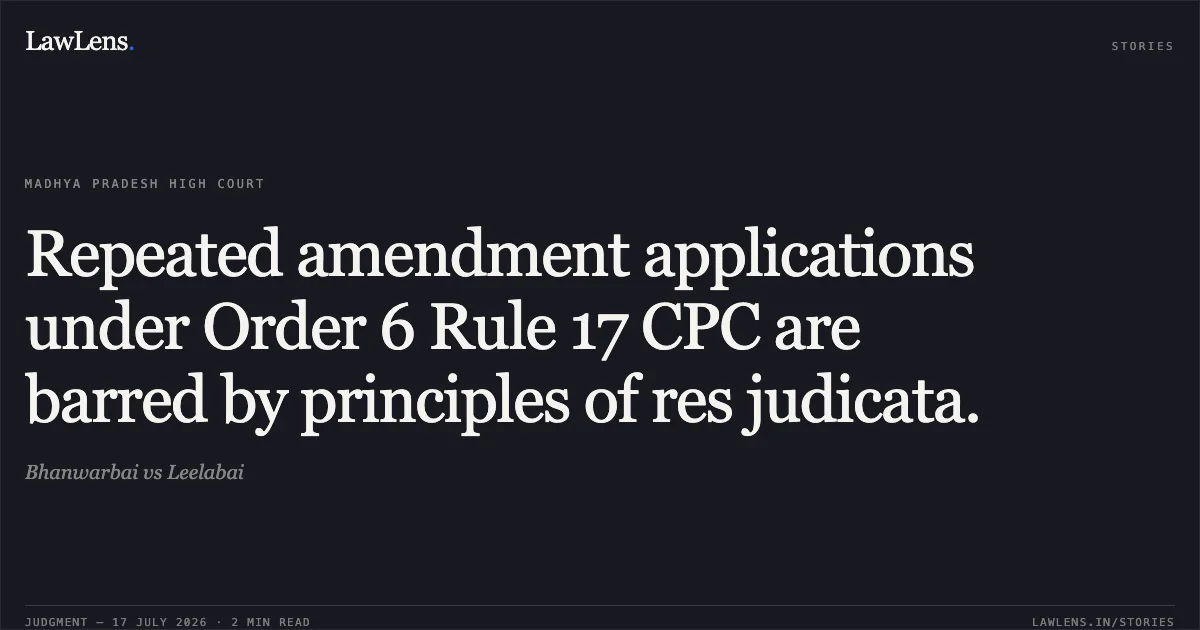
The petitioners (defendants) challenged an order dated 18.06.2026 passed by the Trial Court, which rejected their application for amendment of the written statement filed under Order 6 Rule 17 r/w Section 151 of the CPC
Source reference: para. 1Previously, the petitioners had filed a similar amendment application which was rejected; that rejection was challenged in M.P. No. 1234/2026, where the High Court granted liberty to raise grounds after examining plaintiffs at the appropriate stage
Source reference: para. 2The petitioners filed the current application asserting the amendment was necessary to determine the real questions in controversy, noting that respondents filed no reply
Source reference: para. 2The Trial Court rejected the application on the grounds that a similar application had been previously dismissed and the trial had already commenced
Source reference: paras. 2 & 6Issues
1. Whether the Trial Court committed an illegality or perversity in rejecting the application for amendment of the written statement under Order 6 Rule 17 of the CPC
Source reference: para. 72. Whether the principles of res judicata apply to successive applications for the same amendment relief during trial
Source reference: para. 6Law Applied
The Court applied Order 6 Rule 17 of the CPC, which mandates that all amendments necessary for determining the real question in controversy shall be allowed, provided that no such application be granted after the commencement of trial unless the party demonstrates "due diligence"
Source reference: para. 4Supreme Court precedent in Life Insurance Corporation of India v. Sanjeev Builder Private Limited and Another (2022) 16 SCC 1, which establishes that while courts should be liberal, amendments should be disallowed if they are mala fide, cause irreparable prejudice, or change the nature of the suit, especially after the trial has commenced
Source reference: para. 5Reasoning
The Court observed that the petitioners sought the same relief under Order 6 Rule 17 CPC that had been previously rejected by the Trial Court without the Trial Court granting specific liberty to re-file
Source reference: para. 6The High Court reasoned that the principle of res judicata is impliedly applicable to such successive applications for the same purpose
Source reference: para. 6the Court noted that the trial had already commenced and witnesses had been examined, triggering the restrictive proviso of Order 6 Rule 17
Source reference: para. 6The Court found that the application lacked the requisite showing of due diligence and appeared to be a "dilatory tactic" intended to delay the proceedings
Source reference: para. 7Consequently, the Court held that the Trial Court's decision was legally sound and did not suffer from perversity or impropriety
Source reference: para. 7Holding
The High Court dismissed the petition, holding that the Trial Court correctly rejected the amendment application as it was a repetitive request filed after the commencement of trial without sufficient justification
The Court affirmed that no grounds for interference under Article 227 of the Constitution were made out. Relief denied
Source reference: paras. 7-8Acts & Sections Cited
1 provisions across 1 statute referred to in this judgment. Each provision opens on LawLens.
Code of Civil Procedure, 19081
Original Court PDF
BhanwarbaivsLeelabai
Click to open original judgment
Original judgment, available to read, download and summarize on LawLens.in