Facts
The petitioner-detenue challenged Detention Order No. 07/DMK/PSA/2025 dated 13 December 2025, passed by the District Magistrate, Kulgam under Section 8 of the Jammu and Kashmir Public Safety Act, 1978, directing his preventive detention to prevent acts prejudicial to the maintenance of public order.
Source reference: para. 1The detention grounds referred to eleven FIRs alleging offences relating to theft of livestock/cattle under Sections 331(4) and 305 of the Bharatiya Nyaya Sanhita; charge-sheets had been filed and the detenue had been released on bail in the cases.
Source reference: para. 2The petitioner contended that the alleged conduct concerned, at most, ordinary law and order; that the bail orders relied upon by the detaining authority had not been supplied; and that the grounds, prepared in English, had not been translated into a language understood by him, thereby violating Article 22(5) of the Constitution and Section 13 of the Public Safety Act.
Source reference: para. 3The respondents maintained that the authority had independently considered the material, that the relevant documents had been supplied and explained to the detenue, and that the bail orders were referred to only to indicate the status of the criminal cases.
Source reference: para. 4Issues
Whether the detention order was based on relevant material demonstrating activities prejudicial to the maintenance of public order, or whether the allegations constituted only ordinary law-and-order violations capable of being addressed through criminal proceedings?
Source reference: paras. 6–9Whether non-supply of the bail orders invalidated the detention order by depriving the detenue of an effective opportunity to make a representation under Article 22(5) of the Constitution and Section 13 of the Public Safety Act?
Source reference: paras. 10–11Whether furnishing the grounds of detention in English, without supplying a translated copy, violated the detenue’s constitutional and statutory rights when the grounds were allegedly explained to him in a language understood by him?
Source reference: paras. 12–13Law Applied
Preventive detention under Section 8 of the Jammu and Kashmir Public Safety Act, 1978, is an exceptional and preventive measure, and must comply strictly with Article 22(5) of the Constitution and Section 13 of the Act.
Source reference: para. 6Judicial review is limited to examining whether the subjective satisfaction of the detaining authority is founded on relevant material and whether constitutional and statutory safeguards have been complied with; the Court cannot reassess the sufficiency of the material or substitute its own satisfaction.
Source reference: paras. 6–7Preventive detention may be ordered notwithstanding pending criminal proceedings where the antecedent conduct and its continuing tendency provide a rational basis for apprehending prejudicial activities.
Source reference: para. 8The distinction between “law and order” and “public order” depends on the nature, frequency, continuity and impact of the conduct on the even tempo of public life, rather than merely on the nomenclature of the offence.
Source reference: para. 9Material relied upon by the detaining authority must ordinarily be supplied to enable an effective representation, but a document not constituting independent foundational material will not necessarily invalidate detention if its substance and effect are disclosed in the grounds.
Source reference: paras. 10–11Article 22(5) requires effective communication of the grounds in a language understood by the detenue; however, compliance may be established through contemporaneous material showing that the detenue understood the grounds and was able to make an effective representation. The Court relied on Sarfaraz Alam v. Union of India, 2024 INSC 18, in this regard.
Source reference: para. 12Reasoning
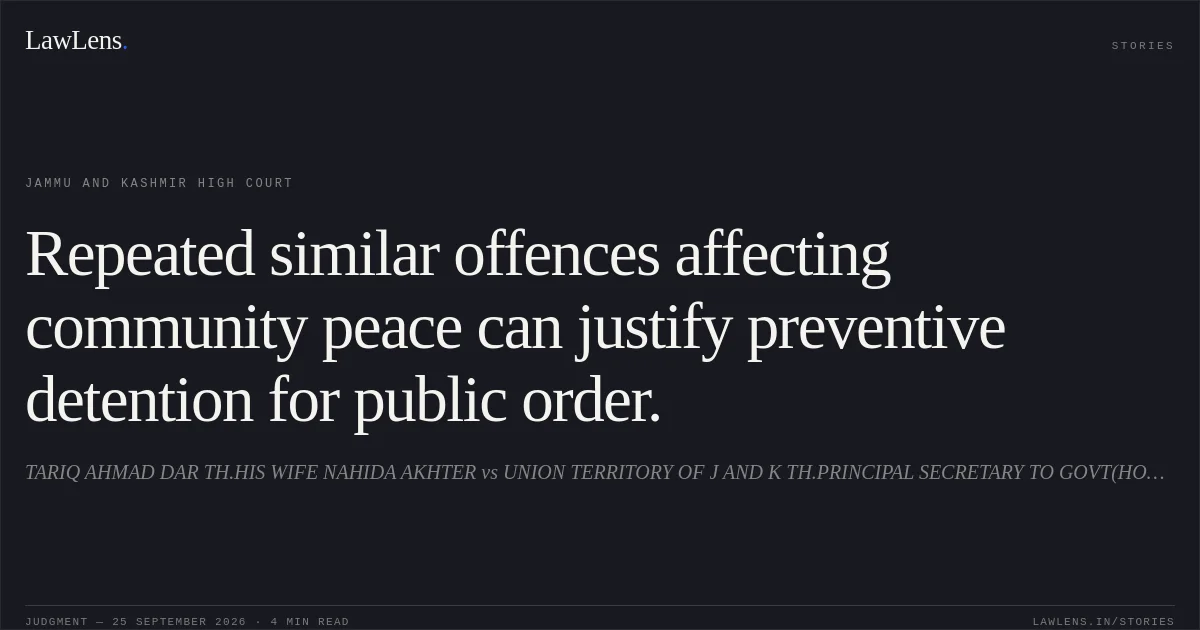
The Court held that the detaining authority had not relied on an isolated incident but had considered eleven FIRs involving similar allegations of livestock/cattle theft, together with the filing of charge-sheets and the detenue’s release on bail.
Source reference: paras. 7, 9The repeated and continuing nature of the alleged conduct was treated as relevant material supporting the apprehension of recurrence and the conclusion that the activities could disturb public order; the Court therefore declined to substitute its assessment for that of the detaining authority.
Source reference: paras. 8–9, 14The challenge based on non-supply of bail orders failed because the grounds expressly disclosed that the detenue had been granted bail, and the bail orders were not shown to constitute independent foundational material.
Source reference: paras. 10–11On the language issue, the Court accepted the respondents’ position that the detention order and grounds had been explained to the detenue in a language understood by him and that he had been informed of his right to make a representation.
Source reference: paras. 12–13In the absence of proof that any specific material remained incomprehensible or that actual prejudice was caused, the preparation of the original grounds in English was held insufficient to invalidate the detention.
Source reference: paras. 12–13The Court consequently found no reliance on irrelevant or extraneous considerations and no constitutional or statutory infirmity in the detention order.
Source reference: paras. 14–16Holding
The Court answered all issues against the petitioner. It held that the repeated involvement in similar criminal activities constituted relevant material for the detaining authority’s subjective satisfaction regarding prejudice to public order; that non-supply of the bail orders did not vitiate the detention; and that effective communication and explanation of the grounds in a language understood by the detenue satisfied Article 22(5) and Section 13 of the Public Safety Act.
The habeas corpus petition and pending application were dismissed, the detention order was upheld, and the scanned detention record was directed to be returned through counsel for the respondents.
Source reference: paras. 17–18Acts & Sections Cited
2 provisions across 1 statute referred to in this judgment. Each provision opens on LawLens.
Bharatiya Nyaya Sanhita, 20232
Original Court PDF
TARIQ AHMAD DAR TH.HIS WIFE NAHIDA AKHTERvsUNION TERRITORY OF J AND K TH.PRINCIPAL SECRETARY TO GOVT(HOME) AND OTHERS
Click to open original judgment
Original judgment, available to read, download and summarize on LawLens.in