Facts
The Respondent-Assessee, a manufacturer of cotton and blended yarns, claimed deductions for machinery replacement as revenue expenditure for Assessment Years (AY) 1996-97 (Rs. 6.19 crores) and 1997-98 (Rs. 13.10 crores)
Source reference: p. 2-3The Assessing Officer (AO) disallowed these claims, classifying the expenditures as capital in nature on the grounds that the replaced machineries were independent, sophisticated units capable of higher production
Source reference: p. 2, 7The Commissioner of Income Tax (Appeals) [CIT(A)] confirmed the AO’s order regarding new machinery but allowed deductions for specific spare parts
Source reference: p. 2, 9On further appeal, the Income Tax Appellate Tribunal (ITAT) ruled in favor of the Assessee by relying on the Madras High Court’s decision in CIT v. Janakiraman Mills Ltd., which treated replacement of worn-out machinery as "current repairs"
Source reference: p. 4The Revenue challenged the ITAT's order before the High Court
Source reference: p. 1Issues
1. Whether the replacement of machinery parts amounts to revenue expenditure or capital expenditure?
Source reference: p. 5 / para. 82. Whether bringing into existence a new asset or obtaining a new advantage through machinery replacement constitutes revenue expenditure?
Source reference: p. 5 / para. 8Law Applied
The court primarily considered Sections 32 (Depreciation) and 37(1) (Revenue Expenditure) of the Income Tax Act, 1961
Source reference: p. 7, 11It relied on the Supreme Court’s decision in CIT v. Saravana Spinning Mills (P) Ltd. [2007] 293 ITR 201, which reversed the Janakiraman Mills doctrine
Source reference: p. 12Further, the court applied the principles from CIT v. Sri Mangayarkarasi Mills (P) Ltd. (2009) 182 Taxman 141 (SC), establishing that a textile mill is not a single asset but a collection of independent entities, and replacement of such entities constitutes capital expenditure unless they qualify as "current repairs" (e.g., if parts are obsolete or several decades old)
Source reference: p. 13-14It also cited Super Spinning Mills Ltd v. ACIT (2013) 37 Taxmann.com 290 (Mad), a precedent involving the same assessee on the same issue
Source reference: p. 12, 14Reasoning
The High Court found that the ITAT's decision was based solely on the precedent of Janakiraman Mills Ltd., which has since been overruled by the Supreme Court in Saravana Spinning Mills
Source reference: p. 12-13The court noted that the "integrated plant" theory—which argued that replacing a machine within a mill is merely a repair to the whole plant—is no longer legally tenable
Source reference: p. 13Under the current legal framework established by the Supreme Court, each machine in a spinning mill is viewed as an independent entity; therefore, wholesale replacement constitutes the creation of a new asset rather than "current repairs"
Source reference: p. 13-14Because the ITAT relied on an overruled judgment and failed to conduct an independent factual analysis of the machinery in question, its order was unsustainable
Source reference: p. 13Holding
The High Court allowed the appeals in part, setting aside the ITAT’s order
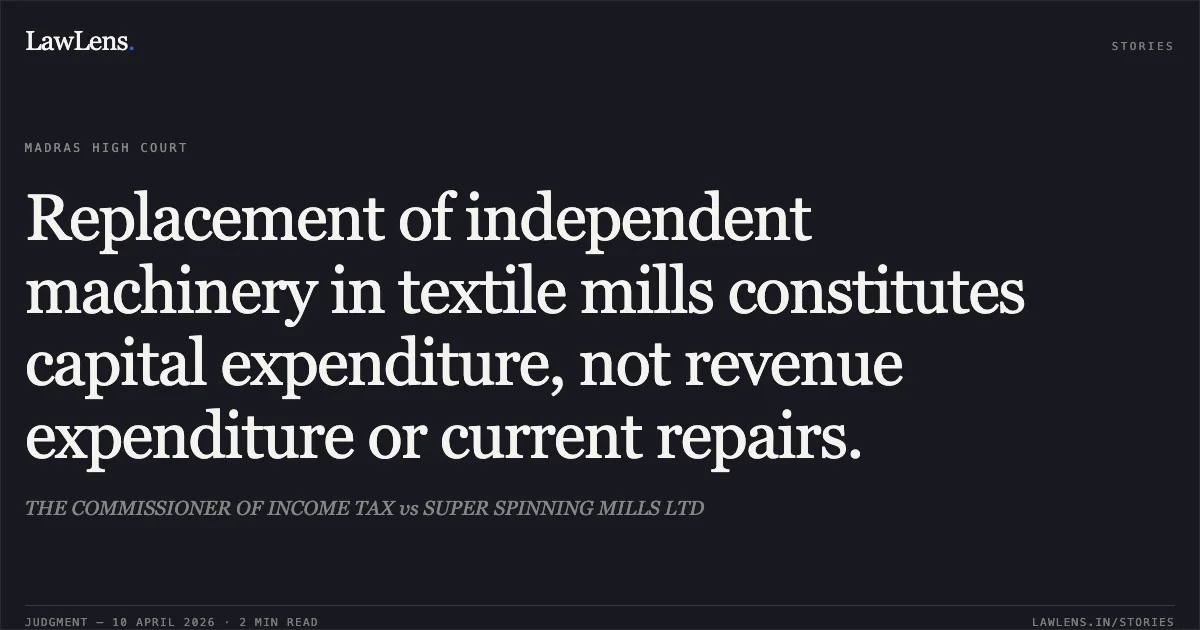
The court held that the replacement of independent machinery cannot be summarily treated as revenue expenditure based on overruled precedents
Source reference: p. 13The matter was remanded to the Appellate Authority (CIT(A)) for a fresh hearing to allow the Assessee to provide evidence justifying why specific replacements should be treated as revenue expenditure under the strict guidelines set by the Supreme Court and the 2013 Super Spinning Mills decision
Source reference: p. 14No order as to costs was made
Source reference: p. 15Acts & Sections Cited
7 provisions across 2 statutes referred to in this judgment. Linked provisions open on LawLens.
Income Tax Act, 19616
Income Tax Act, 19221
Original Court PDF
THE COMMISSIONER OF INCOME TAXvsSUPER SPINNING MILLS LTD
Click to open original judgment
Original judgment, available to read, download and summarize on LawLens.in