01Facts
The appellant-developer was constructing the registered group housing project “Lav Kush Apartment.” The respondent-allottee booked Flat No. 602 on 8 September 2014, and an allotment letter was issued on 18 September 2014.
¶ 3–6Against the total sale consideration of ₹1,15,97,000, the respondent paid ₹72,30,000 but allegedly failed to pay the balance despite repeated demands. The appellant cancelled the allotment on 26 October 2019. However, in its subsequent reply dated 5 December 2019, the appellant called upon the respondent to pay the balance consideration and execute the sale deed.
¶ 3–6The Regulatory Authority directed the appellant to refund ₹72,30,000, without awarding interest, by order dated 26 November 2020; the amount was refunded on 8 January 2021.
¶ 3–6The respondent appealed before the Uttar Pradesh Real Estate Appellate Tribunal seeking interest under Section 18 of the Real Estate (Regulation and Development) Act, 2016. The Tribunal set aside the Regulatory Authority’s order and remanded the complaint for determination of the legality and validity of the cancellation dated 26 October 2019 under Section 11(5) of the Act.
¶ 7–10The developer challenged the remand order before the High Court under Section 58 of the Act.
¶ 1102Issues
i.Whether the appeal under Section 58 of the Act was maintainable in the absence of a substantial question of law under Section 100 of the Code of Civil Procedure, 1908.
¶ 21–27ii.Whether the Tribunal exceeded the pleadings and the relief sought by remanding the matter for determination of the legality and validity of the cancellation dated 26 October 2019.
¶ 12–14, 28–35iii.Whether the Tribunal was justified in remanding the complaint to determine the effect of the cancellation and the appellant’s subsequent offer to permit payment of the balance consideration and execution of the sale deed.
¶ 34–36iv.Whether the appellant’s grounds concerning limitation, alleged prejudice arising from subsequent transfer of the unit, and the alleged delay in filing the respondent’s appeal raised a substantial question of law warranting interference.
¶ 13–15, 39–4003Law Applied
Section 58 of the Real Estate (Regulation and Development) Act, 2016 permits an appeal to the High Court only on one or more grounds specified in Section 100 CPC; therefore, the existence of a substantial question of law is essential, and Section 58(2) bars an appeal from an order made with the consent of the parties.
¶ 21Under Sir Chunilal Mehta & Sons Ltd. v. Century Spinning & Manufacturing Co. Ltd. , a substantial question of law must be substantial, debatable, and materially affect the parties’ rights; a settled legal principle applied to the facts ordinarily does not qualify.
¶ 24Hero Vinoth v. Seshammal similarly holds that the question must be real, important, and open to debate, rather than technical or merely factual.
¶ 25Order XLI Rule 23 CPC, as amended in Uttar Pradesh, permits remand where the appellate court considers it necessary in the interest of justice; appellate courts also possess power to remand where a complete and proper adjudication requires it.
¶ 29–32Section 11(5) of the Act permits an allottee to challenge a unilateral, unjustified, or contractually impermissible cancellation, while Section 18 governs the allottee’s entitlement to refund, interest, or compensation in cases covered by the statute.
¶ 34–35Provisions in the judgment · 9 · Linked ones open on LawLens
Real Estate (Regulation and Development) Act, 2016. Section 2Section 11Section 13Section 18Section 58Section 88
Limitation Act, 1963 Section 29
Code of Civil Procedure, 1908 Section 100Section 109
04Reasoning
The High Court held that the legality of the cancellation was not an extraneous issue but went to the root of the respondent’s claim for interest under Section 18.
¶ 34–36The Regulatory Authority had ordered refund without deciding whether the cancellation dated 26 October 2019 was valid, final, or affected by the appellant’s subsequent communication dated 5 December 2019 offering the respondent an opportunity to pay the balance and execute the sale deed.
¶ 34–36Since the respondent had questioned the cancellation in the proceedings and Section 11(5) expressly contemplated such a challenge, the Tribunal did not travel beyond the pleadings by directing adjudication of that issue.
¶ 35The remand did not finally determine the parties’ rights and caused no irreversible prejudice because the appellant remained free to raise all available objections before the Regulatory Authority.
¶ 17, 37–39The questions raised regarding limitation, alleged prejudice, and the merits of cancellation either remained factual or were matters for determination after remand; they did not constitute substantial questions of law under Section 58.
¶ 33, 38–4005Holding
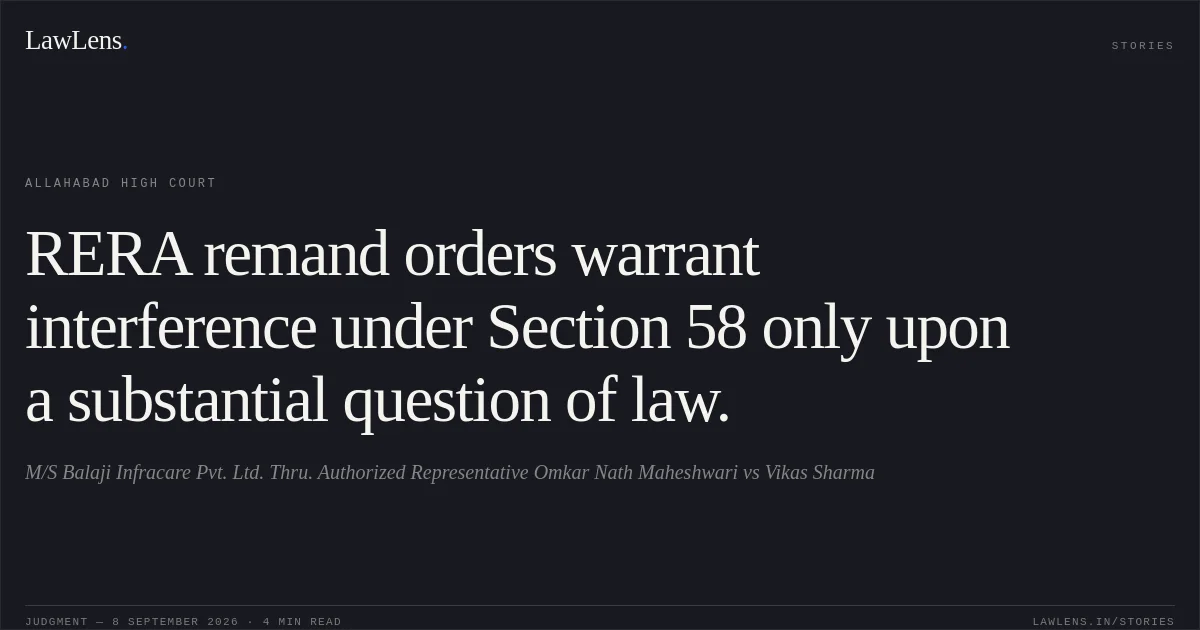
The High Court dismissed the appeal, holding that the Tribunal rightly set aside the Regulatory Authority’s order and remanded the complaint for a fresh determination of the legality and validity of the cancellation dated 26 October 2019 under Section 11(5) of the Act.
¶ 38–41The Regulatory Authority was directed to decide the matter on merits after affording both parties an opportunity of hearing.
¶ 38–41The High Court declined to adjudicate the parties’ other contentions, including limitation and the ultimate effect of the appellant’s subsequent communication, leaving those issues open for consideration upon remand.
¶ 36, 39–41No order as to costs was made.
¶ 41Original Court PDF
M/S Balaji Infracare Pvt. Ltd. Thru. Authorized Representative Omkar Nath MaheshwarivsVikas Sharma
Click to open original judgment
Original judgment, available to read, download and summarize on LawLens.in