Facts
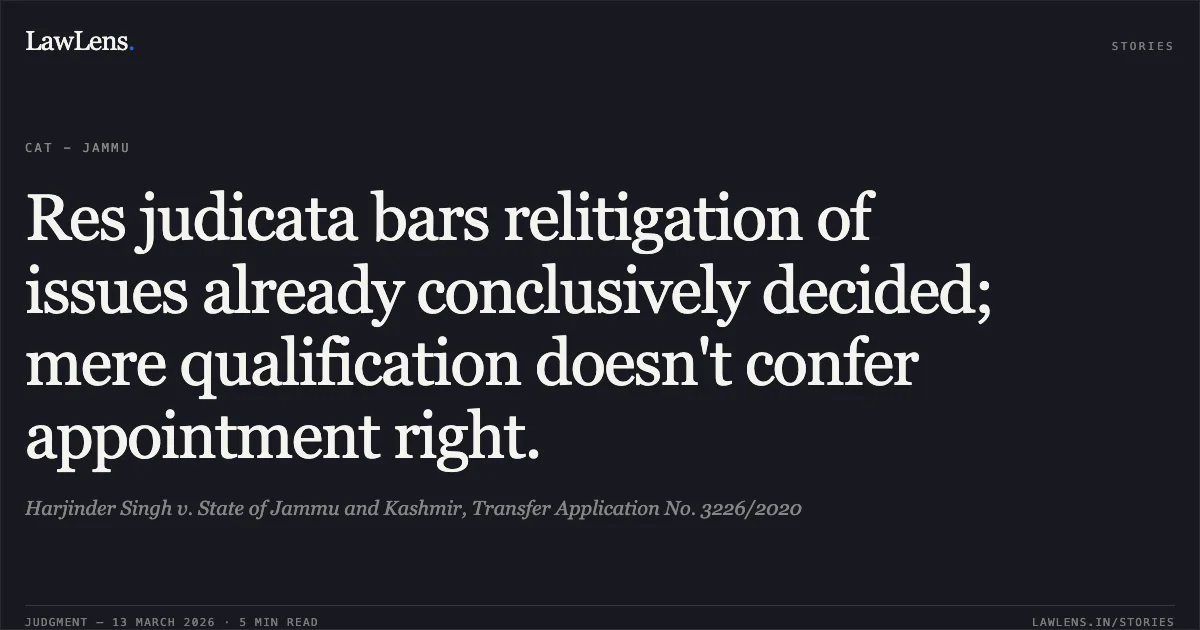
The applicant, Harjinder Singh, filed SWP No. 873/2017 before the High Court of Jammu and Kashmir at Jammu, which was later transferred and registered as T.A. No. 3226/2020 before the Central Administrative Tribunal, Jammu Bench.
Source reference: para. 1, 3aThe applicant, qualified with 10+2 with science and a graduation from the University of Jammu, claimed eligibility for the post of Forester under the Jammu and Kashmir Forest (Subordinate) Service Recruitment Rules, 1991 (SRO 335 of 1991), which stipulated 10+2 with science subjects as the minimum qualification.
Source reference: para. 3bThe applicant's grievance centered on the appointment of respondent Nos. 6 and 7 as Foresters.
Source reference: para. 3cRespondent No. 6 was appointed vide Government Order No. 1136-GAD of 2001 dated 03.10.2001, and respondent No. 7 vide Government Order No. 1312-GAD of 2002 dated 02.08.2002.
Source reference: para. 3cThe applicant alleged these appointments violated recruitment rules and lacked a proper selection process, specifically highlighting that respondent No. 6 was only a matriculate and 11th-class qualified without science subjects, failing to meet the prescribed 10+2 with science subjects requirement.
Source reference: para. 3c, 3dThe applicant had previously challenged these initial appointments in SWP No. 2453/2002.
Source reference: para. 3fThis petition was dismissed by a Single Judge on 29.03.2016, primarily because respondent No. 6 had already been permanently absorbed and the regularization order was not challenged.
Source reference: para. 3fThe subsequent Letters Patent Appeal No. 86/2016 was dismissed by the Division Bench on 01.12.2016, but with liberty for the applicant to challenge subsequent regularization orders if permissible in law.
Source reference: para. 3f, 8Following this liberty, the applicant filed the present proceedings, challenging the regularization of respondent No. 6 via a Finance Department Notification dated 30.08.2013, and respondent No. 7 via Government Order No. 514-FST of 2012 dated 31.12.2012.
Source reference: para. 3gThe applicant contended that since the initial appointments were illegal, their regularization was also illegal and sought quashing of these orders, or alternatively, a direction for his own appointment as Forester with consequential benefits.
Source reference: para. 3g, 3iThe respondents countered, asserting that the application was barred by res judicata as the core dispute had been finally adjudicated.
Source reference: para. 4a, 10They stated that respondent Nos. 6 and 7 were ad-hoc appointees whose services were later regularized under the Jammu and Kashmir Civil Services (Special Provisions) Act, 2010, after fulfilling its conditions.
Source reference: para. 4b, 9They argued that merely possessing higher qualifications does not confer a right to appointment.
Source reference: para. 4c, 10The department had also previously rejected the applicant's representation.
Source reference: para. 4dIssues
Whether the present application, challenging the regularization of respondent Nos. 6 and 7, is barred by the principles of res judicata, given the dismissal of the applicant's earlier challenge to their initial appointments?
Source reference: para. 4a, 8Whether the regularization of respondent Nos. 6 and 7, after two decades of service and under the Jammu and Kashmir Civil Services (Special Provisions) Act, 2010, can be disturbed at this stage?
Source reference: para. 9, 12Whether the applicant, merely by possessing the requisite qualification, has a right to be appointed to the post of Forester without undergoing a prescribed selection process?
Source reference: para. 4c, 10Whether an applicant can seek appointment on the analogy of allegedly illegal or irregular appointments made to other individuals?
Source reference: para. 11Law Applied
The court primarily applied the principle of res judicata, emphasizing that a dispute once finally adjudicated by a competent court cannot be reopened in subsequent proceedings, even if disguised under a different form, to ensure finality of litigation.
Source reference: para. 8, 13It also considered the legal principle that mere possession of qualifications does not confer a right to appointment; instead, appointment requires participation and selection through a prescribed recruitment process.
Source reference: para. 10Furthermore, the court applied the doctrine that an illegal or irregular appointment cannot serve as a precedent for claiming similar benefits.
Source reference: para. 11The court also acknowledged the legal framework of the Jammu and Kashmir Civil Services (Special Provisions) Act, 2010, which provided for the regularization of long-serving ad-hoc appointees.
Source reference: para. 4b, 9Finally, the court relied on the established judicial principle against disturbing settled service matters after a significant lapse of time, especially when employees have been regularized and served for many years.
Source reference: para. 12Reasoning
The Tribunal found that the applicant's present challenge to the regularization orders of respondent Nos. 6 and 7 was a continuation of the earlier dispute regarding their appointments, which had already attained finality through the dismissal of SWP No. 2453/2002 and Letters Patent Appeal No. 86/2016.
Source reference: para. 7, 8The principle of res judicata squarely applied, preventing the applicant from reopening the same issue under a different form, thereby ensuring the finality of litigation.
Source reference: para. 8The court emphasized that the appointments of respondent Nos. 6 and 7 were made over two decades ago, and their services were subsequently regularized under the Jammu and Kashmir Civil Services (Special Provisions) Act, 2010, a statutory framework designed to address long-standing ad-hoc appointments.
Source reference: para. 9, 12Disturbing their settled service positions after such a long lapse of time and regularization under law was deemed unjustified.
Source reference: para. 9, 12Furthermore, the Tribunal reiterated that the mere possession of educational qualifications does not confer an automatic right to appointment; instead, it only entitles one to participate in a prescribed selection process when a post is advertised.
Source reference: para. 10The applicant admittedly had not undergone any such recruitment process for the post of Forester.
Source reference: para. 10Lastly, the court held that an illegal or irregular appointment cannot be used as a precedent to claim a similar appointment, rendering the alternative relief sought by the applicant legally untenable.
Source reference: para. 11Holding
The Transfer Application was dismissed for being devoid of merit.
The Tribunal held that the claim was barred by res judicata, the settled service positions of respondent Nos. 6 and 7 could not be disturbed after a significant lapse of time and regularization under the Jammu and Kashmir Civil Services (Special Provisions) Act, 2010, and the applicant had no right to appointment merely based on qualification or by seeking parity with allegedly irregular appointments.
Source reference: para. 8, 9, 10, 11, 12No order as to costs was made.
Source reference: para. 15Original Court PDF
Harjinder Singh v. State of Jammu and Kashmir, Transfer Application No. 3226/2020
Click to open original judgment
Original judgment, available to read, download and summarize on LawLens.in