Facts
The appellant was appointed as a daily-wage employee in the Revenue Department of the Municipal Corporation, Katni, on 26 June 1995 and allegedly worked continuously for more than 240 days.
Source reference: para. 3; p. 1His services, along with those of 272 other employees, were terminated with effect from 2 August 1999 without compliance with the applicable labour-law requirements, including Section 25F of the Industrial Disputes Act, 1947.
Source reference: para. 3; p. 1The appellant pursued proceedings before the High Court, and the matter was eventually remanded for consideration by the Commissioner, Municipal Corporation, Katni.
Source reference: paras. 4–7; pp. 1–3The Commissioner allegedly failed to adjudicate the claim, compelling the appellant to approach the Labour Court.
Source reference: paras. 4–7; pp. 1–3The Labour Court granted relief by ordering reinstatement but denied back wages.
Source reference: no citationThe Municipal Corporation challenged that decision before the High Court.
Source reference: no citationBy order dated 16 January 2024 in Miscellaneous Petition Nos. 5852 of 2022 and 6047 of 2023, the writ Court allowed the petition filed by the respondent-Municipal Corporation and dismissed the appellant’s petition, principally relying on res judicata.
Source reference: paras. 2, 7–9; pp. 1–3The appellant preferred the present writ appeals.
Source reference: paras. 2, 7–9; pp. 1–3The Division Bench also noted that similarly situated employees, including Sudhir Kumar Khare and Pramod Kumar Khare, had ultimately obtained relief and were regularized.
Source reference: para. 11; p. 3Issues
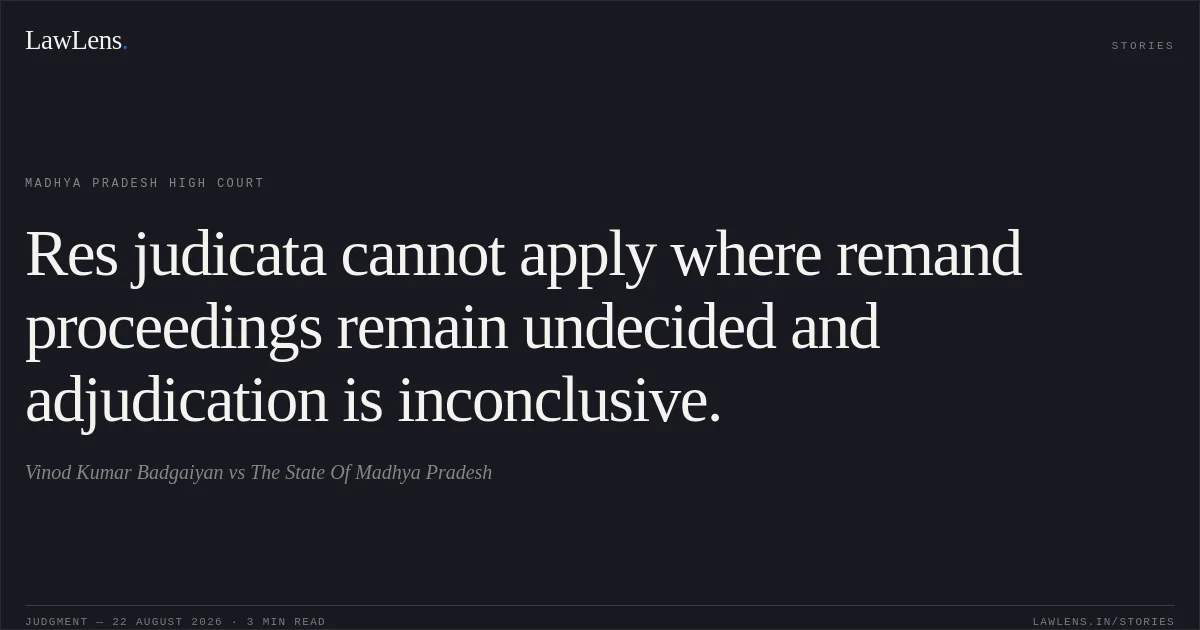
Whether the writ Court erred in applying the doctrine of res judicata to the appellant’s claim when the earlier proceedings had merely remanded the matter to the Commissioner and had not resulted in a final adjudication on the merits.
Source reference: paras. 12–13; p. 4Whether the order dated 16 January 2024, which interfered with the Labour Court’s order and dismissed the appellant’s claim, was liable to be set aside.
Source reference: paras. 2, 7–9, 14; pp. 1–3, 5Whether the appellant was entitled to parity of treatment with similarly situated employees who had been reinstated or regularized.
Source reference: paras. 5–8, 11; pp. 2–3Law Applied
The Court applied Section 11 of the Code of Civil Procedure, 1908, which embodies the doctrine of res judicata and bars re-litigation only where an issue has been directly and substantially in issue and has been finally heard and decided by a competent court.
Source reference: paras. 12–13; p. 4The Court also considered the appellant’s reliance on Section 25F of the Industrial Disputes Act, 1947, which requires compliance with conditions precedent before retrenchment of a qualifying workman, although the appeals were ultimately decided on the issue of res judicata.
Source reference: paras. 3, 6; pp. 1–2The governing principle was that a prior proceeding resulting only in a remand or referral for consideration, without a final determination on the merits, does not attract res judicata.
Source reference: paras. 12–13; p. 4Reasoning
The Division Bench held that the earlier proceedings had not finally adjudicated the appellant’s entitlement.
Source reference: para. 13; p. 4The matter had been remanded to the Commissioner, Municipal Corporation, Katni, but the Commissioner did not consider or decide the claim; consequently, the appellant’s substantive rights remained unresolved.
Source reference: para. 13; p. 4Since there was no final decision after due consideration of the issues, the essential requirement for applying Section 11 CPC was absent.
Source reference: paras. 12–13; p. 4The writ Court therefore erred by treating the earlier proceedings as creating a bar of res judicata.
Source reference: paras. 12–13; p. 4The Court also took into account the appellant’s prolonged litigation of more than 26 years and the treatment accorded to similarly situated employees.
Source reference: para. 11; p. 3Holding
The Court answered the res judicata issue in favour of the appellant, holding that the earlier remand proceedings did not constitute a final adjudication and therefore did not bar the appellant’s claim under Section 11 CPC.
Both writ appeals were allowed.
Source reference: para. 14; p. 5The order dated 16 January 2024 passed in Miscellaneous Petition Nos. 5852 of 2022 and 6047 of 2023 was set aside, and the petitions were restored to the file of the writ Court.
Source reference: para. 14; p. 5The parties were directed to appear before the writ Court, which was requested to decide the matters expeditiously in view of the litigation having continued for more than 26 years.
Source reference: para. 15; p. 5Acts & Sections Cited
1 provisions across 1 statute referred to in this judgment. Each provision opens on LawLens.
Code of Civil Procedure, 19081
Original Court PDF
Vinod Kumar BadgaiyanvsThe State Of Madhya Pradesh
Click to open original judgment
Original judgment, available to read, download and summarize on LawLens.in