Facts
The petitioner-employee challenged the order dated 23 December 2019 passed by the Industrial Tribunal/Labour Court (3), Vadodara, in Misc. Application No. 32 of 2019 arising from Reference (LCV) No. 537 of 1997 and Recovery Application No. 307 of 2014.
Source reference: paras. 5–6; pp. 2–3The employee’s termination reference had been partly allowed on 10 August 2001, with directions for reinstatement and payment of 50% back wages.
Source reference: paras. 5–6; pp. 2–3The employer subsequently filed restoration applications in 2005 and 2015, both of which were dismissed for default on 21 February 2005 and 22 August 2015 respectively.
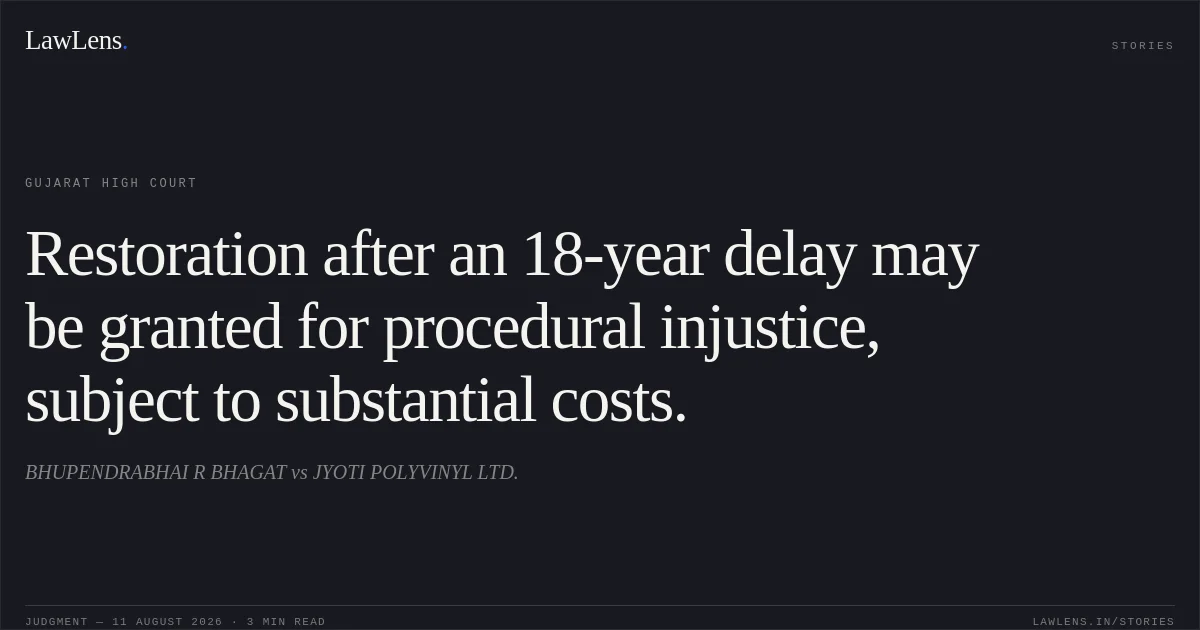
Source reference: paras. 6, 9; pp. 3, 6In 2019, the employer filed a third restoration application seeking condonation of approximately 18 years’ delay.
Source reference: para. 5; p. 2The Labour Court condoned the delay but imposed costs of only Rs. 27,000.
Source reference: para. 5; p. 2Issues
Whether the Labour Court was justified in condoning the employer’s delay of approximately 18 years in seeking restoration of the reference proceedings, in the circumstances of the case.
Source reference: paras. 9–11; pp. 5–7Whether the costs imposed by the Labour Court for condoning the delay were inadequate and liable to be enhanced.
Source reference: paras. 5, 11–12; pp. 2, 7–9Whether appropriate directions should be issued for expeditious disposal of the restored reference proceedings.
Source reference: para. 12; p. 9Law Applied
The Court applied Rule 26-A of the Industrial Disputes (Gujarat) Rules, 1966, governing applications for setting aside an ex parte award or restoration of proceedings.
Source reference: para. 10; p. 7The governing principle is that a litigant seeking relief after substantial delay must establish “sufficient cause”; although the expression is not exhaustively defined, it must be assessed on the facts and circumstances of each case.
Source reference: para. 10; p. 7Where proceedings are concluded without formally closing the relevant stages of cross-examination or evidence, and without giving the affected party proper notice, the resulting award may be treated as ex parte and restoration may be justified.
Source reference: paras. 9–12; pp. 5–9Delay may nevertheless be balanced by imposing compensatory or deterrent costs, particularly where the opposing workman has been subjected to prolonged and repeated litigation.
Source reference: paras. 9–12; pp. 5–9Reasoning
The High Court accepted that the employer had been negligent, having failed to prosecute its restoration applications filed in 2005 and 2015, and that the delay of 18 years was “huge”.
Source reference: paras. 9, 11; pp. 6–8The record disclosed a procedural defect in the original adjudication: the Labour Court had neither closed the employee’s further cross-examination nor the employer’s evidence, and had not issued notice before deciding the reference.
Source reference: para. 11; p. 7These circumstances constituted sufficient cause for restoration despite the delay.
Source reference: para. 11; p. 7At the same time, the employee had been compelled to contest repeated restoration proceedings and was also facing separate litigation concerning a subsequent termination.
Source reference: paras. 11–12; pp. 8–9The cost of Rs. 27,000 was therefore disproportionate to the prejudice caused and was considered too meagre.
Source reference: paras. 11–12; pp. 8–9The Court balanced the employer’s right to an opportunity to contest the reference against the employee’s right to compensation for prolonged litigation by enhancing the costs to Rs. 1,00,000.
Source reference: paras. 11–12; pp. 8–9Holding
The petition was partly allowed.
The High Court upheld the restoration of the reference but modified the order dated 23 December 2019 by increasing the costs payable by the employer from Rs. 27,000 to Rs. 1,00,000.
Source reference: para. 12; p. 9The employer was directed to deposit the amount within four weeks, failing which the benefit of restoration would not operate.
Source reference: para. 12; p. 9Upon deposit, the restored reference was to be completed by the Labour Court within two months, with both parties directed to cooperate and avoid unnecessary adjournments.
Source reference: para. 12; p. 9The deposited amount was directed to be disbursed to the employee after following due process.
Source reference: para. 13; p. 10The Labour Court was directed to decide the reference independently and without being influenced by the earlier award dated 10 August 2001.
Source reference: para. 13; p. 10Original Court PDF
BHUPENDRABHAI R BHAGATvsJYOTI POLYVINYL LTD.
Click to open original judgment
Original judgment, available to read, download and summarize on LawLens.in