Facts
The Appellant/Plaintiff was employed by the Respondent Company from 1993 to 2003, reaching the position of Engineering Manager
Source reference: para 3Due to financial difficulties in FY 2002-03, the Company implemented a salary reduction on a graded scale; the Appellant’s salary was reduced by 30% (Rs. 24,000 per month) for one year
Source reference: para 4-5The Appellant alleged this was a "deferment" to be repaid by April 2003, along with a one-month bonus
Source reference: para 6The Respondent contended the reduction was a "restructuring" accepted by the Appellant without a promise of repayment
Source reference: para 14The Appellant resigned in December 2003 and received a full and final settlement
Source reference: para 30, 45He filed a suit for recovery of Rs. 4,99,649 in March 2006
Source reference: para 2, 46The trial court dismissed the suit on April 20, 2024, leading to this appeal
Source reference: para 1, 22Issues
1. Whether the Appellant established a contractual provincial arrangement making the reduced component of his salary and a bonus legally recoverable as "deferred salary."
Source reference: p. 5, Issue (i) / para 222. Whether the salary reduction constituted a temporary restructuring accepted by the employee rather than a legally binding deferment.
Source reference: para 36, 54Law Applied
Sections 91 and 92 of the Indian Evidence Act, 1872, which exclude oral evidence when the terms of a contract have been reduced to the form of a document
Source reference: para 43-44The principle of Contractual Interpretation, emphasizing that internal management discussions (admissible under Section 88-A of the Evidence Act for authenticity) do not supersede formal written contracts unless they create a specific binding obligation
Source reference: para 51, 53The precedent in M/s Aithent Technologies Pvt. Ltd. v. Archana Verma (RFA 608/2014), which rejected similar claims arising from the same restructuring exercise
Source reference: para 28Reasoning
The Court found that the Appellant failed to produce any written document or Board Resolution proving that the salary reduction was a deferment
Source reference: para 37-38Conversely, the Respondent produced a signed document (Ex. PW-1/D1) titled "re-structure" of remuneration as an "interim measure," which contained no promise of repayment
Source reference: para 41-42Under Sections 91 and 92 of the Evidence Act, the Appellant was barred from leading oral evidence to contradict the written terms of this restructuring letter
Source reference: para 43-44Furthermore, the Appellant’s separation documents in 2003, signed without protest, were silent on any outstanding arrears
Source reference: para 45Even e-mails from the CEO using the word "deferred" were deemed unilateral and insufficient to create a binding legal obligation
Source reference: para 48The Court concluded that internal discussions about bonuses or reviews for lower-salary slabs did not extend a legally enforceable right to the Appellant
Source reference: para 51, 53Holding
The Court answered the issues in the negative, holding that the Appellant failed to establish a contractual right to the claimed amounts
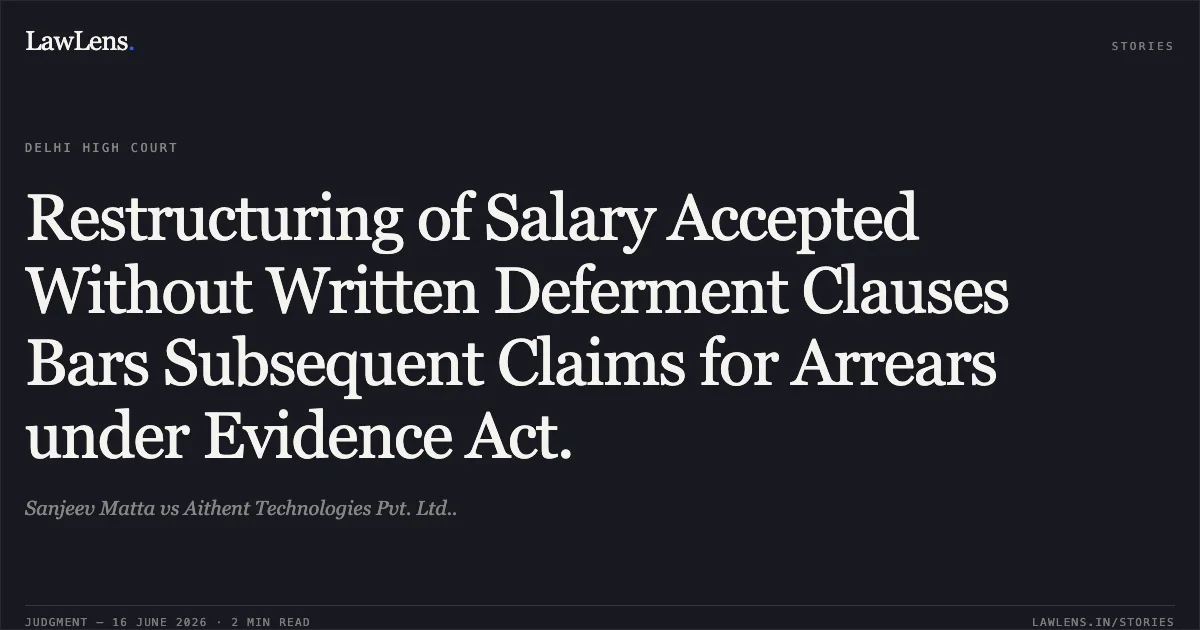
The High Court upheld the Trial Court’s findings, ruling that the salary reduction was a mutually accepted restructuring and not a deferment
Source reference: para 42, 54The Appeal (RFA 647/2024) was dismissed, and the dismissal of the suit for recovery was affirmed
Source reference: para 55Acts & Sections Cited
1 provisions across 1 statute referred to in this judgment. Each provision opens on LawLens.
Code of Civil Procedure, 19081
Original Court PDF
Sanjeev MattavsAithent Technologies Pvt. Ltd..
Click to open original judgment
Original judgment, available to read, download and summarize on LawLens.in