Facts
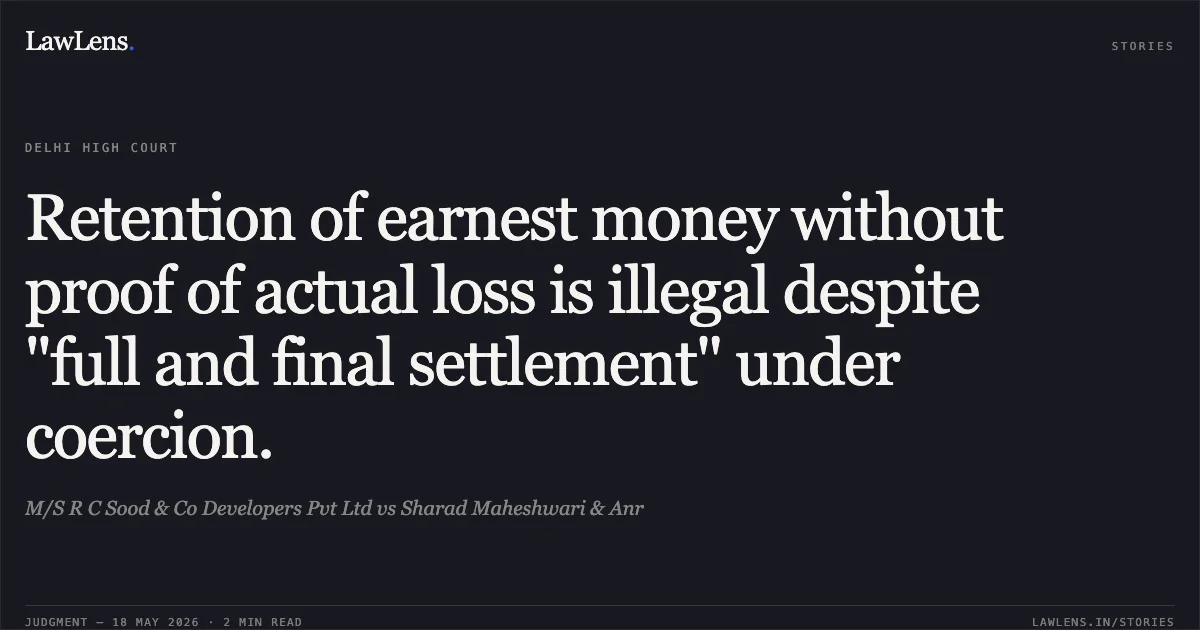
The Respondents (Plaintiffs) entered into an Agreement to Sell (ATS) dated 27.02.2008 with the Appellant (Defendant) for a villa in Gurgaon for ₹2.5 Crores
Source reference: p.2The Respondents paid a total of ₹62 Lakhs
Source reference: p.2The Appellant cancelled the allotment on 09.03.2009, citing non-payment of instalments, and forfeited the earnest money
Source reference: p.3, 24After failed negotiations for an alternative villa, the Appellant refunded ₹44 Lakhs on 27.06.2009, asserting a "Full and Final Settlement," while retaining ₹18 Lakhs
Source reference: p.5The Respondents accepted the amount "under protest" via email on 30.06.2009, alleging the settlement was signed under coercion
Source reference: p.5-6The Trial Court decreed the suit in favor of the Respondents for ₹18 Lakhs with interest
Source reference: p.2The Appellant challenged this decree in the High Court.
Source reference: no citationIssues
1. Whether the cancellation of the villa allotment vide letter dated 09.03.2009 was legal and justified
Source reference: p.9, para. 36(i)2. Whether the "Full and Final Settlement" and receipt of ₹44 Lakhs were executed voluntarily or under undue influence and coercion
Source reference: p.9, para. 36(iii)-(iv)3. Whether the Appellant was entitled to forfeit ₹18 Lakhs as earnest money/liquidated damages
Source reference: p.9, para. 36(ii)Law Applied
The Court applied Section 16 (Undue Influence) and Section 74 (Compensation for breach of contract) of the Indian Contract Act, 1872
Source reference: p.29, para. 114It relied on the principle of Necessitas non habet legem (necessity knows no law) as recognized in Ambika Construction v. Union of India and MD, NTPC Ltd. v. Reshmi Constructions, which holds that a settlement signed under economic duress or unequal bargaining power does not constitute valid "accord and satisfaction"
Source reference: p.17, 28Furthermore, per Kailash Nath Associates v. DDA, the Court applied the rule that forfeiture of earnest money requires proof of actual loss or damage
Source reference: p.14, 29Reasoning
The Court observed that the payment schedule was construction-linked, not merely time-linked, as the ATS sequencing was "indicative" of construction progress
Source reference: p.21, para. 78The Appellant failed to prove that the construction milestones were met or that Demand Notices were served via Registered AD as mandated by Clause 45
Source reference: p.22-23Consequently, the Respondents were not in default, making the cancellation illegal
Source reference: p.24, para. 96Regarding the settlement, the Court found the Appellant held a dominant position by withholding ₹62 Lakhs, leaving the Respondents vulnerable
Source reference: p.28, para. 110-111The Respondents’ immediate protest via email after encashing the cheque evidenced a lack of free consent
Source reference: p.27, para. 107Finally, the Court held that the Appellant provided no evidence of financial loss to justify the forfeiture of ₹18 Lakhs under Section 74, rendering the retention of funds an illegal penalty rather than liquidated damages
Source reference: p.30, para. 117-118Holding
The High Court dismissed the appeal and upheld the Trial Court’s judgment
It held that the cancellation was arbitrary and the settlement was vitiated by undue influence
Source reference: p.25, 29The Court directed the Appellant to refund the balance of ₹18,00,000/- along with pendente lite and future interest @ 6% per annum
Source reference: p.31, para. 120-121Acts & Sections Cited
2 provisions across 2 statutes referred to in this judgment. Each provision opens on LawLens.
Code of Civil Procedure, 19081
Indian Contract Act, 18721
Original Court PDF
M/S R C Sood & Co Developers Pvt LtdvsSharad Maheshwari & Anr
Click to open original judgment
Original judgment, available to read, download and summarize on LawLens.in