01Facts
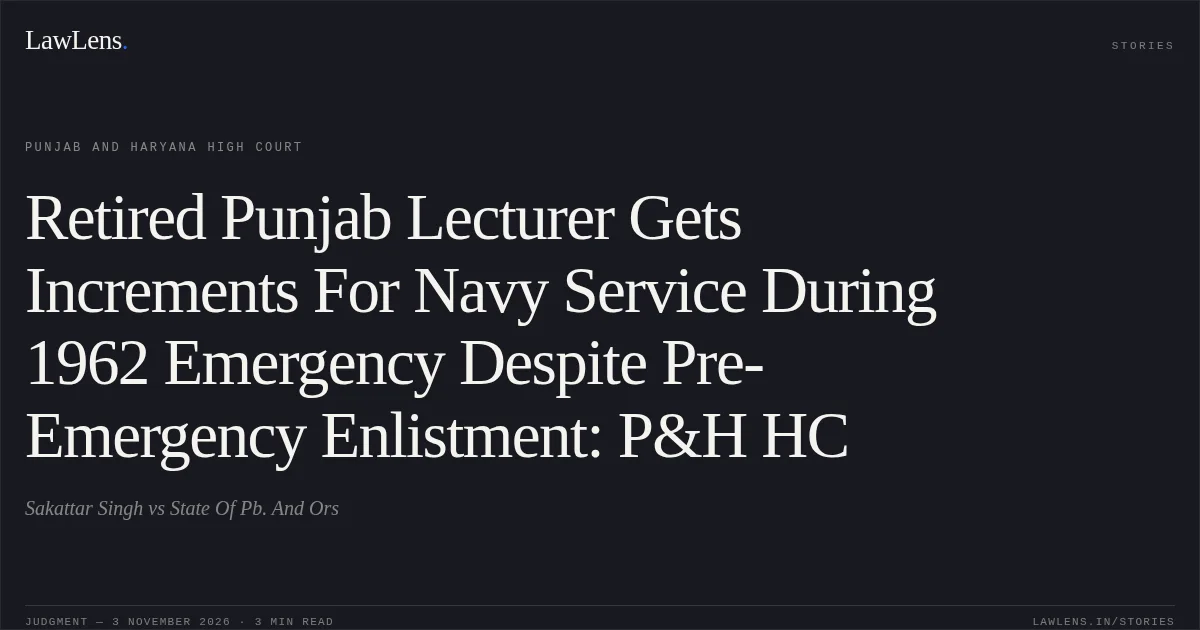
The petitioner served in the Indian Navy from 7 July 1960 to 6 July 1970, including part of the period of the first National Emergency.
p. 1After discharge, he worked as an ad hoc Lecturer in English at several government colleges and was appointed as a regular Lecturer on 30 July 1976.
p. 1The State rejected his claim for the benefit of military service under the Punjab Government National Emergency (Concession) Rules, 1965 (“1965 Rules”) by order dated 1 May 2000; he challenged that order under Articles 226 and 227.
pp. 1–3The writ petition was admitted in 2003.
pp. 1–3The State objected, among other things, that the petitioner had joined the armed forces before the Emergency and that a lengthy gap before regular civil appointment barred the benefit.
pp. 1–3, 1202Issues
i.Whether a person who joined the armed forces before the proclamation of the first National Emergency could claim the benefit of military service under Rule 4 of the 1965 Rules for service rendered during the Emergency.
p. 4ii.Whether the gap between the petitioner’s discharge from the Navy and his regular civil appointment barred him from claiming that benefit.
pp. 12–1303Law Applied
Rule 2 of the 1965 Rules defines military service to include service in the armed forces rendered during the period of operation of the Emergency proclaimed on 26 October 1962; Rule 4 provides for qualifying military service to count for increments, seniority and, subject to its conditions, pension.
pp. 4–5, 14–15In Jang Singh v. State of Punjab and others, the Full Bench held that a person may have enlisted before the Emergency but may claim the benefit only for service rendered during the Emergency, rather than for the entirety of their military career.
pp. 5–7State of Punjab v. Malkit Singh affirmed the availability of the 1965 Rules’ benefit to qualifying pre-Emergency enlistees and explained the protection of accrued rights under the 1982 Rules.
pp. 8–10Capt. K.S. Shergill v. State of Punjab held that a gap in civil appointment does not defeat a claim confined to military service actually rendered during the Emergency.
pp. 12–13The court distinguished Chittaranjan Singh Chima v. State of Punjab, which concerned different rules governing recruitment and seniority.
pp. 10–1104Reasoning
Applying Jang Singh, the court held that the petitioner’s pre-Emergency enlistment did not itself exclude him from the 1965 Rules; the relevant question was whether he rendered military service during the Emergency.
pp. 4–7, 14–15His Navy service encompassed the relevant period, so the qualifying portion—not his entire ten-year service—could be considered under Rule 4.
pp. 4–7, 14–15The court rejected the State’s reliance on the 1968 Rules because the petitioner had not claimed appointment against a reserved post under those rules, and distinguished Chittaranjan Singh Chima on the same basis.
pp. 10–11Following Capt. K.S. Shergill, it also concluded that the gap before regular civil appointment did not defeat a claim limited to service actually rendered during the Emergency.
pp. 12–1305Holding
The court set aside the impugned order and partially allowed the writ petition.
p. 15Because the petitioner had retired, it confined the relief to the increment benefit available under Rule 4 for his actual military service during the first National Emergency, with consequential pension benefits where applicable.
p. 15The State was directed to compute those benefits; pending applications were disposed of accordingly.
p. 15Original Court PDF
Sakattar SinghvsState Of Pb. And Ors
Click to open original judgment
Original judgment, available to read, download and summarize on LawLens.in