Facts
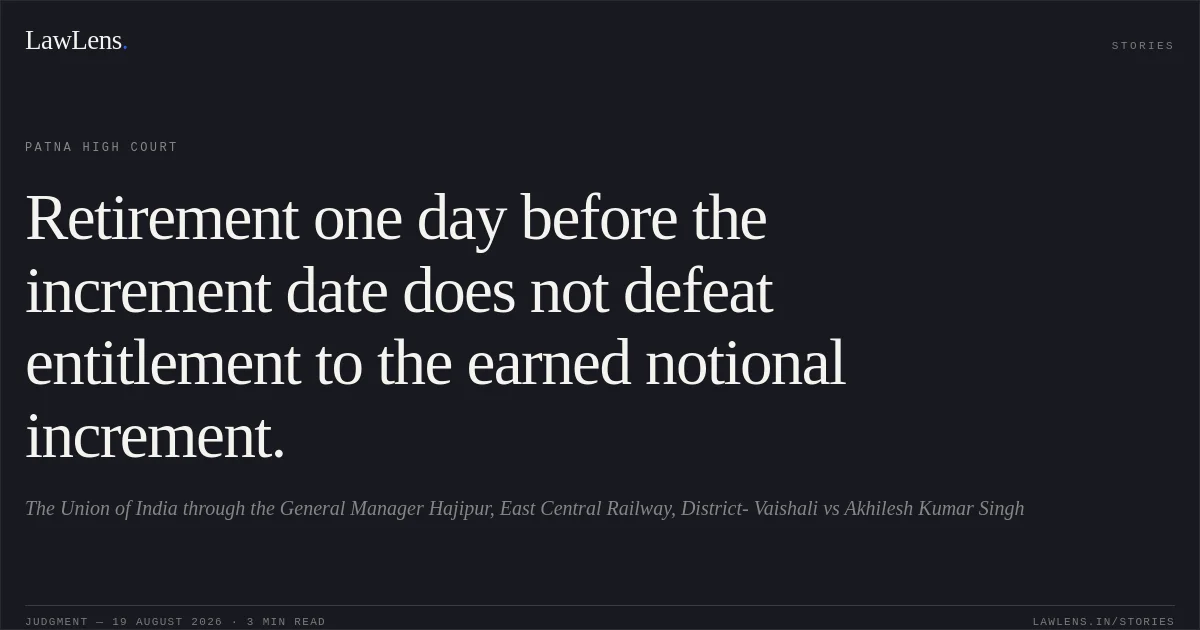
The respondent, an Accounts Assistant under the East Central Railway, superannuated on 30 June 2021.
Source reference: p.2, para. 2Although he had completed the requisite year of service and was due an annual increment on 1 July 2021, the increment was denied because his retirement preceded the increment date by one day.
Source reference: p.2, para. 2He challenged the denial before the Central Administrative Tribunal, Patna Bench, in O.A. No. 050/00276/2024.
Source reference: p.2, para. 1The Tribunal directed the Railway authorities to grant the annual increment notionally with effect from 1 January 2023, recalculate the retiral benefits, issue a revised pension payment order, and pay interest at 6% per annum.
Source reference: p.2, para. 1The Union of India and Railway authorities challenged that order before the Patna High Court.
Source reference: no citationDuring the writ proceedings, the respondent stated that a revised PPO had been issued and pension arrears paid, but the consequential revision of gratuity, leave encashment and commuted pension remained outstanding.
Source reference: p.5, para. 5Issues
Whether a government servant who retires on 30 June, one day before the annual increment due on 1 July, is entitled to the benefit of that increment on a notional basis for computation of retiral benefits?
Source reference: p.2, para. 2; p.3, para. 3Whether the grant and arrears of the enhanced pension and consequential retiral benefits were required to be regulated in accordance with the temporal directions issued by the Supreme Court in Union of India v. M. Siddaraj?
Source reference: pp.3–5, para. 4What consequential relief was payable in respect of gratuity, leave encashment and commutation of pension after revision of the pensionary benefits?
Source reference: p.5, para. 5Law Applied
The Court applied the principle laid down by the Supreme Court in The Director (Administration and Human Resources), KPTCL v. C.P. Mundinamani, reported in (2023) 14 SCC 411, that an employee who retires on the day immediately preceding the date on which the annual increment becomes payable cannot be denied the increment earned through satisfactory service during the preceding year merely because the employee was not in service on the formal increment date.
Source reference: p.3, para. 3The Court also applied the Supreme Court’s directions in Union of India v. M. Siddaraj, Miscellaneous Application Diary No. 2400 of 2024 in Civil Appeal No. 3933 of 2023, particularly that the enhanced pension for third parties would be payable from 1 May 2023, while cases in which judgments had attained finality would be governed by the principle of res judicata; the order further regulated claims arising from pending or subsequently filed proceedings.
Source reference: pp.3–5, para. 4Excess payments already made were protected from recovery.
Source reference: p.5, para. 4Reasoning
The respondent had rendered the full period of service necessary to earn the annual increment and retired only one day before its formal date of accrual.
Source reference: p.3, para. 3Applying C.P. Mundinamani, the Court accepted that retirement on 30 June 2021 could not defeat the benefit of the increment earned for the preceding year.
Source reference: p.3, para. 3However, the extent and timing of the monetary consequences had to conform to the later directions in M. Siddaraj, which modified the manner in which enhanced pension and arrears were to be paid to similarly situated retirees.
Source reference: pp.3–5, para. 4Since the revised PPO and pension arrears had already been issued and paid, the remaining issue concerned recalculation and payment of the consequential retiral dues.
Source reference: no citationThe petitioners expressly agreed to revise and pay the gratuity, leave encashment and commuted pension in accordance with C.P. Mundinamani, read with M. Siddaraj, within four weeks.
Source reference: p.5, para. 5Holding
The High Court held that the respondent was entitled to the benefit of the annual increment earned immediately before retirement, but that the payment and arrears had to be regulated in accordance with the Supreme Court’s directions in M. Siddaraj.
In view of the parties’ agreement, the writ petition was disposed of with a direction to the Railway authorities to revise and pay the consequential amounts of gratuity, leave encashment and commuted pension within four weeks from 18 August 2026.
Source reference: p.6, para. 6Original Court PDF
The Union of India through the General Manager Hajipur, East Central Railway, District- VaishalivsAkhilesh Kumar Singh
Click to open original judgment
Original judgment, available to read, download and summarize on LawLens.in