Facts
Respondent Nos. 1 and 2 initiated Batankan (mutation/partition) proceedings for Survey Nos. 579/Min-3 and 580/Min-3 in Tehsil Bhander, Datia, impleading only State authorities despite the existence of multiple co-sharers.
Source reference: p. 1The Tehsildar allowed the application despite alleged procedural lapses, including notices issued to deceased persons and forged service acknowledgments.
Source reference: p. 2On appeal, the Sub-Divisional Officer (SDO) set aside the Tehsildar’s order due to non-impleadment of necessary parties and defective service.
Source reference: p. 2On a second appeal, the Additional Commissioner restored the Tehsildar’s order without providing reasoned findings on limitation or procedural defects.
Source reference: p. 3Meanwhile, a competent Civil Court issued a decree on 29.11.2025 declaring equal one-fifth shares for all co-owners in Survey No. 579/Min-3.
Source reference: p. 3Issues
1. Whether the partition/Batankan proceedings were vitiated due to the non-impleadment of necessary parties and violation of the principles of natural justice.
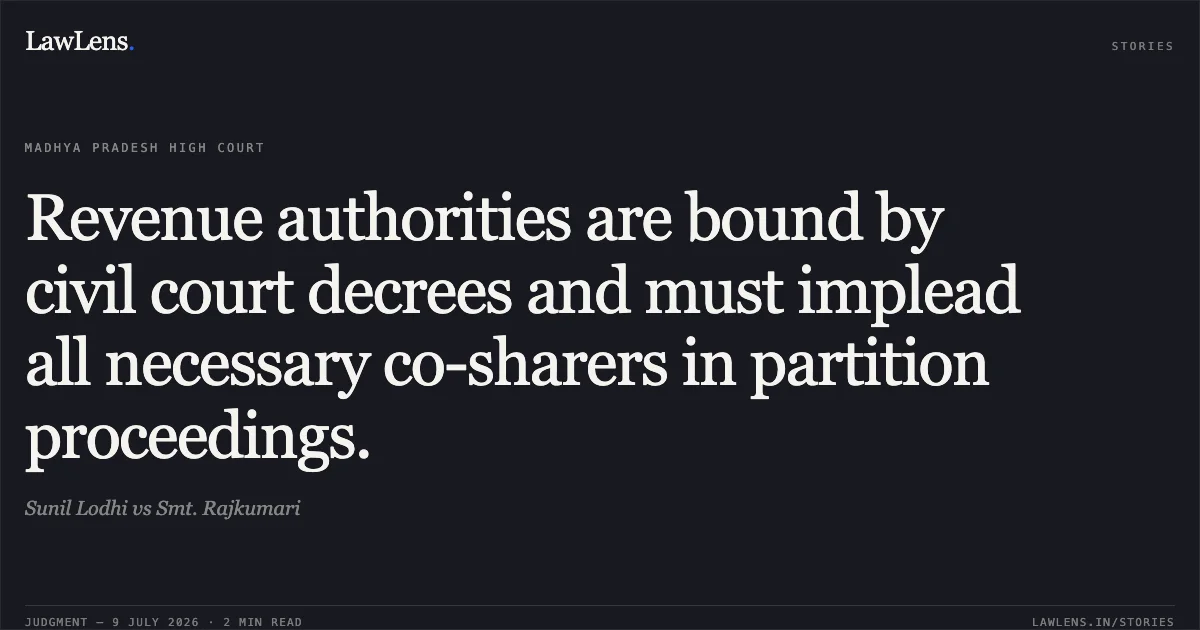
Source reference: p. 32. Whether the Revenue Authorities are bound by the subsequent declaration of title and shares by a competent Civil Court regarding the same property.
Source reference: p. 43. Whether the Additional Commissioner’s order was legally sustainable given the lack of reasoned findings on limitation and procedural irregularities.
Source reference: p. 4Law Applied
The court applied Article 226 of the Constitution of India regarding the High Court's power of judicial review.
Source reference: p. 1It relied on the fundamental principle of natural justice, which mandates that any party whose proprietary or civil rights are affected must be afforded proper notice and an effective opportunity to be heard.
Source reference: p. 4The court applied the doctrine of the supremacy of Civil Court decrees over revenue proceedings, holding that revenue entries/Batankan are consequential in nature and must strictly conform to the declaration of title and shares made by a competent Civil Court.
Source reference: p. 5Reasoning
The Court reasoned that Batankan proceedings inherently determine the rights of every co-owner; therefore, the absence of necessary parties renders such proceedings fundamentally defective.
Source reference: p. 3-4It observed that the Tehsildar’s service of notice was a "farce," as notices were issued to dead persons or returned unserved, yet the matter proceeded.
Source reference: p. 4The Court found that the Additional Commissioner committed a manifest error by "mechanically" restoring the Tehsildar's order without addressing the SDO’s specific findings on procedural illegality or the petitioners' objections regarding limitation.
Source reference: p. 4Crucially, the Court emphasized that the Civil Court decree dated 29.11.2025 had materially altered the legal landscape, and since revenue authorities act in a consequential capacity to civil adjudications, they cannot ignore a binding decree of title.
Source reference: p. 5Holding
The Court held that proceedings conducted in violation of natural justice and without necessary parties are legally unsustainable.
The High Court allowed the writ petition and quashed the orders of the Additional Commissioner (04.01.2023) and the Tehsildar, remanding the matter to the Tehsildar with directions to implead all necessary parties, ensure valid service, and pass a fresh order strictly in conformity with the Civil Court’s judgment and decree dated 29.11.2025.
Source reference: p. 5-6Acts & Sections Cited
1 provisions across 1 statute referred to in this judgment. Each provision opens on LawLens.
Limitation Act, 19631
Original Court PDF
Sunil LodhivsSmt. Rajkumari
Click to open original judgment
Original judgment, available to read, download and summarize on LawLens.in