Facts
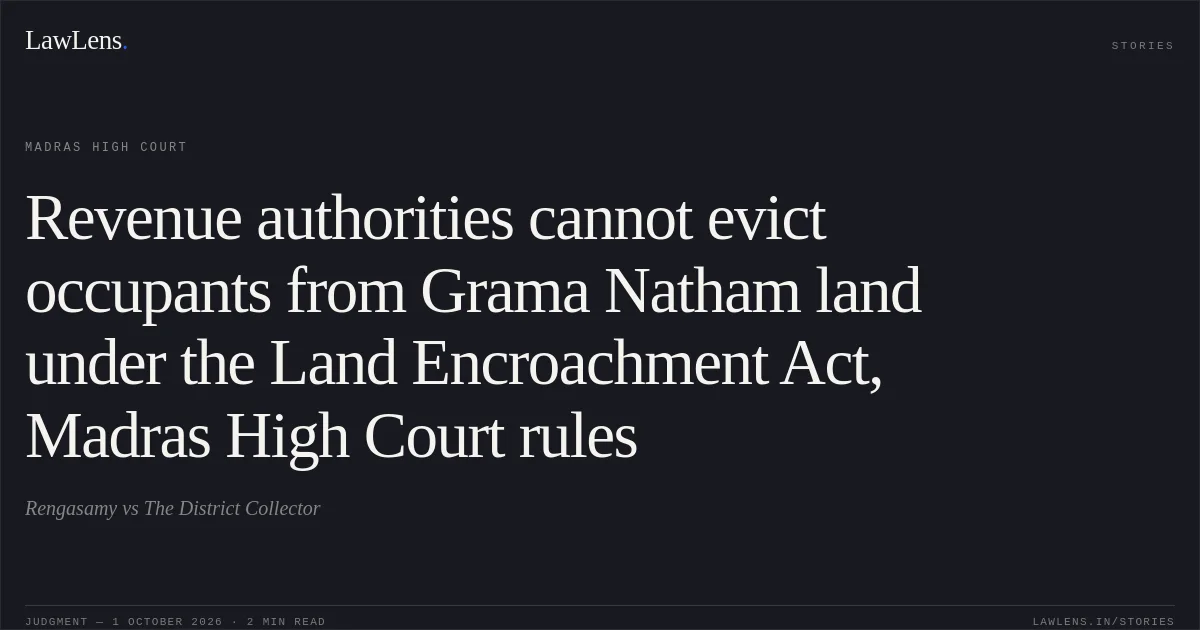
The petitioner occupied land classified as Grama Natham in S.F. No. 225/28, Naduvappatti Village.
Source reference: p. 2After the Revenue Inspector issued a show-cause notice under Section 7 of the Tamil Nadu Land Encroachment Act, 1905, and the petitioner submitted an explanation, the Tahsildar issued an eviction notice under Section 6 dated 09.09.2024.
Source reference: p. 2–3The petitioner challenged that notice, contending that revenue authorities lacked jurisdiction to evict occupants from Grama Natham land.
Source reference: p. 2–3The State’s counsel accepted that the revenue authorities had no jurisdiction to initiate eviction proceedings for alleged encroachment on Grama Natham land.
Source reference: p. 4Issues
1. Whether the Tahsildar could issue an eviction notice under Section 6 of the Tamil Nadu Land Encroachment Act, 1905, concerning land classified as Grama Natham.
Source reference: p. 3–42. Whether the impugned eviction notice should be set aside in light of the Full Bench ruling in Kaman @ Kamatchi v. The District Collector, Dindigul District.
Source reference: p. 4–5Law Applied
Section 6 of the Tamil Nadu Land Encroachment Act, 1905, provides for eviction proceedings, while Section 7 provides for a prior show-cause notice.
Source reference: no citationThe Court relied on the Full Bench decision in Kaman @ Kamatchi v. The District Collector, Dindigul District, 2026 (2) CTC 257, which held that revenue authorities have no power to initiate eviction proceedings in respect of land classified as Natham; an aggrieved party may pursue a remedy before the competent Civil Court.
Source reference: p. 4Reasoning
The land was identified as Grama Natham, and the State’s counsel conceded that revenue authorities lacked jurisdiction to initiate eviction proceedings for alleged encroachment on such land.
Source reference: p. 4–5Applying the Full Bench ruling, the Court concluded that the Tahsildar’s eviction notice could not be sustained and that any aggrieved party’s remedy lay before the competent Civil Court.
Source reference: p. 4–5Holding
The Court set aside the Tahsildar’s eviction notice dated 09.09.2024 and left the parties to pursue any remedy before the competent Civil Court in accordance with law.
The writ petition was allowed, with no order as to costs; the connected miscellaneous petition was closed.
Source reference: p. 5Acts & Sections Cited
2 provisions across 1 statute referred to in this judgment. Each provision opens on LawLens.
Original Court PDF
RengasamyvsThe District Collector
Click to open original judgment
Original judgment, available to read, download and summarize on LawLens.in