Facts
The Petitioner filed a writ petition under Article 226 of the Constitution of India challenging an order dated 31.12.2012 passed by the Deputy Commissioner (DC), Koderma, which cancelled a long-running jamabandi in the Petitioner's name for 2.10 acres of land (Plot No. 4617, Khata No. 127)
Source reference: paras. 1-2The Petitioner claimed the land was originally settled by an ex-landlord in favour of his vendor, Sobron Thakur, in 1953 via a customary hukumnama, and was subsequently purchased by the Petitioner through registered sale deeds in 2002
Source reference: para. 3Respondent No. 5, a mining lessee operating on the land since 1984, challenged the Petitioner’s mutation
Source reference: paras. 7, 10The State contended the land was Gair Mazurwa Khas (forest land) and that the Petitioner’s jamabandi was created through fraud and collusion without any original settlement documents
Source reference: para. 9Issues
1. Whether the Deputy Commissioner has the jurisdiction to cancel a long-standing jamabandi under the law
Source reference: para. 52. Whether administrative orders such as mutation/jamabandi can be reviewed or cancelled if they are found to be fraudulent or passed without jurisdiction
Source reference: para. 14Law Applied
The court primarily applied the principle that jamabandi and mutation proceedings are administrative in nature and do not constitute a judicial proceeding, thus making them reviewable
Source reference: para. 15, 17The Court relied on Jagdeo Mahto v. Commissioner, North Chotanagpur Division (2009), which established that jamabandi can be cancelled if created by an authority lacking jurisdiction or based on apparent error of law/facts
Source reference: para. 10The Court further cited Abdul Jabbar v. State of Bihar (1992) to affirm that there is no general proposition that a jamabandi once created can never be cancelled
Source reference: para. 17Finally, it applied the doctrine from Meghmala v. G. Narasimha Reddy (2010), holding that fraud vitiates all proceedings and renders them a nullity
Source reference: para. 18Reasoning
The Court reasoned that while long-running jamabandis should not be cancelled in a "routine way," this protection does not apply to entries obtained through fraud or lack of jurisdiction
Source reference: para. 14The Petitioner failed to produce the original hukumnama or any "chit of paper" to substantiate the claim of settlement in favour of the vendor
Source reference: paras. 13, 16Evidence showed the land was recorded as Gair Mazurwa Khas Jangal Jhari (State forest land) and that Respondent No. 5 had a valid mining lease since 1984, which the Petitioner allegedly disturbed despite having no actual possession
Source reference: paras. 7, 9, 13The Court found that because the Petitioner could not prove the bona fides of the initial settlement, the DC acted within his administrative authority to revisit and cancel an entry that was ex-facie collusive or fraudulent
Source reference: paras. 13, 15, 18Holding
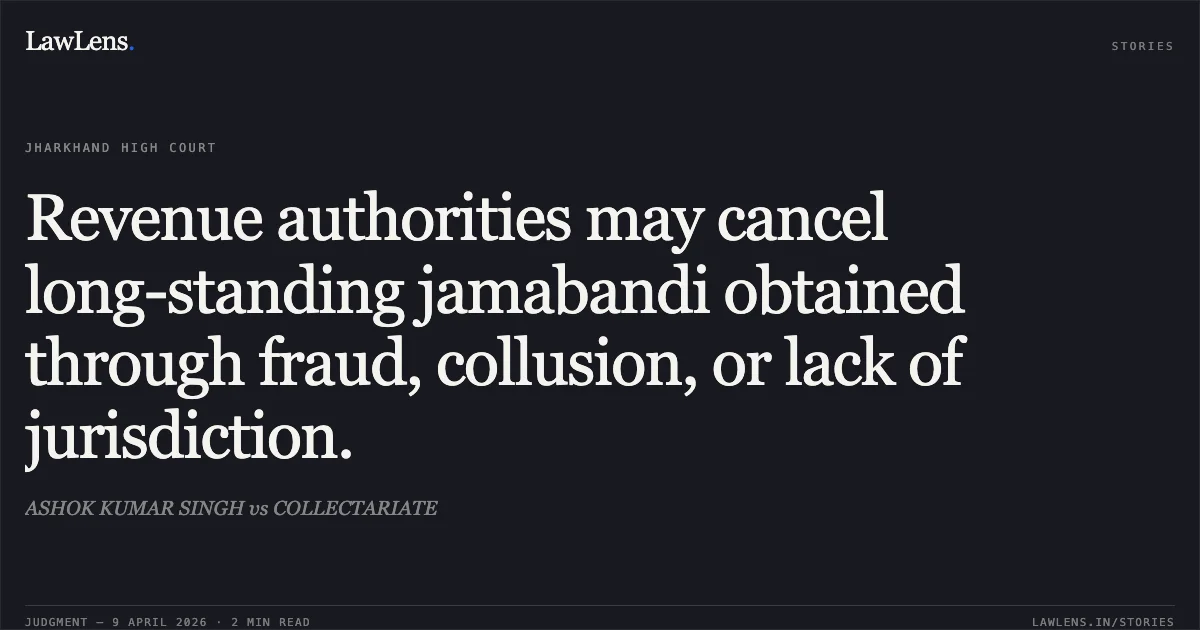
The Court dismissed the writ petition, holding that revenue authorities are competent to cancel a jamabandi if it is established that the entry was created without jurisdiction, via fraud, or without a formal order
The court answered that fraud renders such administrative actions a nullity
Source reference: para. 18The court granted the Petitioner liberty to file a title suit in a competent court of civil jurisdiction to establish his rights
Source reference: para. 20Original Court PDF
ASHOK KUMAR SINGHvsCOLLECTARIATE
Click to open original judgment
Original judgment, available to read, download and summarize on LawLens.in