Facts
The plaintiffs (Anand Das and Kunwariya Bai) filed a suit for permanent injunction regarding 8.00 acres of land inherited from Late Sukhdev
Source reference: p. 2They alleged that although an agreement to sell was executed with Defendant No. 1 (the appellant) in 1997 for ₹2,71,000, and earnest money of ₹1,20,000 was received, the defendant failed to pay the balance or get the deed registered by May 1998
Source reference: p. 2The plaintiffs claimed continued possession, which the defendant disputed, asserting he was put in possession upon execution of the agreement and a subsequent possession receipt
Source reference: p. 3-4The Trial Court partly allowed the suit, protecting the plaintiffs' possession of certain Khasra numbers while noting others had reverted to a third party (Vyas Narayan) via revenue proceedings
Source reference: p. 4-5The First Appellate Court dismissed the defendant's appeal and an application for additional evidence
Source reference: p. 6Issues
1. Whether the defendant was entitled to protection against dispossession under Section 53-A of the Transfer of Property Act
Source reference: p. 72. Whether the High Court can interfere with concurrent findings of fact in a second appeal under Section 100 of the CPC in the absence of a substantial question of law
Source reference: p. 10Law Applied
Section 100 of the Code of Civil Procedure (CPC), which restricts second appeals to "substantial questions of law" and prohibits interference with concurrent findings of fact unless they are perverse or based on no evidence
Source reference: p. 6, 10Section 53-A of the Transfer of Property Act, which provides an equitable shield to a proposed transferee in possession who is ready and willing to perform his part of a contract
Source reference: p. 7Order 41 Rule 27 of the CPC was applied regarding the strict limitations on admitting additional evidence at the appellate stage
Source reference: p. 9The court further relied on Russi Fisheries Pvt. Ltd. v. Bhavna Seth (2026) and Bholaram v. Amerchand (1981), establishing that even erroneous findings of fact do not justify interference under Section 100 CPC
Source reference: p. 10-12Reasoning
The court found that the appellant failed to prove his possession of the suit land.
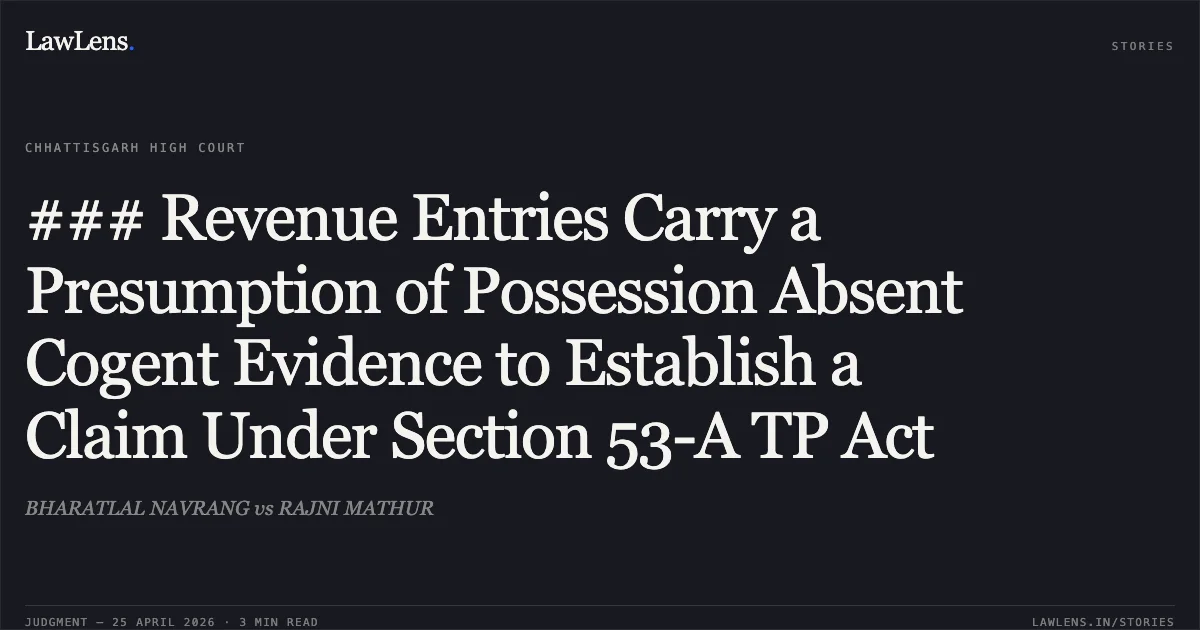
Source reference: p. 8Revenue records (B-1 Kishtbandi Khatauni and Khasra entries) for 2003–04 carried a presumption of correctness and recorded the plaintiffs as being in possession, while the defendant admitted in cross-examination that his name was never recorded in the revenue "remarks" column
Source reference: p. 8Consequently, the "shield" of Section 53-A was unavailable to the defendant as the essential condition of "delivery of possession" was not met
Source reference: p. 8Regarding the application for additional evidence, the court reasoned that such measures cannot be used to fill gaps in a case after a decree has been challenged, following the principle in Gobind Singh v. Union of India
Source reference: p. 9Since the Findings of both lower courts were based on a valid appreciation of oral and documentary evidence (Exhibits P/1 to P/11), there was no perversity or misapplication of law
Source reference: p. 9-10Holding
The High Court dismissed the appeal, holding that no substantial question of law arose for consideration
The court affirmed the concurrent findings that the plaintiffs were in lawful possession of the suit property
Source reference: p. 8-9The final holding established that concurrent findings of fact, even if allegedly erroneous, cannot be reopened in a second appeal under Section 100 CPC unless vitiated by perversity. The judgments of the Trial Court and First Appellate Court were upheld
Source reference: p. 11-13Acts & Sections Cited
2 provisions across 1 statute referred to in this judgment. Each provision opens on LawLens.
Code of Civil Procedure, 19082
Original Court PDF
BHARATLAL NAVRANGvsRAJNI MATHUR
Click to open original judgment
Original judgment, available to read, download and summarize on LawLens.in