Facts
The petitioner claimed ownership and possession over portions of land comprised in Hal Plot Nos. 2822 and 2824 and alleged that the land had been wrongly recorded in the name of private respondent No. 5, Jishnu Debbarma.
Source reference: paras. 8–9In Revenue Case No. 36/2008, the District Collector accepted a field-enquiry report and ordered correction of the revenue records in the petitioner’s favour, resulting in Khatian No. 5306 being issued in his name.
Source reference: paras. 8–9Respondent No. 5 had earlier instituted restoration proceedings under Section 187B of the Tripura Land Revenue and Land Reforms Act, 1960 (“TLR & LR Act”), which were dismissed by the Sub-Divisional Magistrate in 2011.
Source reference: para. 10His appeal under Section 93(1) was, however, allowed by the District Collector on 20.07.2012, directing restoration of 0.14 acres of land to him. The petitioner was not impleaded or heard in that appeal.
Source reference: para. 10The petitioner claimed that he became aware of the appellate order only in July 2020 and obtained its certified copy on 17.08.2020. He filed a second appeal and an application for condonation of delay on 10.02.2022.
Source reference: paras. 10–11Pursuant to an order in WP(C) No. 397 of 2022, the Principal Secretary, Revenue Department, heard the condonation application and rejected it, along with the second appeal, on 21.05.2022, holding that the petitioner lacked locus standi and had failed to justify the delay of 3,432 days.
Source reference: paras. 13–14The petitioner’s subsequent Civil Revision Petition under Article 227 and review petition were dismissed on the ground that the Principal Secretary was neither a court nor a tribunal amenable to Article 227 supervision.
Source reference: paras. 15–16The Supreme Court thereafter left it open to the petitioner to invoke Article 226 against the revisional order, leaving all issues, including limitation, open.
Source reference: para. 17Issues
Whether the writ petition under Article 226 was maintainable and whether the order dated 21.05.2022 rejecting the condonation application and second appeal warranted interference?
Source reference: paras. 2, 17–18Whether the petitioner established a legally enforceable title or ownership interest merely on the basis of revenue entries and the correction of Khatian No. 5306?
Source reference: paras. 5, 8, 25–26Whether the disputed questions relating to title, extent and possession could appropriately be adjudicated in writ jurisdiction?
Source reference: paras. 25–27Whether the petitioner’s delay in filing the second appeal ought to have been condoned, particularly in view of his alleged lack of notice and the COVID-19 limitation exclusions?
Source reference: paras. 11, 14, 20–21; para. 17Law Applied
The Court applied Article 226 of the Constitution, observing that certiorari jurisdiction is confined to jurisdictional error, excess of jurisdiction, violation of natural justice, or an error of law apparent on the face of the record.
Source reference: para. 25Sections 93 and 94 of the TLR & LR Act govern first and second appeals and prescribe a limitation period of thirty days for a first appeal and sixty days for a second appeal, excluding the time required to obtain a copy of the order.
Source reference: para. 24Section 187 restricts transfers of land belonging to Scheduled Tribes unless the statutory conditions, including permissible transferee status or prior written permission of the Collector, are satisfied.
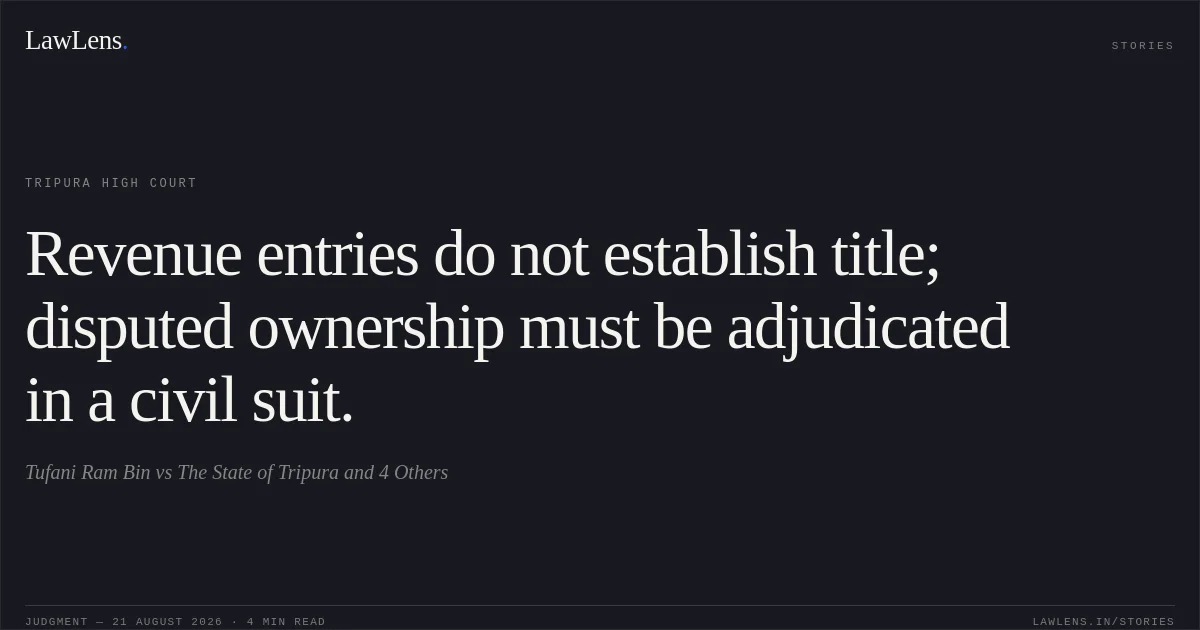
Source reference: para. 24The Court relied on the principle that revenue records and mutation entries serve fiscal purposes, do not constitute documents of title, and neither create nor extinguish ownership; disputes involving title and possession are ordinarily for a civil court.
Source reference: para. 25It also applied the rule that Article 226 proceedings are inappropriate for adjudicating serious and disputed questions of fact and title.
Source reference: para. 25Reasoning
The Court found that the petitioner’s claim rested substantially on revenue entries, the field-enquiry report and Khatian No. 5306, rather than on any primary title document.
Source reference: paras. 3–4, 26Although the petitioner asserted ownership, he failed to produce sale deeds or other documents establishing the flow of title, even after receiving an adjournment specifically for that purpose.
Source reference: paras. 3–4, 26The Court held that the revenue correction could not itself confer ownership because mutation and Khatian entries have no presumptive value regarding title.
Source reference: para. 25The competing claims of the parties involved substantial disputes concerning the validity of historical sale deeds, tribal-land restrictions under Section 187, title, extent and possession.
Source reference: para. 25Such disputes could not be conclusively determined in a writ petition, particularly when necessary family members and other persons claiming through the original owner had not been impleaded.
Source reference: para. 25In the absence of proof of title, the Court drew an adverse inference against the petitioner and declined to examine the merits of the competing ownership claims.
Source reference: para. 26The Court consequently found no basis to interfere with the impugned administrative order under Article 226.
Source reference: para. 26The limitation and COVID-related contentions were not accepted as a ground for relief, while the Supreme Court’s order had expressly left all such issues open.
Source reference: paras. 17, 20–21Holding
The writ petition was dismissed.
The Court declined to quash the Principal Secretary’s order dated 21.05.2022 rejecting the condonation application and the second appeal, principally because the petitioner failed to establish title and sought adjudication of disputed questions of fact through revenue entries in writ jurisdiction.
Source reference: para. 26The Court clarified that its decision did not finally determine the parties’ title, extent or possession and left it open to them to approach the competent civil court by instituting an appropriate suit in accordance with law.
Source reference: para. 27Pending miscellaneous applications, if any, were also closed.
Source reference: para. 28Acts & Sections Cited
5 provisions across 1 statute referred to in this judgment. Each provision opens on LawLens.
Tripura Land Revenue and Land Reforms Act, 19605
Original Court PDF
Tufani Ram BinvsThe State of Tripura and 4 Others
Click to open original judgment
Original judgment, available to read, download and summarize on LawLens.in