Facts
In 1950, a Gazette Notification was issued under the Hyderabad Forest Act to include 787 acres in Survey No. 81, Kalvalanagaram Village, as a reserve forest
Source reference: p. 1The Appellants claimed ownership over 600 acres of this land, alleging that H.E.H. the Nizam granted pattas (land titles) to them or their predecessors in 1931-32
Source reference: p. 3On 19.05.2003, the Joint Collector rejected the Appellants' claims for exclusion from the forest declaration due to a lack of original title deeds and physical possession
Source reference: p. 1, 5A Single Judge of the High Court allowed the Appellants’ Writ Petition in 2012, quashing the Joint Collector’s order and declaring the forest reservation ultra vires because the notification cited the repealed 1326F Act instead of the 1355F Act
Source reference: p. 7The State appealed, and the Division Bench reversed the Single Judge’s order, holding that revenue entries do not confer title and a wrong statutory reference does not invalidate a notification
Source reference: p. 8The Appellants then approached the Supreme Court
Source reference: p. 2Issues
1. Whether the 1950 Forest Notification was void ab initio because it cited the repealed Hyderabad Forest Act, 1326F
Source reference: p. 7 / para. 9-102. Whether the Appellants established legal title to the subject land based on revenue records like Faisal Patti, Vasool Baqi, and Pahanies in the absence of original pattas
Source reference: p. 5 / para. 83. Whether a Writ Court under Article 226 has the jurisdiction to declare ownership and title in a property dispute against the Government
Source reference: p. 12 / para. 17Law Applied
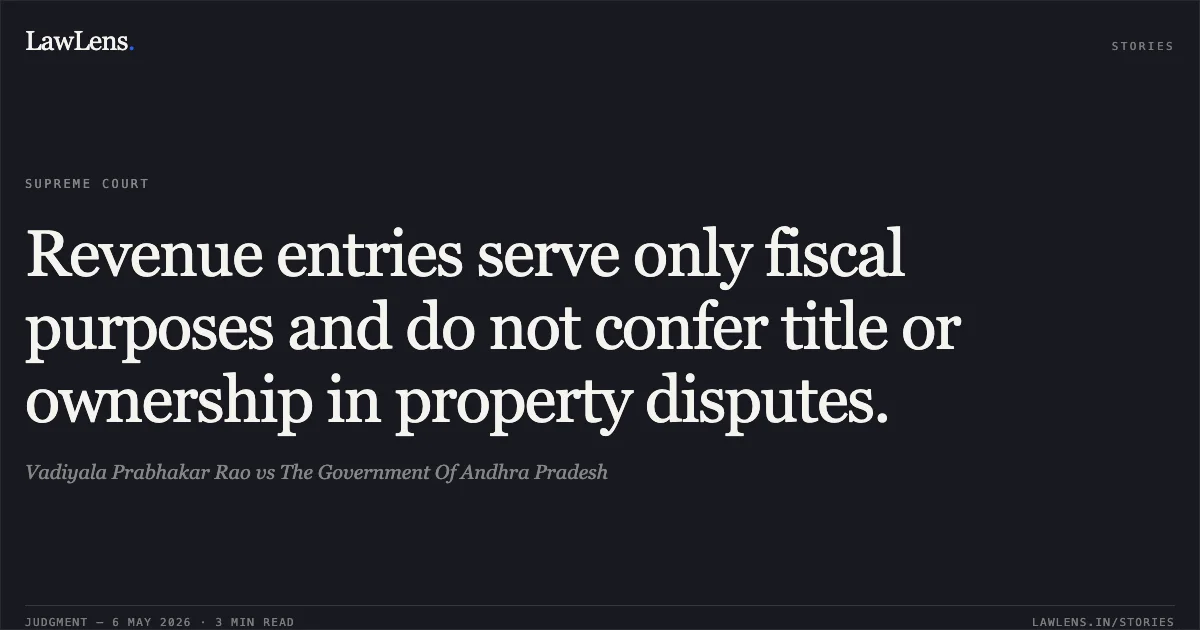
The Court applied the principle that revenue records—including Jamabandi, Faisal Patti, and Pahanies—serve only a "fiscal purpose" for tax collection and do not confer, create, or extinguish ownership or title
Source reference: p. 11It relied on Suraj Bhan v. Financial Commissioner and Jitendra Singh v. State of MP to establish that mutation entries lack presumptive value regarding title
Source reference: p. 11The Court reiterated the doctrine from Sohan Lal v. Union of India that proceedings under Article 226 are not the appropriate forum for resolving serious disputes of fact or title, which must be adjudicated by a Civil Court
Source reference: p. 12The Court held that a notification is not invalidated by a reference to a wrong enactment if the power exists under a new Act and the act is not inconsistent with it
Source reference: p. 8Reasoning
The Court found that the Appellants failed to produce primary evidence of title, specifically the original patta certificates
Source reference: p. 10It reasoned that the revenue entries relied upon were "truncated and contradictory," often recording the land as "Jungle," which supported the State’s claim rather than the Appellants’
Source reference: p. 12The Court critiqued the Single Judge’s expansion of judicial review, noting that a Writ of Certiorari is limited to jurisdictional errors or patent illegalities and cannot be used to declare private title in a summary proceeding
Source reference: p. 13-14Regarding the statutory error in the 1950 Notification, the Court agreed with the Division Bench that a mere citation of a repealed Act (1326F) does not render the proceedings non est if the substance of the action aligns with the successor Act (1355F)
Source reference: p. 8The Court determined that the Appellants’ reliance on "stray or solitary" revenue entries could not override the long-standing status of the land as forest
Source reference: p. 12Holding
The Supreme Court answered that revenue entries do not constitute proof of title and that the High Court’s Single Judge exceeded his jurisdiction by declaring the Appellants’ ownership in a writ petition
The Court held that the 1950 Forest Notification was valid despite the reference to the repealed Act
Source reference: p. 8The Court refused to remand the matter to a Civil Court, stating that extending the 75-year-old litigation was unnecessary given the lack of merit in the documents provided
Source reference: p. 14The Civil Appeal was dismissed, and the Division Bench's judgment was upheld
Source reference: p. 14Acts & Sections Cited
1 provisions across 1 statute referred to in this judgment. Each provision opens on LawLens.
Andhra Pradesh Forest Act, 19671
Original Court PDF
Vadiyala Prabhakar RaovsThe Government Of Andhra Pradesh
Click to open original judgment
Original judgment, available to read, download and summarize on LawLens.in