Facts
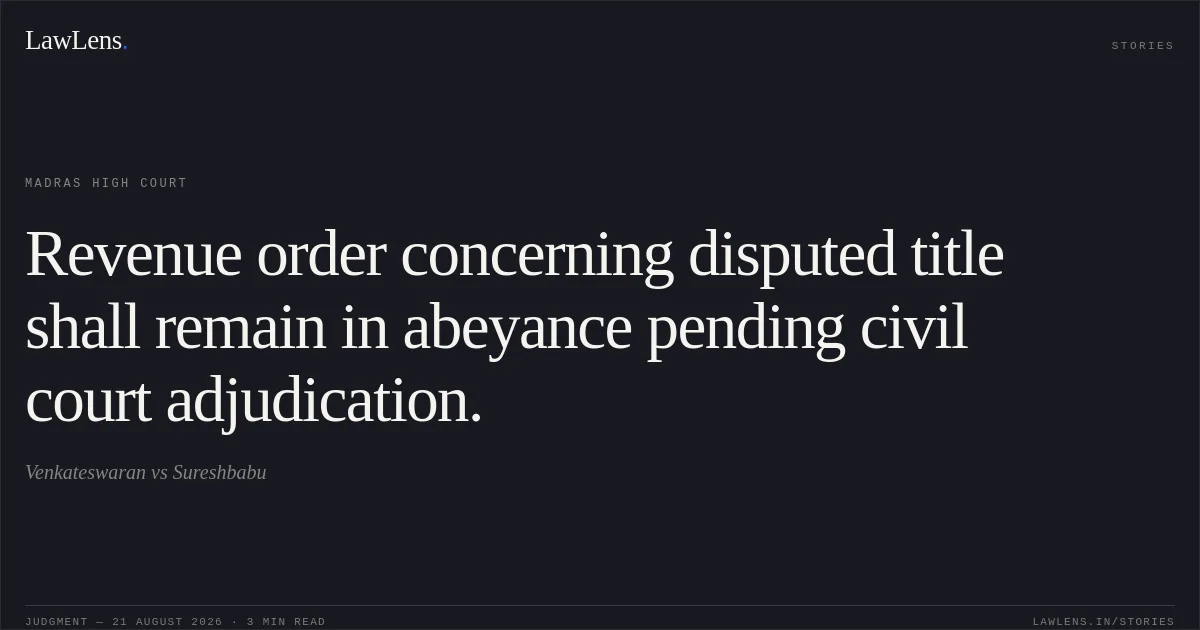
The appellant, who was the third respondent in the writ petition, challenged the order dated 23.06.2026 passed in W.P.(MD) No.17443 of 2026.
Source reference: p.2, para.2The first respondent had questioned, through a writ of certiorarified mandamus, the order dated 19.05.2026 passed by the Revenue Divisional Officer, Melur, concerning mutation of patta relating to property bearing New Patta No.98 at Kalikappan Bit-1 Village, Karuppayurani Taluk, Madurai District.
Source reference: p.2, para.2The dispute involved title to the property and competing claims based on a Will, the validity of which was disputed by the opposing party and would require proof in accordance with law.
Source reference: p.2, para.3The learned Single Judge quashed the Revenue Divisional Officer’s order and restrained the parties from dealing with or alienating the property.
Source reference: p.3, para.3During the pendency of the writ appeal, the first respondent instituted a civil suit seeking declaration of title before the District Court, Madurai, on 14.08.2026.
Source reference: p.2, para.2Issues
Whether disputed questions concerning title to the property, including the validity of the Will, should be adjudicated in writ proceedings or before the competent Civil Court?
Source reference: p.2, paras.2–3; p.3, para.4Whether the Revenue Divisional Officer’s order concerning mutation of patta should remain operative while the civil suit and subsequent appeals concerning title are pending?
Source reference: p.3, para.4Whether the learned Single Judge was justified in issuing a direction restraining the parties from dealing with or alienating the property in the writ proceedings?
Source reference: p.3, para.3Law Applied
The Court applied the principle that disputed questions of title, including the proof and validity of a Will, are matters for adjudication by the competent Civil Court and are not ordinarily suitable for final determination in writ proceedings.
Source reference: p.2, para.3; p.3, para.4It further proceeded on the principle that revenue or patta proceedings do not conclusively determine title, and that the effect of an order passed by a revenue authority should ordinarily await the outcome of civil litigation where title is directly in dispute.
Source reference: p.3, para.4No specific statutory provision or judicial precedent was cited in the judgment.
Source reference: no citationReasoning
The Court noted that the identity of the property was undisputed, but the parties raised competing claims to title based on a disputed Will.
Source reference: p.2, para.3Since the Will would have to be proved in the manner recognised by law, and the first respondent had already instituted a suit for declaration of title, the Civil Court was the appropriate forum to decide the disputed facts and title issues.
Source reference: p.2, para.2; p.3, para.4Accordingly, rather than allowing the revenue order to operate during the pendency of the civil proceedings, the Court directed that it be kept in abeyance.
Source reference: p.3, para.4The Court refrained from expressing any opinion on the merits of the rival claims.
Source reference: p.3, para.4It reasoned that if the plaintiff succeeded in establishing title, the Revenue Divisional Officer’s order would lose effect; if the plaintiff failed, the order would stand revived.
Source reference: p.3, para.4Holding
The Writ Appeal was disposed of without costs.
The Court directed that the Revenue Divisional Officer’s order dated 19.05.2026 remain in abeyance pending the decision of the civil suit and the appeals, if any, before the appropriate courts.
Source reference: p.3, para.4The Court left the disputed questions of title and the validity of the Will to be decided by the Civil Court and expressed no opinion on the merits of the parties’ claims.
Source reference: p.3, para.4The connected miscellaneous petition was closed.
Source reference: p.4, para.5Original Court PDF
VenkateswaranvsSureshbabu
Click to open original judgment
Original judgment, available to read, download and summarize on LawLens.in