Facts
The petitioner, a former Panchayat Secretary, retired on 30 September 2003. Audits of Meppady Grama Panchayat for 2001–2002 and 2002–2003 were conducted in 2005–2006, and the corresponding audit reports were issued on 1 June 2006 and 3 November 2006 respectively.
Source reference: para. 2; pp. 2–3In 2019, approximately sixteen years after the petitioner’s retirement, the Panchayat initiated revenue-recovery proceedings. Demand notices were issued for ₹6,61,872 and ₹10,18,025, together with interest, followed by attachment notices against the petitioner’s properties.
Source reference: para. 2; p. 2; Appendix, Exts. P5–P10The respondents alleged that the petitioner was responsible for an expenditure of ₹2,41,895 without proper vouchers and for a loss of ₹1,49,940 arising from revenue collection irregularities.
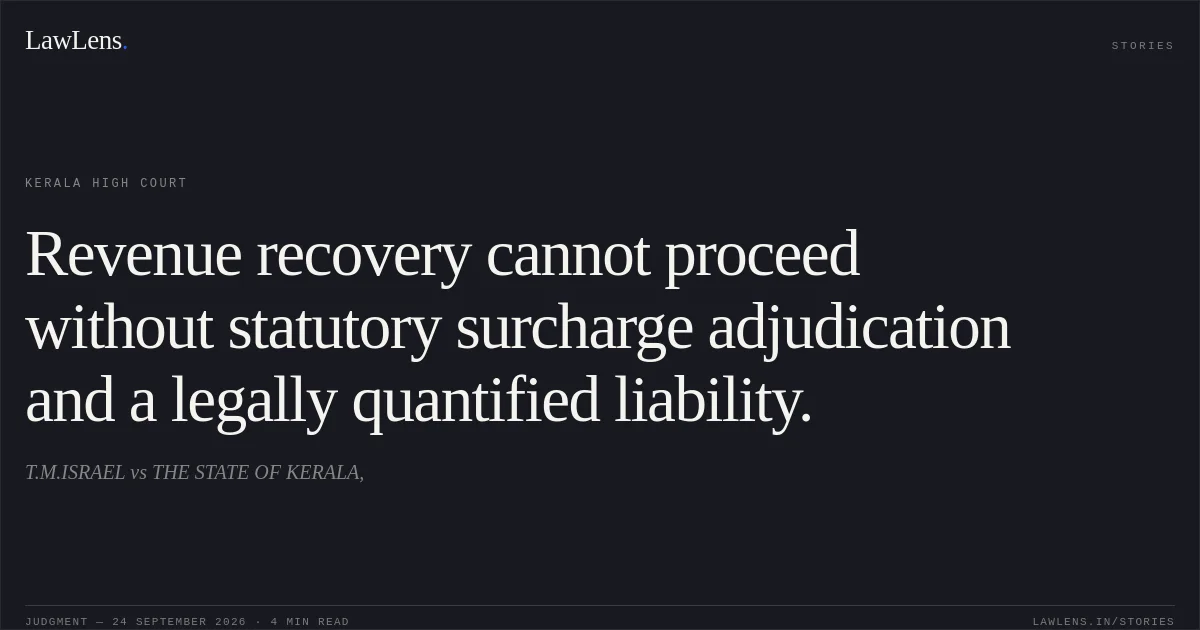
Source reference: para. 6; p. 3The petitioner contended that no statutory surcharge certificate or valid adjudication determining his liability had been issued before resorting to revenue recovery.
Source reference: paras. 3, 19–20; pp. 2, 10–12Issues
Whether revenue-recovery proceedings could be initiated against the petitioner without issuing a surcharge certificate and completing the procedure prescribed under Section 16 of the Kerala Local Fund Audit Act, 1994 and Rule 20 of the Kerala Local Fund Audit Rules, 1996.
Source reference: paras. 3, 10–12, 15–16; pp. 2, 5–8Whether revenue recovery could be resorted to without prior notice, proper adjudication, and determination of a legally quantified amount due from the petitioner by a competent forum.
Source reference: paras. 19–24; pp. 10–14Whether the proceedings were otherwise barred or rendered unsustainable by the statutory limitations applicable to post-retirement recovery and recovery of sums due to a Panchayat.
Source reference: paras. 5, 7, 9, 13–15; pp. 3–8Law Applied
The Court applied Section 180 of the Kerala Panchayat Raj Act, 1994, under which Panchayat officers and employees, other than contingent employees, are Government servants, and Rule 3 of Part III of the Kerala Service Rules, which restricts institution of disciplinary or judicial proceedings after retirement in respect of causes of action more than four years old, subject to the prescribed exceptions.
Source reference: para. 7; p. 4Section 215(9) of the Kerala Panchayat Raj Act requires an opportunity to explain before an amount is certified as due and contains a four-year limitation for surcharge.
Source reference: paras. 8–9; pp. 4–5Section 16 of the Kerala Local Fund Audit Act, 1994 mandates that the auditor issue a reasoned disallowance, surcharge, or charge, communicate it to the affected person, and permit challenge before the District Court; only the amount certified as due and unpaid is recoverable under the Kerala Revenue Recovery Act, 1968.
Source reference: para. 10; pp. 5–6Rule 20 of the Kerala Local Fund Audit Rules, 1996 prescribes the issuance and communication of charge/surcharge notices and certificates.
Source reference: paras. 11–12; pp. 6–7The Court relied on Babu Varghese v. Bar Council of Kerala, 1999 (1) KLT 836 (SC), for the principle that where a statute prescribes a manner of doing an act, it must be done in that manner or not at all.
Source reference: para. 19; pp. 10–11It further relied on Corporation of Kozhikode v. K.N. Radha, 2022 (4) KHC 557, Lt. Col. E.V. Krishnan v. State of Kerala, 2022 (6) KLT OnLine 1275, and State of Kerala v. V.R. Kalliyanikutty, (1999) 3 SCC 657, for the rule that revenue recovery is an executionary mechanism available only for a legally recoverable and adjudicated or quantified amount.
Source reference: paras. 20–21, 23; pp. 11–13Reasoning
The Court found that the respondents had not issued any surcharge certificate or completed the statutory surcharge process against the petitioner.
Source reference: para. 15; p. 8Although the respondents relied on audit objections and directions of the Local Fund Accounts Committee, those materials could not substitute the specific procedure prescribed by Section 16 of the Kerala Local Fund Audit Act and Rule 20 of the 1996 Rules; statutory procedure could not be replaced by an alternative administrative course.
Source reference: paras. 17–18, 22; pp. 9–13The petitioner had also not been served with notice before the revenue-recovery proceedings were commenced, and there had been no adjudication by a competent forum determining the exact amount legally due from him.
Source reference: para. 19; p. 10Since the Revenue Recovery Act merely provides a mode of enforcing an existing legally recoverable liability and does not itself create or adjudicate the liability, the respondents could not directly invoke revenue recovery on the basis of unresolved audit objections.
Source reference: paras. 20–23; pp. 11–13Accordingly, the Court held that the recovery proceedings initiated in 2019, long after the petitioner’s retirement and without compliance with the statutory adjudicatory safeguards, were legally unsustainable.
Source reference: para. 24; p. 13Holding
The writ petition was allowed.
The revenue-recovery proceedings initiated against the petitioner through Exhibits P5 to P10, including the demand and property-attachment notices, were quashed because they were commenced without a valid surcharge proceeding, proper notice, and adjudication of the petitioner’s liability by a competent forum.
Source reference: para. 24; p. 14; para. 26; p. 15The first respondent was additionally directed to conduct an independent and impartial inquiry into the alleged administrative delay and to initiate criminal prosecution if prima facie material disclosed intentional abuse of position or criminal misconduct by officials.
Source reference: para. 25; p. 14; para. 26; p. 15Acts & Sections Cited
7 provisions across 2 statutes referred to in this judgment. Linked provisions open on LawLens.
Kerala Local Fund Audit Act, 19944
Kerala Panchayat Raj Act, 19943
Original Court PDF
T.M.ISRAELvsTHE STATE OF KERALA,
Click to open original judgment
Original judgment, available to read, download and summarize on LawLens.in