Facts
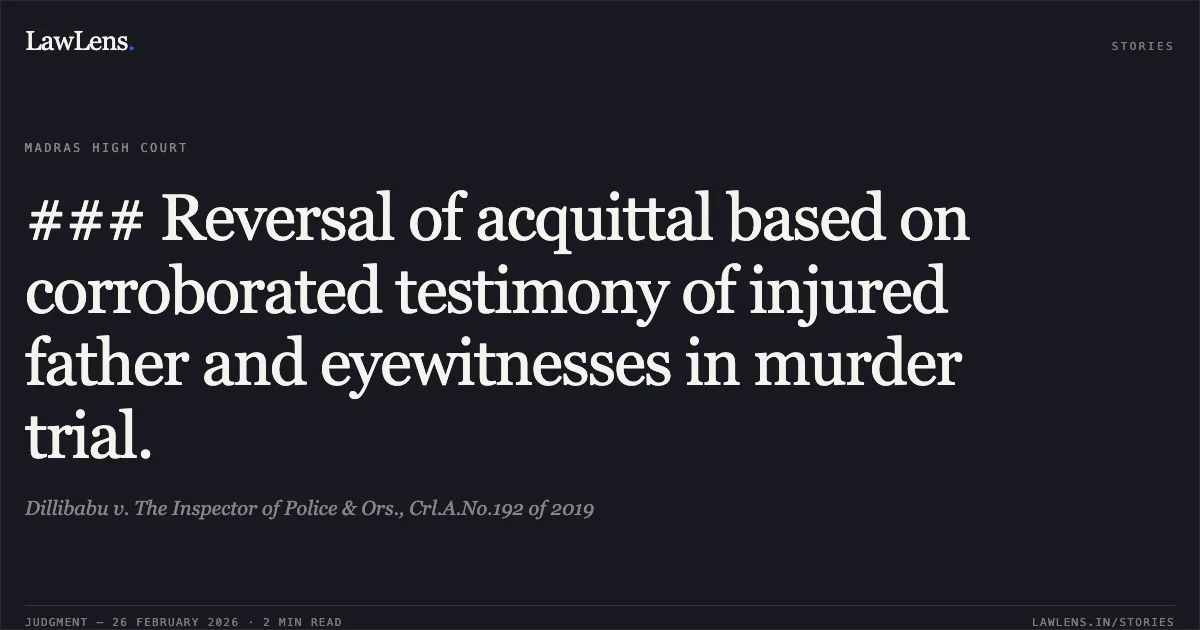
The Appellant (PW1/Defacto Complainant) challenged the acquittal of Respondents 2-4 (A1-A3) by the XV Additional Sessions Court, Chennai.
Source reference: p.1On 29.08.2016, following a dispute regarding temple Annadhanam, the accused waylaid PW1 and his son (the deceased Gopinath).
Source reference: p.2They repeatedly attacked them with wooden logs (MO1) and stones (MO2).
Source reference: p.2Specifically, A1 threw a large stone at the deceased's head with intent to kill.
Source reference: p.2The deceased succumbed to head injuries on 31.08.2016 at Rajiv Gandhi Government Hospital.
Source reference: p.4, 12The Trial Court acquitted the accused citing contradictions in the number of assailants mentioned in the Accident Register and the testimony of hostile secondary witnesses.
Source reference: p.12, 16, 19Issues
1. Whether the Trial Court erred in disregarding the testimony of an injured witness (PW1) and several eyewitnesses (PW2-PW7) due to minor inconsistencies in the medical records.
Source reference: p.15, 202. Whether the prosecution proved the guilt of A1 to A3 beyond reasonable doubt for charges under Sections 341, 323, and 302 r/w 34 of the IPC.
Source reference: p.2, 32Law Applied
The Court primarily applied Section 302 (Murder), Section 323 (Voluntarily causing hurt), and Section 341 (Wrongful restraint) read with Section 34 (Common intention) of the IPC.
Source reference: p.2, 35It relied on the evidentiary principle from *State of Uttar Pradesh v. Naresh*, which establishes that the testimony of an "injured witness" (stamped witness) is accorded special status and should be relied upon unless major contradictions exist.
Source reference: p.25It further applied the appellate standard from *State of Rajasthan v. Sohan Lal*, affirming that the High Court is obliged to re-appreciate evidence in an appeal against acquittal to ensure justice.
Source reference: p.22Regarding medical records, it noted that a Medical Officer's primary duty is to record the nature of injuries rather than determine the identity of assailants.
Source reference: p.21Reasoning
The High Court found that the Trial Court failed to give due weightage to the "stamped" testimony of PW1, whose presence at the scene was indisputable due to his own injuries.
Source reference: p.25, 32The Court observed that PW17 and PW19 (Doctors) and Exs.P6, P7, and P11 (Medical Reports) corroborated the ocular evidence regarding the weapons used and the nature of the assault.
Source reference: p.31, 34The Court rejected the defense's argument regarding the mention of "four persons" in the medical register, noting that the medical officer is not a substitute for investigative identifying procedures.
Source reference: p.21, 34The consistency between the eyewitness accounts (PW2-PW7) regarding the specific overt acts—A1 throwing the stone and A2/A3 using wooden logs—established a common intention to cause death.
Source reference: p.32, 33The recovery of MO1 and MO2 pursuant to voluntary confessions further linked the accused to the crime.
Source reference: p.33Holding
The High Court allowed the appeal and set aside the judgment of acquittal dated 06.10.2018.
A1 to A3 are found guilty of offences under Sections 341, 323, and 302 r/w 34 of the IPC.
Source reference: p.38The Court sentenced the respondents to undergo Life Imprisonment and a fine of Rs.1,000 each for murder, one month simple imprisonment for wrongful restraint, and one year simple imprisonment for causing hurt, to run concurrently.
Source reference: p.38However, the Court suspended the sentence of imprisonment to allow the accused to prefer an appeal before the Hon’ble Supreme Court.
Source reference: p.39Acts & Sections Cited
8 provisions across 2 statutes referred to in this judgment. Each provision opens on LawLens.
Indian Penal Code, 18607
Code of Criminal Procedure, 19731
Original Court PDF
Dillibabu v. The Inspector of Police & Ors., Crl.A.No.192 of 2019
Click to open original judgment
Original judgment, available to read, download and summarize on LawLens.in