Facts
The Appellant was convicted by the Trial Court under Section 376(2)(i) IPC and Sections 5(m), 5(n) r/w Section 6 of the POCSO Act for the alleged sexual assault of a five-year-old girl on 07.09.2017.
Source reference: p.1-2The prosecution alleged that the Appellant took the victim to a terrace, stripped her, and performed "dirty things" resulting in bleeding.
Source reference: p.2The medical examination conducted ten hours later found no external or internal injuries, an intact hymen, and no signs of bleeding or sperm.
Source reference: p.2-3The victim’s allegation of "bleeding" appeared only in her Section 164 Cr.P.C. statement recorded two months after the incident, and was absent from her initial police statement and her testimony before the Trial Court.
Source reference: p.3, 19The Trial Court relied on the statutory presumption under Section 29 POCSO Act to convict.
Source reference: p.6Issues
1. Whether the statutory presumption under Section 29 of the POCSO Act can be invoked without the prosecution first establishing foundational facts.
Source reference: p.82. Whether an accused can be sentenced under a provision of the IPC (providing for natural life imprisonment) by relying on a reverse-onus presumption found only in the POCSO Act.
Source reference: p.133. Whether the ocular testimony of the victim regarding penetration is reliable when fundamentally contradicted by contemporaneous medical evidence.
Source reference: p.15, 18Law Applied
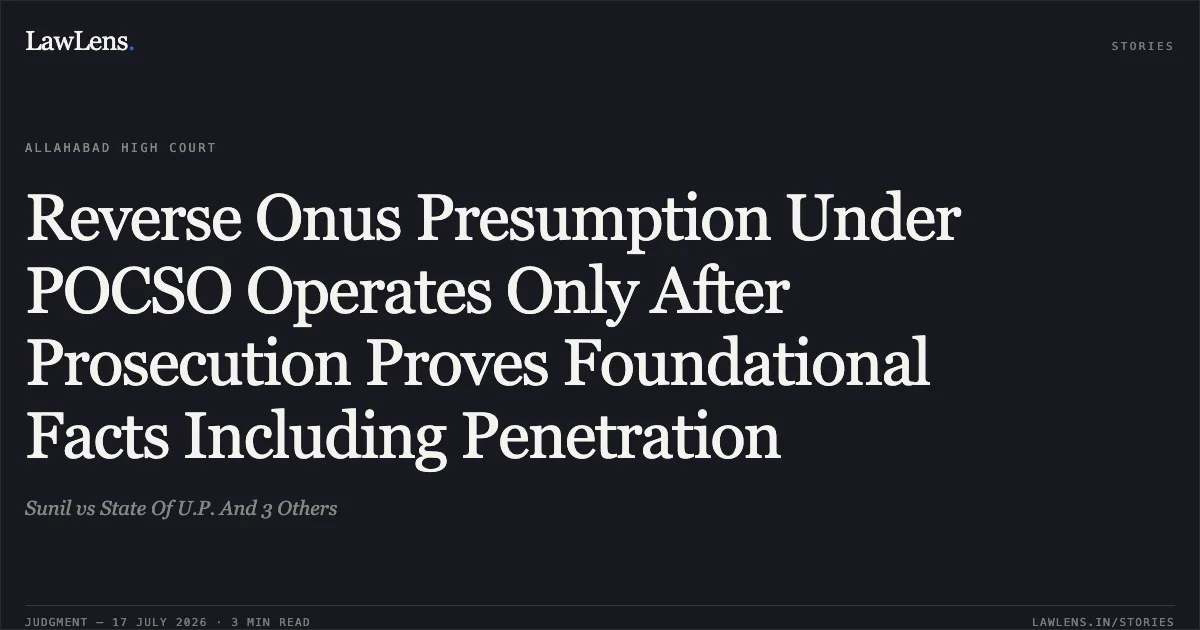
The Court applied Sections 29 and 30 of the POCSO Act regarding statutory presumptions, emphasizing that they are "reverse-onus" provisions that require the prosecution to first prove "foundational facts" beyond reasonable doubt before the burden shifts.
Source reference: p.8-10The Court relied on Noor Aga v. State of Punjab and Gorakh Nath Prasad v. State of Bihar to establish that suspicion cannot substitute proof and that reverse-onus provisions must be strictly construed.
Source reference: p.8-9Regarding inconsistency, it applied the principle from Bhajan Singh v. State of Haryana and Kapildeo Mandal v. State of Bihar that medical evidence prevails if it completely excludes the possibility of the ocular account being true.
Source reference: p.16-17The Court applied the test of a "sterling witness" from Rai Sandeep v. State (NCT of Delhi) to evaluate the consistency of the victim’s testimony.
Source reference: p.17-18Reasoning
The Court observed that the Trial Court erroneously invoked Section 29 POCSO Act to convict for a non-POCSO offense (Sec 376(2)(i) IPC) and to impose a sentence (life for remainder of natural life) that was not available under the version of POCSO applicable at the time of the offense.
Source reference: p.13Analytically, the High Court found that "penetration" was never specifically alleged by the victim in court, but merely inferred from the claim of "bleeding".
Source reference: p.15This claim was directly belied by the medical report which showed zero injuries.
Source reference: p.21The Court found the two-month delay in recording the Section 164 statement and the omission of bleeding in the initial statement as indicators of subsequent tutoring.
Source reference: p.19-20Consequently, the victim did not qualify as a "sterling witness" regarding penetration.
Source reference: p.22The Court refused to discard the entire testimony, applying the rule that the grain must be separated from the chaff; while penetration was unproven, the acts of taking the child to the terrace and touching her genital area with sexual intent were established.
Source reference: p.24-25Holding
The Court partially allowed the appeal, setting aside the conviction and sentence under Section 376(2)(i) IPC and Sections 5 and 6 of the POCSO Act.
The Court held that while the foundational facts for "penetrative sexual assault" were not proved, the ingredients for "aggravated sexual assault" under Section 7 r/w Sections 9(m) and 9(n) of the POCSO Act were established.
Source reference: p.25The Appellant was convicted under Section 10 of the POCSO Act and sentenced to the period already undergone (five years and eight months) and a fine of Rs. 50,000/-.
Source reference: p.25Acts & Sections Cited
20 provisions across 4 statutes referred to in this judgment. Each provision opens on LawLens.
Code of Criminal Procedure, 19735
Indian Penal Code, 18603
Protection of Children from Sexual Offences Act, 2012
Narcotic Drugs and Psychotropic Substances Act, 19852
Original Court PDF
SunilvsState Of U.P. And 3 Others
Click to open original judgment
Original judgment, available to read, download and summarize on LawLens.in