Facts
For Assessment Year 2007–08, the assessee’s bank account received ₹10 crore.
Source reference: p. 2–4He claimed the amount was received as an accommodation entry and that ₹9.97 crore was transferred to a third party, retaining ₹3 lakh as commission.
Source reference: p. 2–4The Assessing Officer treated the credit as unexplained under Section 68 of the Income-tax Act, 1961; the appellate authorities upheld the addition.
Source reference: p. 2–4The High Court dismissed the assessee’s tax case appeal for want of a substantial question of law, and the Supreme Court dismissed his SLP.
Source reference: p. 2–4In this review application, the assessee relied on sale deeds and an ITAT order concerning another party, contending that these documents supported his explanation.
Source reference: p. 2–4Issues
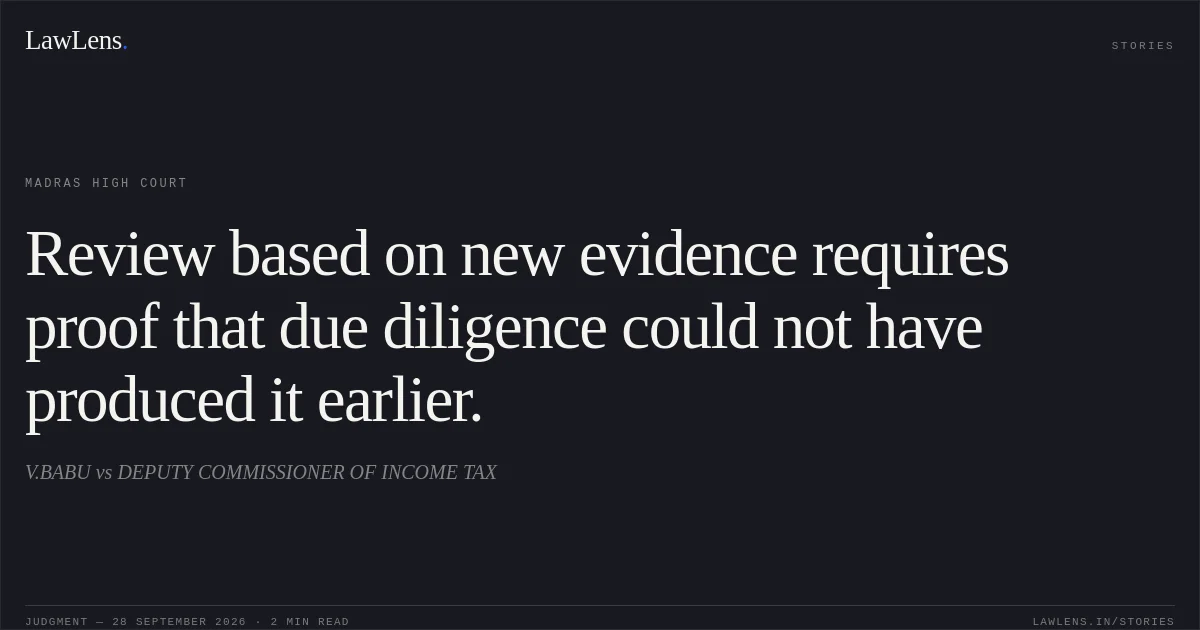
Whether the documents relied on by the assessee constituted new and important evidence warranting review, despite their availability in public records during the original proceedings.
Source reference: p. 7–8Whether the judgment dismissing the tax case appeal disclosed an error apparent on the face of the record warranting review under Order XLVII Rule 1 read with Section 114 of the Code of Civil Procedure, 1908.
Source reference: p. 7–9Law Applied
Section 68 of the Income-tax Act permits a credit to be treated as income where the assessee does not offer a satisfactory explanation of its nature and source; the assessee bears the burden of establishing the creditor’s identity, creditworthiness, and the genuineness of the transaction.
Source reference: p. 6–7Under Order XLVII Rule 1 read with Section 114 of the Code of Civil Procedure, review is not an appeal in disguise and cannot be used to rehear the merits or substitute a different view.
Source reference: p. 7–8Discovery of new evidence may support review only where, despite due diligence, the evidence was not within the applicant’s knowledge or could not have been produced when the original order was passed, as stated in Malleeswari v. K. Suguna, 2025 SCC OnLine SC 1927.
Source reference: p. 7–8Reasoning
The Court found that the ₹10 crore credit in the assessee’s personal bank account was undisputed and that the authorities had rejected his explanation as unsupported.
Source reference: p. 7–9The sale deeds and tribunal orders relied on in review were available in public records during the original proceedings, and the assessee had not shown that he exercised due diligence to obtain or produce them earlier.
Source reference: p. 7–9Their consideration would therefore amount to a rehearing on the merits, which review jurisdiction does not permit.
Source reference: p. 7–9The Court also found no error apparent in the original judgment.
Source reference: p. 7–9Holding
The Court held that the assessee had not established grounds for review under Order XLVII Rule 1 read with Section 114 CPC.
It dismissed the review application for lack of merit, made no order as to costs, and closed the connected miscellaneous petition.
Source reference: p. 9Acts & Sections Cited
1 provisions across 1 statute referred to in this judgment. Each provision opens on LawLens.
Code of Civil Procedure, 19081
Original Court PDF
V.BABUvsDEPUTY COMMISSIONER OF INCOME TAX
Click to open original judgment
Original judgment, available to read, download and summarize on LawLens.in