Facts
The Plaintiff, an Advocate and former Cost and Management Accountant, filed a suit for recovery of approximately ₹2.65 crores for professional consultancy and legal services rendered to the Defendants between 2002 and 2021
Source reference: p.2The Plaintiff alleged an oral agreement for hourly consultancy and fixed appearance fees, claiming the Defendants only paid ₹5,00,000 upon the conclusion of their litigations in 2021
Source reference: p.2-3The Defendants denied any such agreement, asserting the services were voluntary or pro bono
Source reference: p.3The Plaintiff filed an application for summary judgment under Order XIII-A CPC (I.A. No. 38753/2024), which the Court dismissed on 20.05.2026, holding that the matter required a full trial
Source reference: p.4The Plaintiff subsequently filed the present Review Petition alleging that the Court failed to consider material documents (emails, WhatsApp logs) and written submissions
Source reference: p.5Issues
1. Whether there exists any error apparent on the face of the record in the judgment dated 20.05.2026 warranting a review under Order XLVII Rule 1 of the CPC
Source reference: p.6 / para. 92. Whether the non-reference to specific documents or the misappreciation of the consultant-client relationship constitutes a valid ground for exercising review jurisdiction
Source reference: p.12 / para. 17Law Applied
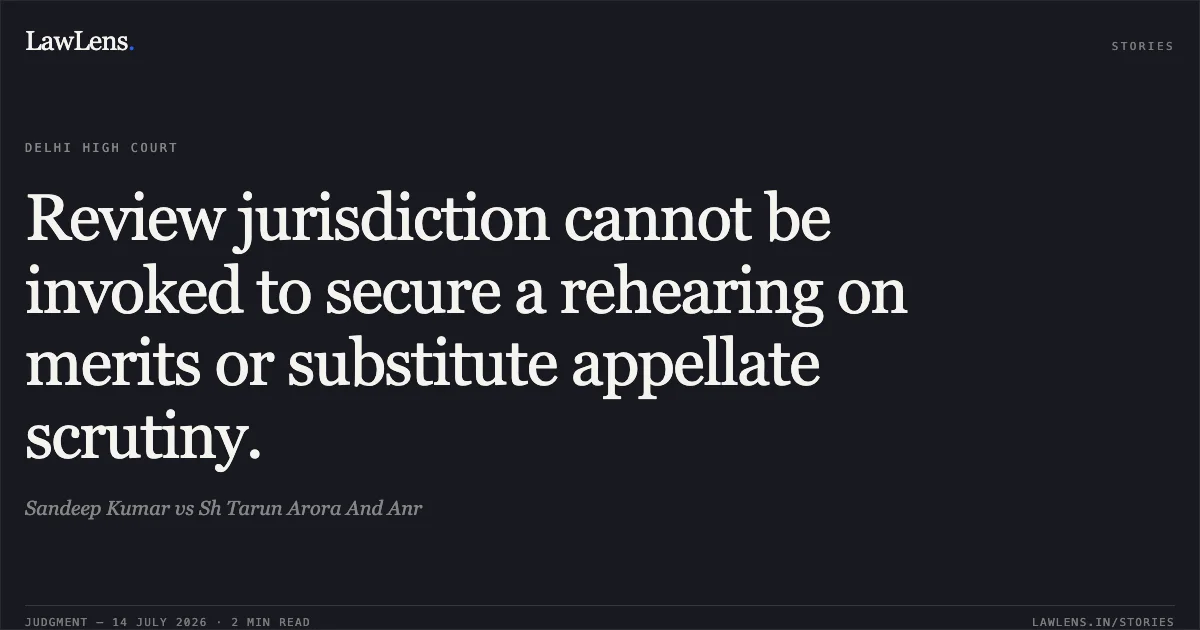
The Court applied Section 114 and Order XLVII Rule 1 of the CPC, which restrict review to the discovery of new evidence or an "error apparent on the face of the record"
Source reference: p.6It relied on Haridas Das v. Usha Rani Banik, clarifying that review is not an "appeal in disguise" and cannot be used to correct an erroneous decision on merits
Source reference: p.7Further, it cited State of West Bengal v. Kamal Sengupta, establishing that an error needing a "long process of reasoning" to discover is not an error apparent on the face of the record
Source reference: p.11The Court also referenced the standards for summary judgment under Order XIII-A CPC, which require that a defendant have "no real prospect of successfully defending the claim"
Source reference: p.4Reasoning
The Court observed that the earlier judgment dated 20.05.2026 had specifically recorded the Plaintiff’s contentions and the legal principles of Order XIII-A CPC
Source reference: p.13The Court reasoned that the Plaintiff's grievances—namely that the Court misconstrued the nature of the relationship and failed to find "admissions" in electronic communications—were essentially challenges to the Court’s appreciation of evidence
Source reference: p.13-14The Court held that whether an oral agreement existed or if the defense was a "sham" are matters for trial, not summary adjudication
Source reference: p.13Because the Plaintiff's arguments required a detailed re-examination of the record and rival versions, they fell within the province of an appeal rather than the limited scope of review
Source reference: p.14Additionally, the Court noted that mere non-mention of every single document in a judgment does not imply non-consideration
Source reference: p.15Holding
The Court dismissed the Review Petition, holding that the Plaintiff failed to demonstrate any manifest error or new evidence
The Court reaffirmed that the dismissal of the summary judgment application did not determine the final rights of the parties but merely relegated the dispute to trial
Source reference: p.15The pending applications (I.A. 17151/2026 and I.A. 17152/2026) were also dismissed
Source reference: p.16Acts & Sections Cited
4 provisions across 1 statute referred to in this judgment. Each provision opens on LawLens.
Code of Civil Procedure, 19084
Original Court PDF
Sandeep KumarvsSh Tarun Arora And Anr
Click to open original judgment
Original judgment, available to read, download and summarize on LawLens.in