Facts
NIT Agartala initiated recruitment for non-teaching posts, including Office/Lab Attendant, through advertisements dated 02.11.2019 and 15.09.2021.
Source reference: no citationSri Kanti Das applied, cleared the written examination, and was included in the shortlist published on 12.12.2022.
Source reference: no citationThe interviews were subsequently cancelled, and the entire recruitment process was cancelled on administrative grounds by notification dated 03.06.2024.
Source reference: p.2, para.3The Single Judge allowed the petitioner’s writ petition, quashed the cancellation, and directed the Institute to consider appointment of qualified candidates in accordance with the merit list.
Source reference: p.3, para.4On appeal, the Division Bench reversed that decision on 04.11.2025, holding, inter alia, that the Institute was bound by Government of India policy decisions and that the cancellation followed consequentially from the discontinuance of interviews.
Source reference: p.3, para.4After the Supreme Court granted liberty to seek review, the petitioner filed the present review petition challenging the Division Bench judgment.
Source reference: p.3, paras.4–5Issues
Whether the Division Bench judgment dated 04.11.2025 disclosed an error apparent on the face of the record warranting review under Section 114 read with Order XLVII Rule 1 of the Code of Civil Procedure.
Source reference: p.7, paras.13–15Whether the petitioner could, in review jurisdiction, re-agitate the issues concerning the applicability of DoPT policy instructions, the statutory recruitment scheme under the National Institutes of Technology Act, 2007, and the Institute’s power to cancel the recruitment process under the advertisement.
Source reference: pp.4–7, paras.6–10, 15Whether the recruitment process could be cancelled on the basis of subsequent policy changes discontinuing interviews for the relevant posts.
Source reference: p.7, para.15Law Applied
The Court applied Section 114 and Order XLVII Rule 1 of the Code of Civil Procedure, under which review is permissible only upon discovery of new and important matter or evidence unavailable despite due diligence, an error apparent on the face of the record, or another sufficient reason.
Source reference: p.7, para.14Relying on State of West Bengal v. Kamal Sengupta, (2008) 8 SCC 612, particularly paragraph 35, the Court held that review jurisdiction is analogous to the power of a civil court under Section 114 read with Order XLVII Rule 1; an erroneous decision cannot be corrected through review; an error requiring elaborate reasoning is not an error apparent; and review cannot be used to introduce arguments or material that could have been raised earlier.
Source reference: pp.5–6, para.11The Court also recognised the petitioner’s reliance on Section 24 of the National Institutes of Technology Act, 2007, the First Statutes, and the alleged hierarchy between statutory provisions, rules, and executive instructions, but treated those contentions as matters already capable of being argued in the original proceedings.
Source reference: p.4, paras.6–9Reasoning
The Court found that the petitioner’s submissions merely sought a fresh examination of the merits of the Division Bench judgment.
Source reference: no citationThe issues relating to cancellation of the recruitment process, the adoption and enforceability of DoPT policy instructions, and the Institute’s authority under the advertisement had already been considered and decided in the judgment under review.
Source reference: p.8, para.15The petitioner’s contention that the statutory framework prevailed over executive instructions, and that the rules of selection could not be altered after commencement of the process, constituted substantive arguments rather than a patent error apparent on the record.
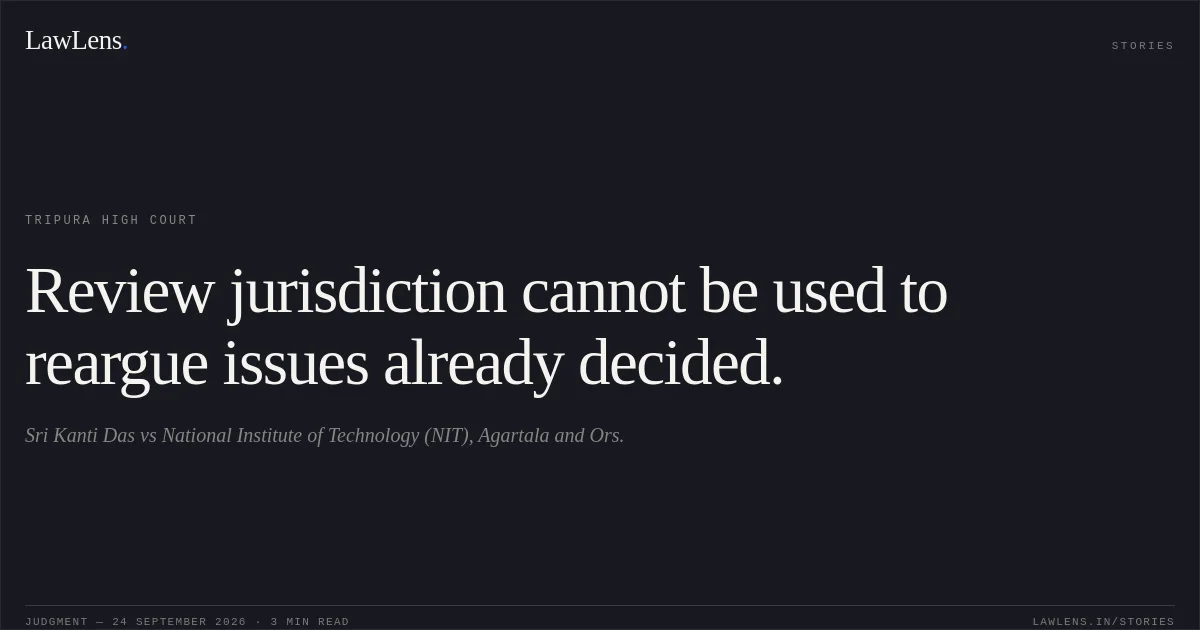
Source reference: pp.4–5, paras.6–10Applying the restricted review principles in Kamal Sengupta, the Court held that review could not be used as an appeal or as a device for re-argument and re-appraisal of questions already adjudicated.
Source reference: pp.6–8, paras.13–15The Court further noted that the challenge to the connected writ appeal had already been rejected by the Supreme Court.
Source reference: p.8, para.15Holding
The Court held that the petitioner failed to establish any error apparent on the face of the record, discovery of new and important material, or any other sufficient ground for review.
The Review Petition was accordingly dismissed on merits.
Source reference: p.8, para.16Any interim stay was vacated, and pending applications, if any, were closed.
Source reference: p.8, para.17Acts & Sections Cited
4 provisions across 2 statutes referred to in this judgment. Each provision opens on LawLens.
National Institutes of Technology, Science Education and Research Act, 20072
Code of Civil Procedure, 19082
Original Court PDF
Sri Kanti DasvsNational Institute of Technology (NIT), Agartala and Ors.
Click to open original judgment
Original judgment, available to read, download and summarize on LawLens.in