Facts
The petitioner sought review of the judgment dated 26 March 2025 in RFA No. 1246 of 2019. He contended that the judgment incorrectly stated that Muniswamy held an undivided one-third share in Survey No. 73, later divided equally between his sons. According to the petitioner, the property was Muniswamy’s absolute and self-acquired property, purchased after an earlier partition between Kempanna and Ramaiah.
Source reference: para. 3The Court noted that the petitioner had argued these matters in the appeal and that they had been considered in detail.
Source reference: para. 4Issues
1. Whether the judgment in RFA No. 1246 of 2019 contained an error apparent on the face of the record warranting review under Order 47 Rule 1 CPC.
Source reference: paras. 3–72. Whether the review petition sought impermissibly to reopen the merits of the decision.
Source reference: paras. 5–7Law Applied
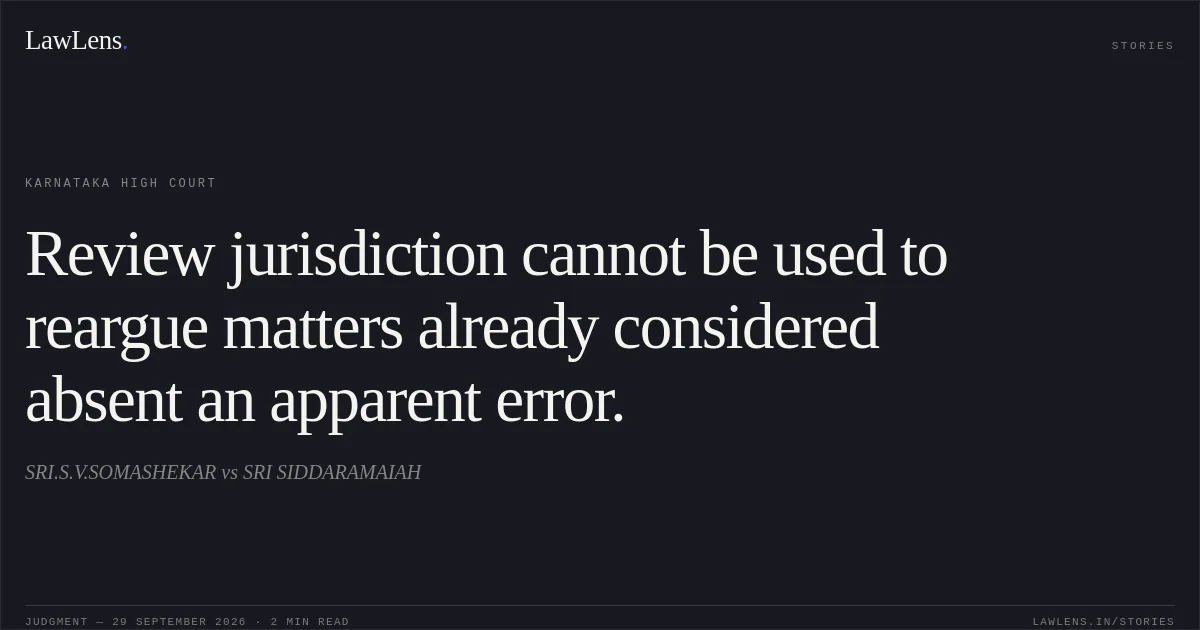
The Court applied Order 47 Rule 1 read with Section 114 of the Code of Civil Procedure. A review may be granted for an error apparent on the face of the record, but an error that requires reasoning to discover is not apparent and does not justify review; review cannot be used to rehear and correct an allegedly erroneous decision or operate as an appeal in disguise.
Source reference: paras. 5–6The Court relied on Sanjay Kumar Agarwal v. State Tax Officers, 2023 SCC OnLine SC 1406, which referred to Sajjan Singh v. State of Rajasthan, 1964 SCC OnLine SC 25, on the finality of judgments and the limited circumstances justifying departure from it. It also applied the principle from Parsion Devi v. Sumitri Devi, (1997) 8 SCC 715, that review is confined to an apparent error and cannot serve as a rehearing.
Source reference: paras. 5–6Reasoning
The Court found that the petitioner’s submissions concerning the partition history and the character of Survey No. 73 had already been advanced and addressed in the appeal judgment.
Source reference: paras. 3–4Reconsidering those contentions would require revisiting the merits, rather than correcting a self-evident error. Applying the limited scope of review under Order 47 Rule 1 CPC, the Court found no apparent error of law or fact in the judgment.
Source reference: para. 7Holding
The Court held that no error apparent on the face of the record warranted review.
The Court dismissed the review petition as without merit. Any pending interlocutory applications were disposed of as no longer surviving for consideration.
Source reference: para. 8Acts & Sections Cited
1 provisions across 1 statute referred to in this judgment. Each provision opens on LawLens.
Code of Civil Procedure, 19081
Original Court PDF
SRI.S.V.SOMASHEKARvsSRI SIDDARAMAIAH
Click to open original judgment
Original judgment, available to read, download and summarize on LawLens.in