Facts
Respondent No. 1 (Jainshree) challenged a 1989 mutation order regarding agricultural land belonging to her late father, Vrishbhan, after a delay of 34 years.
Source reference: para. 2The Sub-Divisional Officer (SDO) dismissed her appeal on 13.12.2024, rejecting the application for condonation of delay under Section 5 of the Limitation Act.
Source reference: para. 2On revision, the Additional Collector set aside the SDO’s order on 17.09.2025, condoned the delay, and simultaneously passed a final order directing that the names of all legal heirs be recorded in equal shares.
Source reference: para. 1, 2The petitioners challenged this revisional order, asserting that the Additional Collector exceeded his jurisdiction by deciding the merits of the case instead of remanding it.
Source reference: para. 6, 8Issues
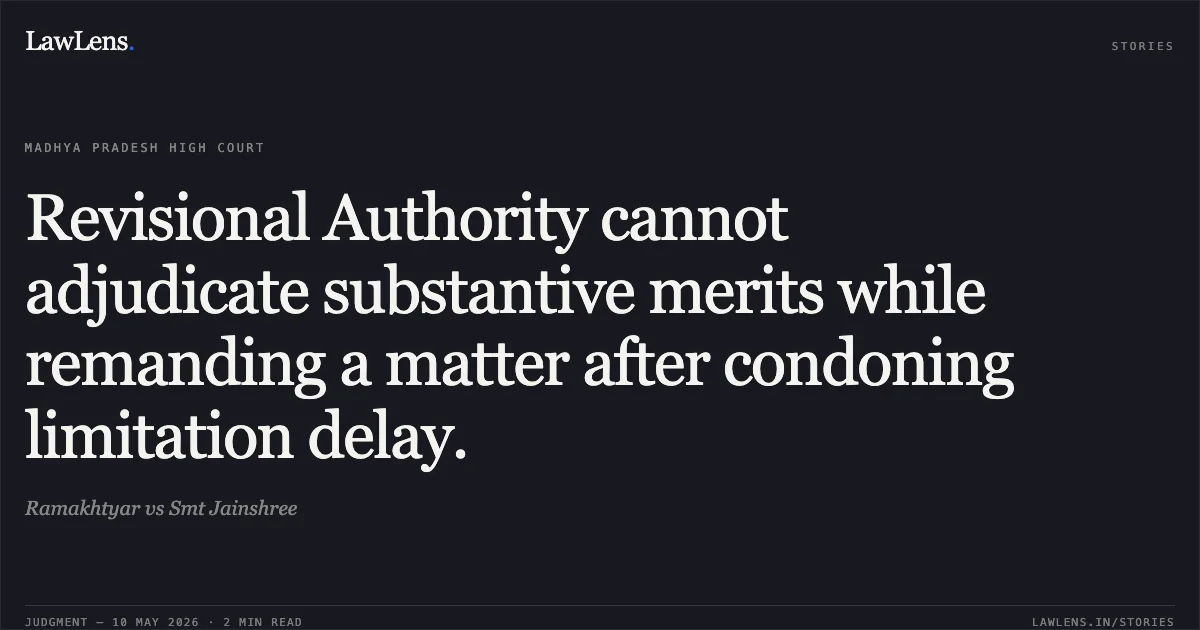
Whether the Additional Collector was justified in condoning an inordinate delay of nearly 37 years using a liberal approach.
Source reference: para. 10Whether a revisional authority exceeds its jurisdiction by adjudicating substantive rights on merits after condoning a delay, rather than remanding the matter to the appellate court.
Source reference: para. 11, 12Law Applied
The court applied Section 5 of the Limitation Act, 1963, which allows for the condonation of delay upon showing "sufficient cause," emphasizing a "justice-oriented" and "liberal approach" in matters affecting succession rights.
Source reference: para. 10It further applied the principles of revisional jurisdiction under the Madhya Pradesh Land Revenue Code, 1959, which limit the authority to examining the correctness of the lower court's proceedings.
Source reference: para. 6The court relied on the procedural principle that once a delay in filing an appeal is condoned by a superior court, the matter must typically be remanded to the lower court for a merit-based adjudication to prevent "pre-judging" the controversy.
Source reference: para. 11, 12Reasoning
The Court found that the Additional Collector's decision to condone the delay was legally sound, as a "liberal approach" is appropriate when mutation entries affect inheritance.
Source reference: para. 10The Court determined that the Additional Collector committed a "jurisdictional overreach" by finally deciding the property rights of the parties.
Source reference: para. 8, 11The High Court reasoned that because the petitioners produced a registered Will dated 11.02.1987, the validity of which was disputed, the matter involved complex questions of fact and evidence.
Source reference: para. 8, 11By directing a specific mutation in equal shares, the revisional authority bypassed the SDO’s duty to conduct a proper inquiry, thereby exceeding the scope of revisional scrutiny.
Source reference: para. 12Holding
The Court partially allowed the writ petition and upheld the Additional Collector's order to the extent of condoning the delay under Section 5 of the Limitation Act.
The Court set aside the directions regarding the recording of legal heirs in equal shares as being beyond revisional jurisdiction and remanded the matter to the Sub-Divisional Officer, Gwalior City, with directions to adjudicate the appeal on its merits—including the effect of the alleged Will—after hearing all parties, ideally within eight weeks.
Source reference: para. 13(ii), (iii)Acts & Sections Cited
1 provisions across 1 statute referred to in this judgment. Each provision opens on LawLens.
Limitation Act, 19631
Original Court PDF
RamakhtyarvsSmt Jainshree
Click to open original judgment
Original judgment, available to read, download and summarize on LawLens.in