Facts
The appellants are registered dealers under the Karnataka Value Added Tax (KVAT) Act, 2003. In these consolidated appeals, the Suo Motu Revisional Authority (SMR Authority) issued notices and passed orders under Section 64 of the Act to revise original reassessment or appellate orders.
Source reference: p. 13-14In some cases, notice was issued based on the denial of Input Tax Credit (ITC) due to non-existent suppliers (STA 3/2023).
Source reference: p. 34while in others, it involved the disallowance of deductions for security and fuel charges in works contracts (STA 11 & 12/2022).
Source reference: p. 44A primary procedural challenge raised by the appellants was that several of the revisional orders were passed more than four years after the original orders sought to be revised, allegedly violating the limitation period prescribed in Section 64(3)(c).
Source reference: p. 14-18Issues
1. Whether the limitation period of four years under Section 64(3)(c) applies only to the initiation of proceedings (calling for records) or also to the passing of the final revisional order.
Source reference: p. 23 / para. 102. Whether security charges and fuel expenses incurred in a works contract are deductible as "labour and other like charges" under Rule 3(2) of the KVAT Rules.
Source reference: p. 44 / para. 19.2.23. Whether the burden of proof under Section 70 to claim ITC is discharged merely by producing tax invoices and proof of payment.
Source reference: p. 36 / para. 19.1.5Law Applied
The Court applied Section 64 of the KVAT Act, 2003, which empowers the Commissioner to revise orders prejudicial to the Revenue within four years.
Source reference: p. 20-22It relied on State of Punjab v. Bhatinda District Coop. Milk Producers Union Ltd., which held that even if no end-period for concluding proceedings is specified, they must be completed within a "reasonable period" derived from the statutory scheme.
Source reference: p. 27 / para. 16The Court also applied Section 70 of the KVAT Act regarding the burden of proof for ITC, as interpreted by the Supreme Court in State of Karnataka v. Ecom Gill Coffee Trading (P) Ltd., which requires proof of physical movement of goods beyond mere invoices.
Source reference: p. 36-41Rule 3(2) of the KVAT Rules was applied to determine deductible turnover in works contracts.
Source reference: p. 44-45Reasoning
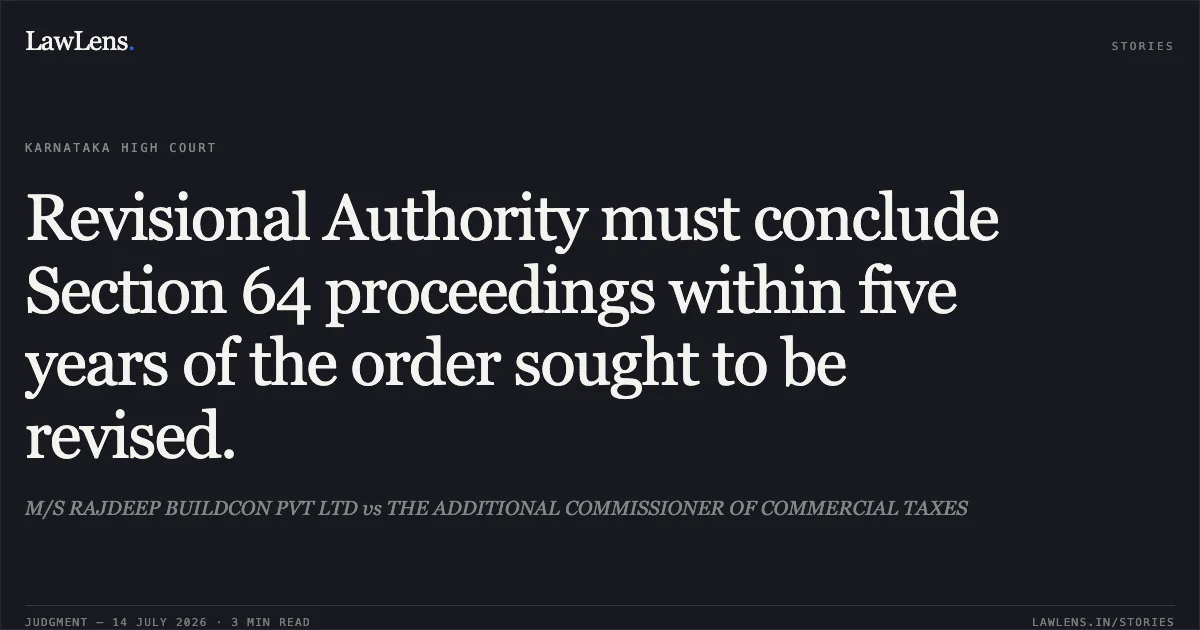
The Court reconciled the Four-Year limitation in Section 64(3)(c) with Section 32 (retention of accounts for five years). It held that while "initiation" (calling for records) must happen within four years, the "conclusion" must occur within a reasonable time, which the Court fixed at five years from the date of the impugned order to align with the record-retention mandate.
Source reference: para. 15, 17Regarding works contracts (STA 11 & 12/2022), the Court applied the principle of ejusdem generis to Rule 3(2)(l), concluding that "security charges" are manpower costs similar to "labour charges" and are thus deductible.
Source reference: para. 19.2.5-19.2.6Fuel charges were also deemed deductible as "consumables" under Explanation II to Rule 3(2).
Source reference: para. 19.2.8In the ITC matter (STA 3/2023), the Court noted the SMR Authority's order preceded the Ecom Gill judgment and thus required a remand to allow the assessee to prove the physical movement of goods as per the new standards.
Source reference: para. 19.1.6-19.1.8Holding
The Court held that (a) calling for records within four years is a valid initiation; (b) the final revisional order must be passed within one year after the expiry of those four years (total five years).
STA 3/2023: Allowed in part; remanded to SMR Authority to apply Ecom Gill tests.
Source reference: p. 56STA 11 & 12/2022: Allowed; security and fuel charges held deductible.
Source reference: p. 57STA 2/2025, 5/2025, & 7/2025: Allowed; revisional orders set aside as they were passed beyond the five-year "reasonable period" limitation.
Source reference: p. 54-56, 58Acts & Sections Cited
1 provisions across 1 statute referred to in this judgment. Each provision opens on LawLens.
Central Sales Tax Act, 19561
Original Court PDF
M/S RAJDEEP BUILDCON PVT LTDvsTHE ADDITIONAL COMMISSIONER OF COMMERCIAL TAXES
Click to open original judgment
Original judgment, available to read, download and summarize on LawLens.in