Facts
The petitioner, Veer Singh Jadon, challenged under Sections 397 and 401 of the Code of Criminal Procedure, 1973, the order dated 12 April 2023 by which the Special Court rejected his application for discharge under Section 227 CrPC and framed charges under Sections 420/120-B, 467, 468 and 471 IPC and Section 3(2)(v) of the Scheduled Castes and the Scheduled Tribes (Prevention of Atrocities) Act, 1989.
Source reference: para. 2The prosecution alleged that co-accused Badrilal Mali relied upon a forged certified copy of an alleged Board of Revenue order dated 1 October 2015 in mutation proceedings concerning agricultural land. The petitioner allegedly acted as Badrilal’s advocate and submitted an affidavit dated 3 April 2017 stating that he had obtained the certified copy from the Board’s copying section. Verification allegedly revealed that the relevant revision was still pending and that no such order had been passed.
Source reference: para. 3An FIR was registered under Section 420 IPC, and Sections 467, 468 and 471 IPC along with Section 3(2)(v) of the SC/ST Act were subsequently added. The investigation allegedly resulted in the seizure of forged documents, witness statements and reports from the Board of Revenue confirming the forgery. A charge-sheet was thereafter filed before the Special Court.
Source reference: para. 3.1The petitioner denied involvement, asserted that he had represented the opposite party in the earlier revenue proceedings, claimed that he neither prepared nor filed the affidavit, and relied upon an alibi that he was present before the Board of Revenue at Gwalior on the relevant date. He also contended that the dispute was essentially civil in nature and that the SC/ST Act had been improperly invoked.
Source reference: paras. 4–4.2The State opposed the revision, contending that the material collected disclosed a prima facie case and that the petitioner’s defenses required examination at trial.
Source reference: para. 5Issues
Whether the material collected during investigation disclosed a prima facie case or grave suspicion sufficient to frame charges against the petitioner under Sections 420/120-B, 467, 468 and 471 IPC and Section 3(2)(v) of the SC/ST Act, thereby justifying rejection of his discharge application under Section 227 CrPC?
Source reference: paras. 7–13Whether the High Court, in exercise of its revisional jurisdiction under Sections 397 and 401 CrPC, should interfere with the order framing charges on the basis of the petitioner’s factual defenses, including denial of authorship, disputed representation, alleged forged signature and plea of alibi?
Source reference: paras. 8–11Whether the prosecution was liable to be quashed or the charges set aside on the ground that the dispute arose from a civil controversy concerning agricultural land and therefore did not attract the SC/ST Act?
Source reference: para. 12Law Applied
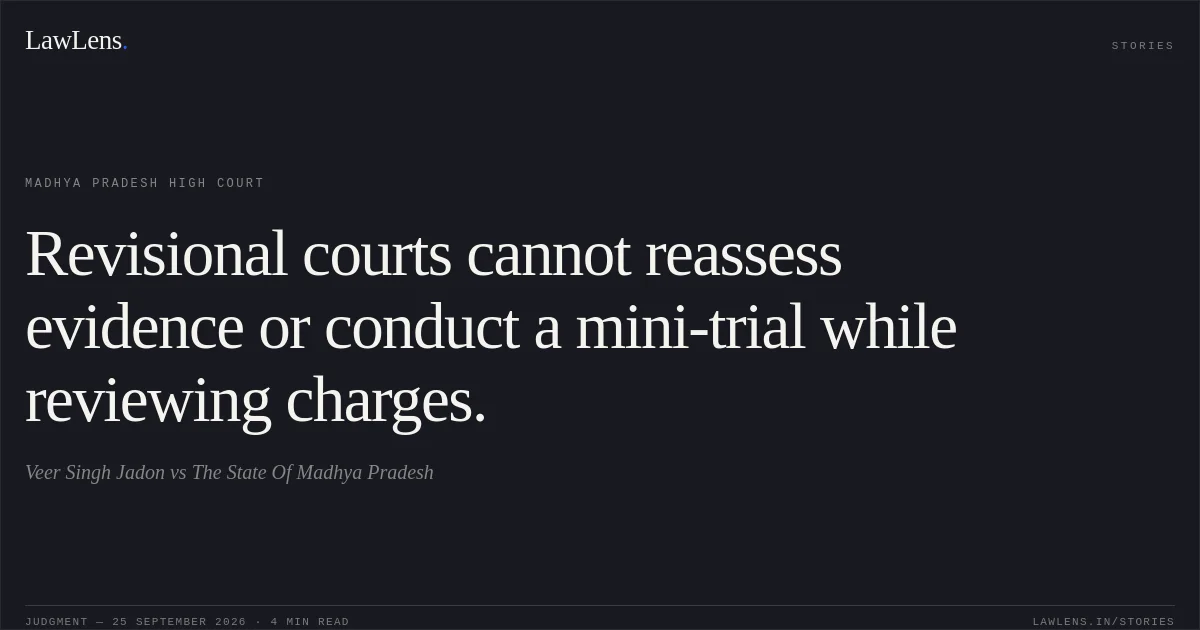
At the stage of framing charges under Section 227 CrPC, the court must determine whether the prosecution material, taken at face value, discloses the ingredients of the alleged offences and raises a prima facie case or grave and reasonable suspicion; it must not conduct a roving inquiry, weigh evidence, assess witness credibility or hold a mini-trial.
Source reference: para. 7Revisional jurisdiction under Sections 397 and 401 CrPC is limited and supervisory; interference with an order framing charges is warranted only where the order is perverse, without jurisdiction, illegal or based on a manifest misreading of the record.
Source reference: para. 8The Court considered the offences alleged under Sections 420, 467, 468, 471 and 120-B IPC and Section 3(2)(v) of the SC/ST Act.
Source reference: para. 12It also applied the principles stated in B. Venkateswaran v. P. Bakthavatchalam, distinguishing a purely civil dispute from allegations involving forgery and criminal conduct.
Source reference: para. 12The Court applied the principles in Ghulam Hassan Beigh v. Mohammad Maqbool Magrey and Dilawar Babu Kurane v. State of Maharashtra, that a court must independently apply its mind and cannot act as a mere “post office” at the stage of framing charges.
Source reference: para. 13Reasoning
The High Court found that the prosecution had placed before the Special Court the FIR, the allegedly fabricated Board of Revenue order, the affidavit bearing the petitioner’s name, witness statements and official verification regarding the non-existence of the purported order.
Source reference: para. 9This material, accepted at face value, was sufficient to raise a prima facie case of forgery, use of forged documents, cheating and conspiracy.
Source reference: para. 9The petitioner’s assertions that he had represented the rival party, that his signature was forged, that he did not file the affidavit and that he was present in Gwalior constituted factual defenses requiring evidentiary determination at trial; evaluating them at the revision or discharge stage would amount to a prohibited mini-trial.
Source reference: para. 10The Court further held that the existence of an underlying land or mutation dispute did not make the prosecution purely civil, since the allegations specifically concerned fabrication of a judicial or revenue record and its use to affect the land rights of a Scheduled Caste member.
Source reference: para. 12The Special Court had considered the relevant investigation material and had not acted mechanically. Its view was therefore plausible and neither perverse nor legally infirm.
Source reference: paras. 11, 13–14Holding
The High Court answered the issues against the petitioner. It held that sufficient prima facie material existed to proceed with the charges and that the petitioner’s defenses could not be adjudicated at the stage of discharge or revision.
The allegations of forgery and use of fabricated records were not merely a continuation of a civil land dispute and were capable, prima facie, of attracting the offences charged, including Section 3(2)(v) of the SC/ST Act.
Source reference: para. 12Accordingly, the criminal revision was dismissed, and the Special Court’s order dated 12 April 2023 rejecting discharge and framing charges was upheld.
Source reference: paras. 14–15The Court clarified that its observations were confined to the revision proceedings and would not prejudice the petitioner’s trial on merits.
Source reference: para. 16Acts & Sections Cited
8 provisions across 3 statutes referred to in this judgment. Each provision opens on LawLens.
Code of Criminal Procedure, 19733
Indian Penal Code, 18604
Scheduled Castes and the Scheduled Tribes (Prevention of Atrocities) Act, 19891
Original Court PDF
Veer Singh JadonvsThe State Of Madhya Pradesh
Click to open original judgment
Original judgment, available to read, download and summarize on LawLens.in